Every unit of energy saved is a unit that does not have to be mined, drilled, burned or built for. This topic is the most calculation-heavy in the unit, so it builds up the setups step by step.
Conservation and efficiency
Energy conservation means using less energy, usually by changing behavior: turning off lights, lowering the thermostat in winter, walking or taking the bus. Energy efficiency means getting the same service with less energy, usually through technology: an LED that gives the same light as an incandescent bulb with at least 75 percent less electricity, a refrigerator that keeps food as cold with half the power, a car that goes farther on a gallon.
Calculating energy savings
Energy is power times time. A 60 W bulb on for 1 hour uses 60 watt-hours (Wh); 1,000 Wh = 1 kilowatt-hour (kWh), the unit on an electric bill. Write each step as a fraction so the units cancel.
Energy saved. A 60 W bulb is replaced by a 9 W LED, on 5 hours a day.
Setup:
W × h gives Wh; day cancels; Wh cancels with the conversion. Answer: per year for one bulb.
Money and carbon dioxide. The family saves 1,489.2 kWh a year; electricity costs $0.15 per kWh and the grid releases 0.4 kg of carbon dioxide per kWh.
Cost:
Carbon dioxide:
Payback for 20 bulbs at $3 each:
Common slips: using the old bulb's watts instead of the difference, forgetting to divide by 1,000, and dividing by the price instead of multiplying.
Saving energy at home
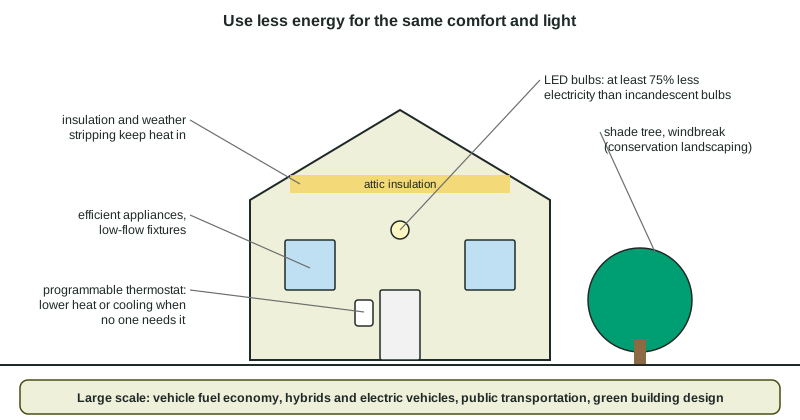
- Heating and cooling use the most energy in most homes. Insulation, weather stripping and efficient windows keep heat in; a programmable thermostat lowers heating or cooling when no one needs it.
- Lighting and appliances. LEDs, and appliances that meet efficiency standards (ENERGY STAR in the United States).
- Water. Low-flow showerheads cut the energy used to heat water.
- Conservation landscaping. Trees that shade the sunny side in summer and windbreaks that block winter winds.
Why conservation matters
Saving energy at the point of use saves even more at the source. A coal plant turns only about a third of its fuel's energy into electricity (a modern natural gas plant a little under half), and a few percent more is lost in the power lines, so each kWh saved at home avoids roughly two to three kWh worth of fuel burned at the plant. Conservation also lowers bills, delays the need to build new power plants, and cuts air pollution and carbon dioxide.
Saving energy at a larger scale
- Transportation: fuel economy standards for new vehicles; hybrid vehicles, which recapture braking energy in a battery and use an electric motor at low speeds; electric vehicles; public transportation; walkable cities.
- Buildings: green building design with insulation, passive solar features and efficient systems; building codes.
- Electricity: cogeneration, smart grids and pricing that rewards using less at peak times.
A policy is a law, standard or incentive ("a law requiring higher fuel economy for new cars"), not a device ("a hybrid car"). Read whether the question asks for one or the other.