Earth is hot inside. That heat drives volcanoes and moving plates, and in a few places it is close enough to the surface to boil water and run power plants. Everywhere, the ground just below our feet holds a steady temperature that buildings can use.
Where geothermal heat comes from
Geothermal energy is heat from Earth's interior. About half of it comes from the radioactive decay of elements such as uranium, thorium and potassium deep inside Earth; the rest is heat left from when the planet formed. The heat flows outward slowly. Near plate boundaries, hot spots and volcanoes, magma and very hot rock sit close to the surface, and groundwater there can be heated to well over 150 °C.
Geothermal power plants
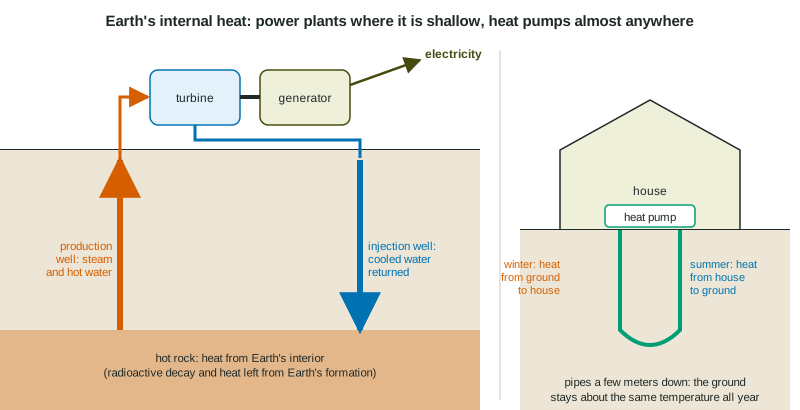
A production well brings steam and hot water up from the underground reservoir. The steam spins a turbine connected to a generator, as in any steam power plant, but no fuel is burned. The cooled water is pumped back down an injection well. Reinjection refills the reservoir; if hot water is removed faster than it is replaced, the field produces less steam over time.
Iceland gets about 30 percent of its electricity and most of its home heating from geothermal sources. The Geysers in northern California is one of the largest geothermal fields in the world.
Ground source heat pumps
A few meters underground, the soil stays at roughly 10 to 16 °C all year in much of the United States. A ground source heat pump circulates fluid through pipes buried in the ground. In winter the fluid picks up heat from the ground, and the heat pump concentrates it and moves it into the building. In summer it works in reverse, moving heat from the building into the cooler ground. The pump uses electricity, but it moves several units of heat for each unit of electricity, so it uses much less energy than electric heating, and with clean electricity it releases little carbon dioxide.
Comparing heating costs. A furnace burns 800 therms of natural gas a year at $1.30 per therm; a heat pump uses 6,600 kWh at $0.14 per kWh.
Furnace:
Heat pump:
Savings: a year. Payback on an extra $12,000 cost:
Heat pumps are a good fit for places with cold winters and hot summers, because one system does both jobs. Their main costs are drilling or trenching for the pipes and the electricity to run the pump.
Weighing geothermal energy
| Advantages | Disadvantages |
|---|---|
| steady output day and night, in any weather | power plants need hot rock near the surface: few sites |
| far less carbon dioxide than fossil fuel plants | steam can release hydrogen sulfide and dissolved minerals |
| small land area; heat pumps work almost anywhere | drilling is expensive; heat pumps cost more to install |
| renewable when water is reinjected | a field can be depleted if overused |
Geothermal heat comes from Earth's interior, not the sun. Name the location reason when you explain where plants are built: "near plate boundaries, hot rock is close to the surface."