Why does one country export oil while its neighbor imports every drop? Why does Iceland run on heat from the ground? Energy resources are spread unevenly, and the reasons are geology and climate.
Fossil fuels: where ancient life was buried
Coal formed from plants buried in ancient swamps; oil and natural gas formed from tiny sea organisms buried in ancient seas. They are found only in sedimentary basins where that burial happened and where layers of rock trapped the fuels. So a few regions, such as the Middle East, hold a large share of the world's oil and gas, and a handful of countries, including the United States, China, Russia, Australia and India, hold most of the world's coal.
Proven reserves
A proven reserve is the part of a deposit that has been found and can be recovered profitably at today's prices with today's technology. That makes it an economic number as well as a geologic one:
- When prices rise, oil that was too costly to extract becomes worth recovering, so reserves rise.
- New technology, such as horizontal drilling, can turn known but unreachable deposits into proven reserves.
- Production lowers reserves every year.
How long will reserves last? Country X has 48 billion barrels of proven oil reserves and produces 1.2 billion barrels a year.
Setup: . Billion barrels cancel and years are left.
Answer: years, if production and reserves stay the same. In practice both change, so this is an estimate.
Renewables depend on place too
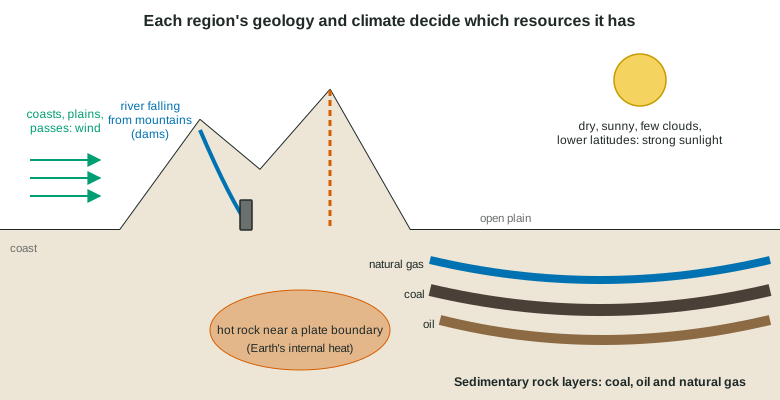
| Resource | Best places | Why |
|---|---|---|
| Sunlight | dry regions at lower latitudes (deserts of the southwestern United States, North Africa, the Middle East, Australia) | high insolation and few clouds |
| Wind | coasts, offshore shelves, open plains, mountain passes | few obstacles and steady air flow |
| Falling water | steep rivers with steady flow (Norway, Brazil, China, Canada) | much water dropping a long way |
| Earth's internal heat | plate boundaries and hot spots (Iceland, New Zealand, the western United States) | hot rock close to the surface |
| Biomass | regions with fast plant growth and farmland | warm, wet climates and crop waste |
Reading resource data
Tables of reserves, production and use let you compare countries with numbers. Two calculations come up often:
- Imports = use - production. As a percent of use: (use - production) / use × 100. A country that uses 2.0 billion barrels a year and produces 0.9 imports
of its oil. - Years left = reserves ÷ production per year, as in the worked example above.
Watch the scale words. A table in "billion barrels" means 48 is 48 billion, or barrels; keep the scale word with your answer or write the full number.
Why it matters
Where resources are shapes what each country uses. Norway gets nearly all its electricity from falling water; Iceland heats most homes with hot water from underground; countries rich in coal tend to burn it. A country without the fuels it uses must import them, so its energy supply and prices depend on world markets, shipping routes and events in other countries. Developing local resources, especially renewables, is one way countries make their supply more secure.
When you explain why a place uses a source, name the physical reason: "Iceland can heat homes with water from underground because it sits on a plate boundary where hot rock is close to the surface."