Distribution of Natural Energy Resources
Energy resources are spread unevenly because they depend on geology and climate.
Part 1 · Hook
Why this matters
Part 2 · Before you start
What this builds on
Part 3 · Prerequisite check
Quick check before you start
1. Where is Earth's internal heat closest to the surface?
- Near plate boundaries and hot spots
- Under the oldest, thickest continents
- At the poles
- Under deep oceans far from any plate edge
Show the answer
Plate boundaries and hot spots bring magma and hot rock close to the surface.
- Correct: Near plate boundaries and hot spots:
- Under the oldest, thickest continents:
- At the poles:
- Under deep oceans far from any plate edge:
2. What does insolation measure?
- The solar energy reaching an area
- How well a house holds heat
- Wind speed
- Rainfall
Show the answer
Insolation is incoming solar radiation, highest where the sun is high and skies are clear.
- Correct: The solar energy reaching an area:
- How well a house holds heat:
- Wind speed:
- Rainfall:
3. Coal formed from what?
- Plants buried in ancient swamps
- Volcanic ash
- Sea salt
- Desert sand
Show the answer
Buried swamp plants, changed by heat and pressure, became coal.
- Correct: Plants buried in ancient swamps:
- Volcanic ash:
- Sea salt:
- Desert sand:
Part 4 · See it
See it first
Part 5 · Step by step
How it works, step by step
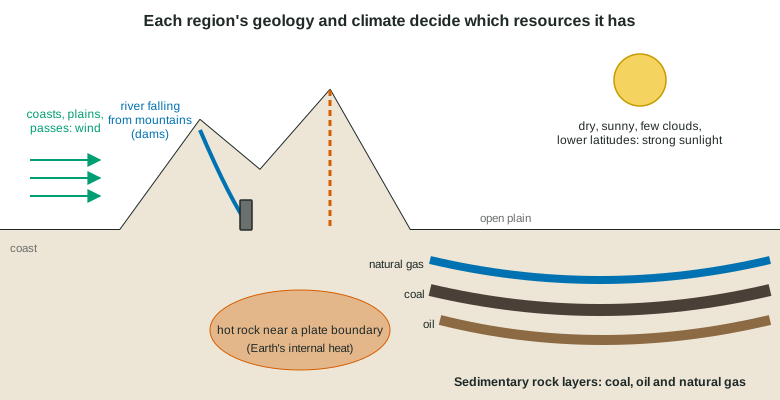
- Ancient swamps and seas buried organic matter in some basinscoal, oil and natural gas are concentrated in those sedimentary rocks
- Plate boundaries bring hot rock near the surfaceheat from underground is practical in places like Iceland, but not everywhere
- Latitude, clouds and land shape decide sunlight, wind and falling waterrenewable resources also vary from place to place
- A country lacks the resources it usesit must import energy, so its supply and prices depend on other countries
Part 6 · Key ideas
Key ideas
- Fossil fuels lie where ancient swamps and seas buried organic matter: a few regions hold most of the world's oil and gas, and a few countries most of the coal.
- A proven reserve is the part of a deposit that is known and can be recovered profitably with today's technology; it rises with higher prices or new techniques, not only new discoveries.
- Renewables depend on place too: sunlight is strongest in dry, clear, lower-latitude regions; wind on coasts, plains and offshore; falling water on steep rivers with steady flow; Earth's internal heat at plate boundaries.
- Years a reserve lasts = reserve ÷ production per year, if production stays the same.
Part 7 · Misconception
A common mistake
The wrong idea: A country's proven reserves are all the oil it has, so the number can only go down.
What actually happens: Proven reserves count only the oil that is known and worth recovering now. They can rise when prices go up or technology improves, even with no new discovery.
Part 8 · Check yourself
Check yourself
Exam-style questions. Anything you miss goes into your review queue.
1. What is a proven reserve of oil?
- Oil stored in large tanks by a government for emergencies
- Oil that has already been pumped, refined and sold to buyers
- Known oil that can be recovered at a profit right now
- The total amount of oil that exists anywhere in Earth's crust
Show the answer
Proven reserves are the part of a deposit that has been located and can be extracted profitably now. The number changes as prices and technology change.
- Oil stored in large tanks by a government for emergencies: Emergency stocks are stored oil, not reserves in the ground.
- Oil that has already been pumped, refined and sold to buyers: Oil already produced is no longer a reserve.
- Correct: Known oil that can be recovered at a profit right now: Right: known, recoverable and economic now.
- The total amount of oil that exists anywhere in Earth's crust: Much oil is not found yet or is too costly to recover; that is not counted as proven.
2. Which place is best suited for large solar farms?
- A polar region with long, dark winters and low sun angles in summer
- A dry region near 25 degrees latitude with clear skies
- A cloudy coastal region near 55 degrees latitude with frequent fog
- A rainy tropical forest near the equator with heavy cloud cover most days
Show the answer
Solar output depends on insolation. Dry subtropical regions get strong, direct sunlight and few clouds.
- A polar region with long, dark winters and low sun angles in summer: Low sun angles and long dark winters give little solar energy.
- Correct: A dry region near 25 degrees latitude with clear skies: Right: high insolation and clear skies.
- A cloudy coastal region near 55 degrees latitude with frequent fog: Clouds and lower sun angles at high latitude cut output.
- A rainy tropical forest near the equator with heavy cloud cover most days: Heavy cloud cover in rainforests blocks much of the sunlight.
Data
Oil reserves, production and use in four countries
| Country | Proven reserves (billion barrels) | Production (billion barrels/yr) | Use (billion barrels/yr) |
|---|---|---|---|
| X | 48 | 1.2 | 0.3 |
| Y | 12 | 0.9 | 2.0 |
| Z | 0 | 0 | 0.7 |
| W | 5 | 0.5 | 0.6 |
3. At its current rate of production, how many years will country X's proven oil reserves last?
Type a number, then its unit (yr). Scale words (2.5 million) and powers of ten (2.5 × 10^6) are read.
Show the answer
- Answer: 40 yr
4. Which country produces much more oil than it uses?
- Country Y
- Country Z
- Country W
- Country X
Show the answer
Country X produces 1.2 billion barrels a year and uses 0.3, so it exports most of its oil.
- Country Y: Country Y uses 2.0 but produces 0.9, so it imports.
- Country Z: Country Z produces nothing and imports all it uses.
- Country W: Country W produces 0.5 and uses 0.6, close to balanced.
- Correct: Country X: Right: production 1.2, use 0.3.
5. What percent of the oil it uses does country Y import? (Imports are use minus production.)
Type a number, then its unit (%). Scale words (2.5 million) and powers of ten (2.5 × 10^6) are read.
Show the answer
- Answer: 55 %
6. Which conclusion is best supported by the table?
- Countries with no proven reserves use no oil in a typical year
- The biggest users of oil may hold only small reserves
- Each country produces about as much oil as it uses each year
- The country with the largest reserves also uses the most oil
Show the answer
Country Y uses the most oil (2.0) but has far smaller reserves than X, and Z uses oil with no reserves at all.
- Countries with no proven reserves use no oil in a typical year: Z has no reserves but uses 0.7 billion barrels a year.
- Correct: The biggest users of oil may hold only small reserves: Right: use and reserves are mismatched.
- Each country produces about as much oil as it uses each year: X and Z show large gaps between production and use.
- The country with the largest reserves also uses the most oil: X has the largest reserves but uses only 0.3.
Part 9 · Summary
Summary
Part 10 · Up next
What comes next
Part 11 · Connections