Fossil Fuels
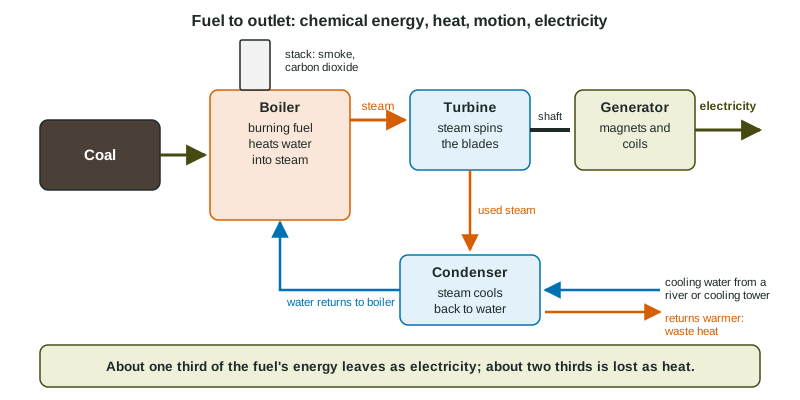
A fossil fuel power plant burns fuel to make steam, which spins a turbine and generator.
Part 1 · Hook
Why this matters
Part 2 · Before you start
What this builds on
Part 3 · Prerequisite check
Quick check before you start
1. Which law explains why every energy conversion loses some energy as heat?
- The second law of thermodynamics
- The first law of thermodynamics
- The 10% rule
- The law of supply
Show the answer
Each conversion turns some energy into heat that cannot do useful work.
- Correct: The second law of thermodynamics:
- The first law of thermodynamics:
- The 10% rule:
- The law of supply:
2. Natural gas is mostly which substance?
- Methane
- Carbon dioxide
- Hydrogen
- Oxygen
Show the answer
Natural gas is mostly methane.
- Correct: Methane:
- Carbon dioxide:
- Hydrogen:
- Oxygen:
Part 4 · See it
See it first
Part 5 · Step by step
How it works, step by step
- Fuel burns in the boilerits chemical energy heats water into high-pressure steam
- Steam pushes on the turbine bladesthe turbine spins a shaft connected to the generator
- The generator spins magnets past coils of wireelectricity flows out to the power lines
- Used steam must be cooled back to water to keep the cycle goingabout two thirds of the fuel's energy is lost as waste heat, and burning releases carbon dioxide
Part 6 · Key ideas
Key ideas
- A power plant converts energy in steps: chemical (fuel) to heat (steam) to motion (turbine) to electricity (generator). Each step loses some energy as heat.
- Overall efficiency is the product of the step efficiencies:
, about 30 percent. To find the input needed, divide the output by the efficiency. - Hydraulic fracturing cracks shale with high-pressure water, sand and chemicals to free natural gas and oil; it can contaminate groundwater and release volatile chemicals and methane.
- Fossil fuels are energy-dense, storable and reliable, but they release carbon dioxide and air pollutants, their extraction damages land and water, and their supply is fixed.
Part 7 · Misconception
A common mistake
The wrong idea: The warm water a power plant returns to a river is harmful because it carries chemicals or metals from the fuel.
What actually happens: Cooling water never touches the fuel. It carries only heat. The harm is thermal: warmer water holds less dissolved oxygen, which stresses fish.
Part 8 · Check yourself
Check yourself
Exam-style questions. Anything you miss goes into your review queue.
1. In a power plant, what does the turbine do?
- It cools the used steam back into liquid water for reuse
- It turns electricity into heat for nearby homes and offices
- It turns the energy of moving steam into a spinning shaft
- It burns the fuel to release heat inside the boiler walls
Show the answer
Steam pushes on the turbine blades and spins them. The spinning shaft drives the generator.
- It cools the used steam back into liquid water for reuse: Cooling the steam is the condenser's job.
- It turns electricity into heat for nearby homes and offices: The plant makes electricity; it does not turn electricity into heat.
- Correct: It turns the energy of moving steam into a spinning shaft: Right: the turbine changes the steam's energy into rotation.
- It burns the fuel to release heat inside the boiler walls: Burning happens in the boiler, before the turbine.
2. What is hydraulic fracturing (fracking)?
- Cracking shale with high-pressure fluid to free gas or oil
- Burning coal seams underground to release gas up through wells
- Using explosives on mountaintops to uncover the coal seams below
- Heating tar sands with steam so the bitumen flows up to the surface
Show the answer
Fracking injects a high-pressure mix of water, sand and chemicals into shale rock. The cracks let trapped natural gas or oil flow to the well; the sand holds the cracks open.
- Correct: Cracking shale with high-pressure fluid to free gas or oil: Right: high-pressure fluid cracks the shale.
- Burning coal seams underground to release gas up through wells: Underground coal burning is a different, rare process.
- Using explosives on mountaintops to uncover the coal seams below: That describes surface mining of coal.
- Heating tar sands with steam so the bitumen flows up to the surface: That describes steam extraction of bitumen from tar sands.
Data
Efficiency at each step of a coal-fired power plant
| Step | What happens | Efficiency (%) |
|---|---|---|
| 1. Boiler | chemical energy in coal becomes heat in steam | 88 |
| 2. Turbine and steam cycle | heat in steam becomes motion of the turbine | 37 |
| 3. Generator | motion becomes electricity | 98 |
| 4. Power lines | electricity carried to homes | 94 |
3. What is the overall efficiency from the energy in the coal to the electricity delivered to homes? Give a percent.
Type a number, then its unit (%). Scale words (2.5 million) and powers of ten (2.5 × 10^6) are read.
Show the answer
Multiply the step efficiencies as decimals:
- Answer: 29.99 %
4. Which step loses the largest share of the energy that enters it?
- Generator
- Power lines
- Turbine and steam cycle
- Boiler
Show the answer
The steam cycle keeps only 37 percent and loses 63 percent, mostly as heat in the condenser's cooling water.
- Generator: The generator loses 2 percent.
- Power lines: Power lines lose 6 percent.
- Correct: Turbine and steam cycle: Right: 63 percent is lost in the steam cycle.
- Boiler: The boiler loses 12 percent.
5. The plant burns coal containing 1,000 MWh of chemical energy. Write the setup for the electricity that reaches homes, using the efficiency of each step, then give the answer in MWh.
Type the setup as on the exam, with brackets and units, then the answer.
Show the answer
- Setup: ; answer 299.9 MWh
Model or diagram
Inside a coal-fired power plant
6. In the diagram, what is the role of the condenser?
- It turns the turbine's motion into electricity
- It removes carbon dioxide from the stack gases
- It cools the used steam back into liquid water
- It burns the coal to release heat for the steam
Show the answer
Cooling water from a river or cooling tower takes heat from the used steam, which condenses and is pumped back to the boiler.
- It turns the turbine's motion into electricity: The generator makes electricity.
- It removes carbon dioxide from the stack gases: The diagram shows carbon dioxide leaving through the stack; the condenser does not remove it.
- Correct: It cools the used steam back into liquid water: Right: the condenser turns steam back into water.
- It burns the coal to release heat for the steam: Burning happens in the boiler.
Part 9 · Summary
Summary
Part 10 · Up next
What comes next
Part 11 · Connections