Nuclear Power
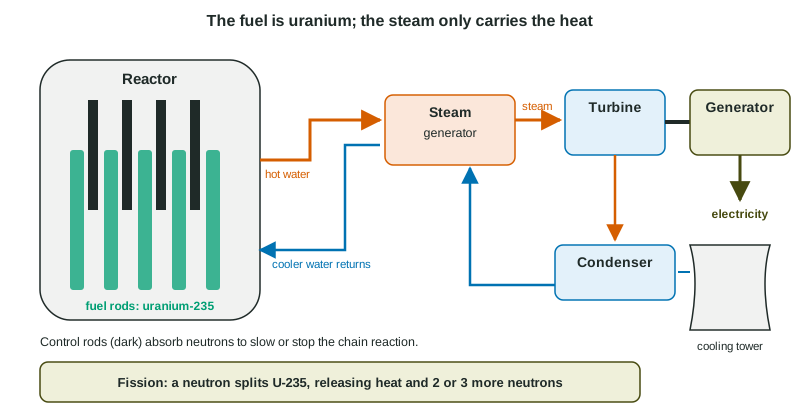
Nuclear power plants split uranium-235 nuclei in a controlled chain reaction; the heat makes steam that spins a turbine, with no carbon dioxide released while running.
Part 1 · Hook
Why this matters
Part 2 · Prerequisite check
Quick check before you start
1. In a coal power plant, what spins the turbine?
- High-pressure steam
- Burning coal directly
- Cooling water
- Electricity from the grid
Show the answer
Heat makes steam, and the steam spins the turbine.
- Correct: High-pressure steam:
- Burning coal directly:
- Cooling water:
- Electricity from the grid:
2. Why is a fuel called nonrenewable?
- It exists in a fixed supply that forms far slower than it is used
- It pollutes the air
- It is expensive
- It is found underground
Show the answer
Nonrenewable is about the rate of replacement.
- Correct: It exists in a fixed supply that forms far slower than it is used:
- It pollutes the air:
- It is expensive:
- It is found underground:
Part 3 · See it
See it first
Part 4 · Step by step
How it works, step by step
- A neutron strikes a uranium-235 nucleusthe nucleus splits (fission), releasing heat and 2 or 3 more neutrons
- Those neutrons split more nuclei, while control rods absorb the extra onesa steady chain reaction makes a steady supply of heat
- Water carries the heat to a steam generatorsteam spins a turbine and generator, with no carbon dioxide released
- Fission leaves radioactive products with long half-livesspent fuel must be cooled and stored for thousands of years, and loss of cooling can cause a meltdown
Part 5 · Key ideas
Key ideas
- The fuel is uranium enriched to about 3 to 5 percent uranium-235. Nuclear fission splits its nuclei, releasing heat and neutrons in a chain reaction; control rods absorb neutrons to control it.
- Radioactive decay: unstable nuclei give off radiation and change into other elements. The half-life is the time for half of the radioactive atoms to decay. Amount left = start × 0.5^(time ÷ half-life).
- Nuclear waste (spent fuel) stays dangerous for thousands of years; it is kept in cooling pools and then dry casks, and the United States has no permanent storage site.
- No air pollution or carbon dioxide while running, but uranium is nonrenewable, mining it disturbs land, plants release warm water, and a meltdown (Three Mile Island 1979, Chernobyl 1986, Fukushima 2011) can spread radioactive material.
Part 6 · Misconception
A common mistake
The wrong idea: A nuclear plant's fuel is the water or steam in its reactor, and the clouds from its cooling towers are radioactive smoke.
What actually happens: The fuel is uranium. Water only carries the heat, and the plume from a cooling tower is water vapor, not smoke.
Part 7 · Check yourself
Check yourself
Exam-style questions. Anything you miss goes into your review queue.
1. What is the fuel in a nuclear power plant?
- Water, which is split apart to release its energy
- Steam, which carries the energy to the turbine
- Coal, which is burned to heat the reactor core
- Uranium, enriched to a higher share of uranium-235
Show the answer
The fuel is uranium (usually enriched to about 3 to 5 percent uranium-235). Water and steam only carry the heat to the turbine.
- Water, which is split apart to release its energy: Water is the coolant and the source of steam; it is not split for energy.
- Steam, which carries the energy to the turbine: Steam carries heat; it is not the fuel.
- Coal, which is burned to heat the reactor core: No fuel is burned in a nuclear reactor.
- Correct: Uranium, enriched to a higher share of uranium-235: Right: uranium-235 is the fuel.
2. What do the control rods in a reactor do?
- They store the spent fuel after it is removed from the core
- They absorb neutrons, which slows the chain reaction
- They add extra uranium to the core when the reaction slows down
- They carry the heat from the reactor core out to the turbine
Show the answer
Control rods are made of materials that absorb neutrons. Lowering them in takes neutrons out of the chain reaction; pulling them out lets it speed up.
- They store the spent fuel after it is removed from the core: Spent fuel is stored in pools and casks, not in control rods.
- Correct: They absorb neutrons, which slows the chain reaction: Right: absorbing neutrons controls the rate.
- They add extra uranium to the core when the reaction slows down: Fuel rods hold the uranium; control rods do not add fuel.
- They carry the heat from the reactor core out to the turbine: Water carries the heat.
3. A sample holds 200 g of cesium-137, which has a half-life of about 30 years. How many grams of cesium-137 remain after 90 years?
Type a number, then its unit (g). Scale words (2.5 million) and powers of ten (2.5 × 10^6) are read.
Show the answer
half-lives. .
- Answer: 25 g
Model or diagram
Decay of a radioactive isotope
4. According to the graph, what is the half-life of this isotope?
- 10 years
- 20 years
- 400 years
- 60 years
Show the answer
The amount falls from 800 g to 400 g, half, in 10 years.
- Correct: 10 years: Right: 800 g becomes 400 g after 10 years.
- 20 years: After 20 years only a quarter (200 g) is left.
- 400 years: 400 is the mass after one half-life, not a time.
- 60 years: Sixty years is six half-lives.
5. How many grams of the isotope remain after 40 years?
Type a number, then its unit (g). Scale words (2.5 million) and powers of ten (2.5 × 10^6) are read.
Show the answer
half-lives; .
- Answer: 50 g
6. Which statement describes the shape of the curve?
- The mass lost each decade grows larger as the sample ages
- The isotope has decayed away after two half-lives pass
- The mass lost each decade shrinks as less remains
- The same mass of the isotope is lost in each decade
Show the answer
Each half-life removes half of what is left: 400 g, then 200 g, then 100 g. The curve flattens but does not reach zero.
- The mass lost each decade grows larger as the sample ages: The losses shrink, they do not grow.
- The isotope has decayed away after two half-lives pass: After two half-lives a quarter (200 g) is still left.
- Correct: The mass lost each decade shrinks as less remains: Right: half of a smaller amount each time.
- The same mass of the isotope is lost in each decade: A straight line would lose the same mass each decade; this curve does not.
Part 8 · Summary
Summary
Part 9 · Up next
What comes next
Part 10 · Connections