A nuclear power plant works like a coal plant from the steam onward: steam spins a turbine, the turbine turns a generator. What is different is the heat source. Instead of burning fuel, it splits atoms.
Fission and the chain reaction
The fuel is uranium, mined as ore. Natural uranium is only about 0.7 percent uranium-235, the form that splits easily, so it is enriched to about 3 to 5 percent and packed into pellets inside long fuel rods.
In nuclear fission, a neutron strikes a uranium-235 nucleus, which splits into two smaller nuclei and releases a large amount of heat and 2 or 3 more neutrons. Those neutrons can split more nuclei: a chain reaction. Control rods made of neutron-absorbing material are raised or lowered between the fuel rods to keep the reaction steady, or to stop it.
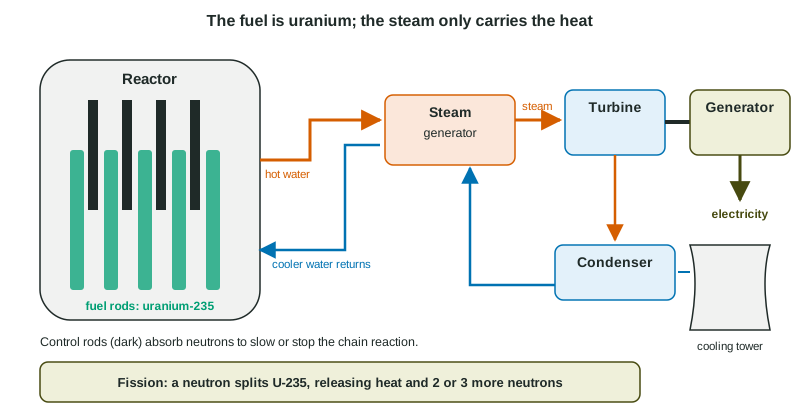
Water flowing through the core carries the heat away to make steam. A condenser and often a cooling tower remove the waste heat; the white plume above a cooling tower is water vapor. Like coal plants, nuclear plants turn only about a third of their heat into electricity.
Radioactive decay and half-life
Some nuclei are unstable. In radioactive decay they give off radiation and change into other elements. The half-life is the time it takes for half of the radioactive atoms in a sample to decay. It is fixed for each isotope: about 8 days for iodine-131, about 30 years for cesium-137, about 24,000 years for plutonium-239.
Each half-life halves what is left, so the amount never quite reaches zero: 100% → 50% → 25% → 12.5% → 6.25%.
Amount left. A sample holds 200 g of cesium-137 (half-life 30 years). How much is left after 90 years?
Number of half-lives: .
Setup: , or halve three times: 200 → 100 → 50 → 25.
Answer: left. Dividing 200 by 3 is the classic mistake.
Time to a fraction. How long until strontium-90 (half-life 29 years) falls to one sixteenth?
One sixteenth is : 4 half-lives.
Answer: years.
Nuclear waste
Used fuel rods, called spent fuel, are full of fission products, some with half-lives of thousands of years. This nuclear waste is first kept in pools of water at the plant to cool, then sealed in steel and concrete dry casks. The United States has no permanent storage site; the long-planned repository at Yucca Mountain in Nevada was never opened. Waste must be isolated from people and groundwater for thousands of years.
Accidents
Fission products keep making heat even after the chain reaction stops. If cooling water is lost, the fuel can overheat and melt: a meltdown. Three Mile Island in Pennsylvania (1979) had a partial meltdown with little release. At Chernobyl in Ukraine (1986), a reactor exploded and burned, spreading radioactive material across Europe. At Fukushima in Japan (2011), an earthquake and tsunami cut the cooling, and three reactors melted down.
Weighing nuclear power
| Advantages | Disadvantages |
|---|---|
| no carbon dioxide or smoke while running | uranium is nonrenewable; mining disturbs land and leaves radioactive tailings |
| huge energy from a small mass of fuel | spent fuel stays dangerous for thousands of years |
| steady output day and night | rare but severe accidents; costly to build |
| small land area for the energy produced | warm cooling water returned to rivers lowers dissolved oxygen |
Nuclear fuel is uranium, not water or steam. Nuclear power is low carbon while running but nonrenewable.