The sun delivers far more energy to Earth than people use. Solar technology collects it in three main ways: as electricity, as heat moved by pumps, and as heat held by the design of a building.
Photovoltaic cells
A photovoltaic cell, or PV cell, is a thin slice of a semiconductor, usually silicon. When light strikes it, it knocks electrons loose and they flow as an electric current. There are no moving parts and no fuel. Many cells wired together make a panel; an inverter changes the panel's direct current into the alternating current homes use. Rooftop panels serve a single building; solar farms with millions of panels feed the grid.
Typical panels turn about 20 percent of the sunlight that strikes them into electricity. They make the most when they face the sun: south in the Northern Hemisphere, north in the Southern Hemisphere.
Active and passive solar heating
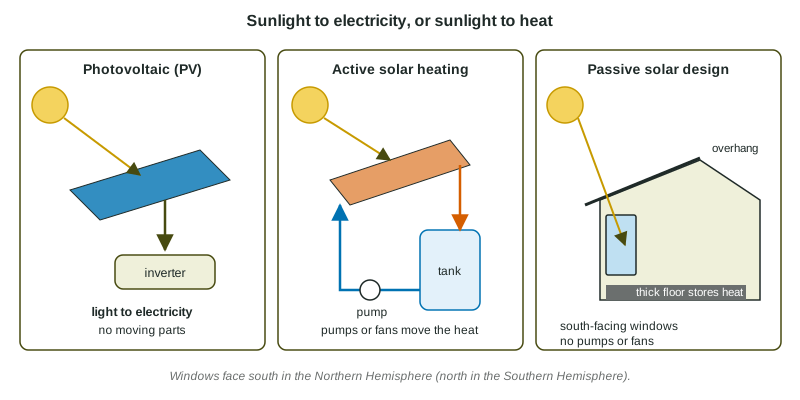
- Active solar systems use equipment to collect and move heat. Dark roof collectors warm a fluid, and a pump carries it to a hot water tank. Concentrated solar power plants use fields of mirrors to focus sunlight on a receiver; the heat makes steam that turns a turbine, and molten salt can store heat into the evening.
- Passive solar design uses the building itself, with no pumps or fans: large windows facing the sun, a roof overhang that shades the high summer sun but lets in the low winter sun, and thick floors or walls of stone or concrete (thermal mass) that absorb heat by day and release it at night.
Intermittency
Intermittency means a source is not available all the time. Solar output is zero at night, drops on cloudy days and is lower in winter, when the sun is low and the days are short. A home or grid that relies on solar needs batteries or other storage, a connection to a larger grid, or backup sources.
Money saved. A rooftop system makes 5,440 kWh in a year, and electricity costs $0.16 per kWh.
Setup: . The kWh cancels and dollars are left.
Answer: saved each year. If the system cost $13,000 after incentives, it pays for itself in about years.
Where solar works best
Solar output depends on insolation. Dry regions at lower latitudes, such as the deserts of the southwestern United States, North Africa and Australia, get strong, direct sunlight with few clouds, so a panel there makes far more electricity in a year than the same panel in a cloudy northern city. Panels are tilted toward the sun, and anything that shades them, such as trees or nearby buildings, cuts their output.
Weighing solar energy
| Advantages | Disadvantages |
|---|---|
| no air pollution or carbon dioxide while running | intermittent: no output at night, less on cloudy days and in winter |
| nondepletable; no fuel to buy | large solar farms cover a lot of land and can disturb desert habitat |
| panels work on rooftops, close to where power is used | mining and making panels uses energy and materials; old panels become waste |
| low running costs; prices have fallen sharply | storage adds cost |
Name the type: "photovoltaic" for electricity from light, "active" for systems with pumps or fans, "passive" for building design. Name intermittency as the main drawback and storage as the fix.