Hydroelectric power is the largest renewable source of electricity in the world. It turns the energy of moving water into electricity, and it changes rivers more than almost any other human structure.
How a dam makes electricity
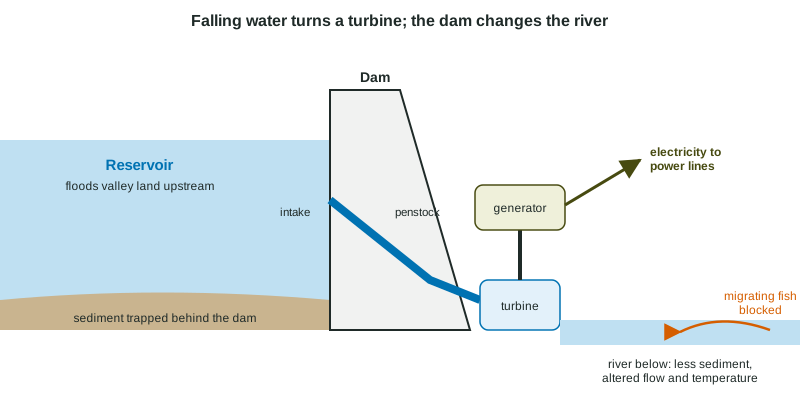
A dam blocks a river and holds water in a reservoir. Water enters an intake near the base, falls through a large pipe called the penstock, and spins a turbine. The turbine turns a generator, just as in a fossil fuel plant, but no fuel is burned and no steam is needed. The water then flows out into the river below.
The output depends on two things: how much water flows through the turbines and how far it falls (the head). A tall dam on a river with steady flow makes the most electricity. In a drought, flow drops and so does output.
Types of hydroelectric power
| Type | How it works | Trade-offs |
|---|---|---|
| Dam and reservoir | a tall dam stores water; releases are controlled | flexible output and storage; floods large areas |
| Run-of-the-river | part of the river's flow runs through turbines, with little or no reservoir | floods little land; output rises and falls with the river |
| Tidal | turbines in a barrage or channel catch water as tides flow in and out | very predictable; few sites have large enough tides; barrages change estuaries |
Calculating output
Energy equals power times time. A plant's capacity is its maximum power; its capacity factor is the share of that maximum it averages over a year.
Yearly output. A 400 MW dam has a capacity factor of 45%. A year has 8,760 hours.
Setup:
Answer: a year. At 10.5 MWh per home, that supplies about
Pumped storage
Some dams store energy for the grid. When electricity is cheap and plentiful, for example on a sunny, windy afternoon, pumps lift water from a lower reservoir to an upper one. When demand peaks, the water flows back down through turbines. This pumped storage uses more energy than it returns, but it lets the grid save electricity from intermittent sources for later, and it still holds most of the energy stored for the world's grids.
Environmental effects
- Flooding. Reservoirs drown forests, farmland, towns and cultural sites. China's Three Gorges Dam displaced more than a million people.
- Fish. Dams block salmon and other fish that migrate between the sea and upstream spawning grounds. Fish ladders help some species.
- Sediment. Sediment settles in the still reservoir, slowly filling it. Water released below carries little sediment, so it erodes the riverbed and banks, and deltas downstream shrink.
- Flow and temperature. Natural floods that renewed riverbanks stop; water released from deep in a reservoir is often colder than the natural river.
- Heat-trapping gases. Plants flooded by a new reservoir decay, releasing carbon dioxide and methane, especially in warm climates.
Benefits: no fuel and no air pollution while running, a long working life, flood control, water storage for irrigation and drinking water, and output that can be raised or lowered in minutes to match demand.
When asked for an impact, be specific: "the dam blocks salmon migration to upstream spawning grounds," not "it hurts fish."