A hydrogen fuel cell makes electricity from a chemical reaction, quietly, with water as its only exhaust. It is used in some cars, buses, trucks, forklifts and backup generators. The catch is that hydrogen has to be made first.
How a fuel cell works
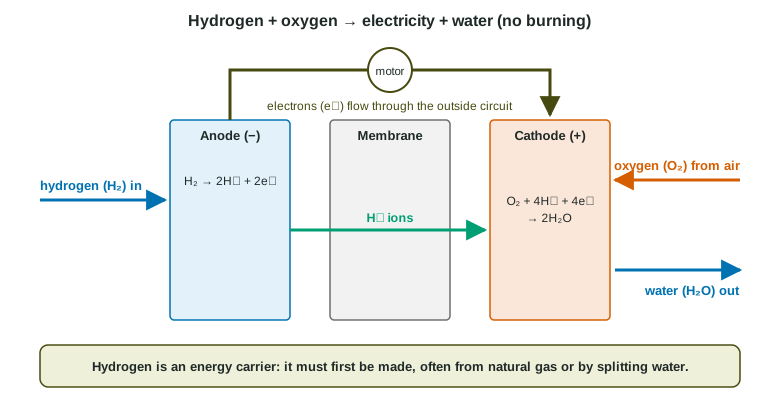
- Hydrogen gas flows to the anode, where a catalyst (often platinum) splits each molecule into hydrogen ions (H⁺) and electrons.
- A membrane lets the ions through but blocks the electrons.
- The electrons travel through an outside circuit to the cathode. That flow is an electric current, which runs a motor or charges a small battery.
- At the cathode, oxygen from the air combines with the ions and electrons to form water.
Overall: hydrogen + oxygen → electricity + water + heat, or 2H₂ + O₂ → 2H₂O. Nothing burns, so there is no soot and no carbon dioxide from the cell. Many cells are stacked together to give enough power.
Hydrogen is an energy carrier
Almost no free hydrogen exists on Earth; it is locked in water and in hydrocarbons such as methane. Energy must be used to free it, so hydrogen is an energy carrier, like electricity, not an energy source.
- From natural gas (steam reforming): most hydrogen today. It is the cheapest method but releases carbon dioxide at the plant.
- By electrolysis: electricity splits water into hydrogen and oxygen. With electricity from wind or sunlight, the whole chain releases very little carbon dioxide, but it costs more.
Every step loses energy: making the hydrogen, compressing and moving it, and turning it back into electricity in the fuel cell.
Source to wheels. Electrolysis 70%, storage and delivery 85%, fuel cell 50%, motor 90%.
Setup:
Answer: about . A battery car (charging 92%, battery 95%, motor 90%) delivers about
Where fuel cells fit
Because hydrogen refuels quickly and stores a lot of energy for its weight, fuel cells make the most sense where batteries would be too heavy or too slow to recharge: long-haul trucks, city buses that run all day, forklifts in warehouses, ships and backup power for hospitals and cell towers. For ordinary cars, batteries have pulled far ahead because they waste much less energy.
Fuel cell cars and battery cars
The exam has tested whether students can keep these apart.
| Hydrogen fuel cell car | Battery-powered car | |
|---|---|---|
| Exhaust | water only | none |
| Refueling | a few minutes at a hydrogen station | 30 minutes to several hours of charging |
| Main drawbacks | few stations; hydrogen hard to store (high pressure, flammable, low density); mostly made from natural gas; costly catalyst | large batteries need mined lithium, cobalt and nickel; long charging; battery disposal |
| Source-to-wheels efficiency | lower (about 25 to 35%) | higher (about 70 to 80%) |
When asked for a fuel cell drawback, give a hydrogen problem: "making hydrogen usually uses natural gas, which releases carbon dioxide," or "hydrogen is hard to store and there are few fueling stations." Do not give long charging times.