Hydrogen Fuel Cell
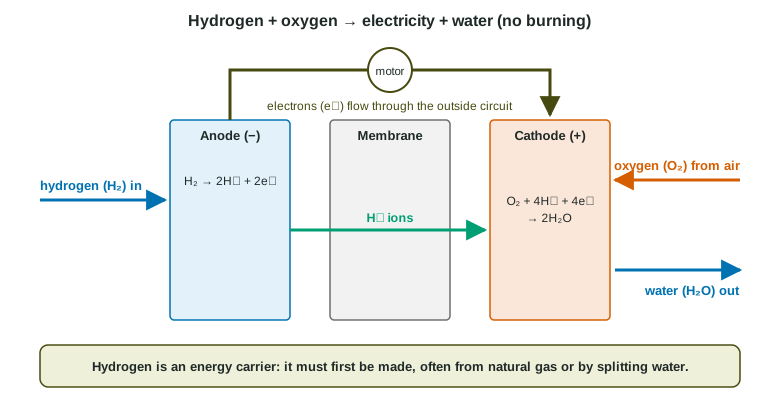
A hydrogen fuel cell turns the chemical energy of hydrogen and oxygen into electricity without burning, and its only exhaust is water.
Part 1 · Hook
Why this matters
Part 2 · Prerequisite check
Quick check before you start
1. How do you find the overall efficiency of several steps?
- Multiply the step efficiencies as decimals
- Add the step efficiencies
- Average the step efficiencies
- Use only the largest step
Show the answer
Losses build on each other, so efficiencies multiply.
- Correct: Multiply the step efficiencies as decimals:
- Add the step efficiencies:
- Average the step efficiencies:
- Use only the largest step:
2. Natural gas is mostly which substance?
- Methane
- Hydrogen
- Carbon dioxide
- Oxygen
Show the answer
Natural gas is mostly methane, and its hydrogen can be stripped off to make hydrogen fuel.
- Correct: Methane:
- Hydrogen:
- Carbon dioxide:
- Oxygen:
Part 3 · See it
See it first
Part 4 · Step by step
How it works, step by step
- Energy is used to make hydrogen, from natural gas or by electrolysis of waterhydrogen stores that energy as a fuel (an energy carrier)
- In the fuel cell, a catalyst splits hydrogen into ions and electronsions cross the membrane while electrons flow through the outside circuit as electric current
- At the cathode, oxygen joins the ions and electronswater forms as the only exhaust; nothing is burned
- Each step, from making hydrogen to the motor, loses energythe whole chain is less efficient than charging a battery directly
Part 5 · Key ideas
Key ideas
- A hydrogen fuel cell combines hydrogen and oxygen to make electricity, with water as the only exhaust. No combustion, no carbon dioxide from the cell.
- Hydrogen is an energy carrier: it must be made. Most comes from natural gas (releasing carbon dioxide at the plant); electrolysis with renewable electricity is very low carbon but costs more.
- Fuel cell drawbacks: few fueling stations, hydrogen is hard to store (high pressure, flammable, low density), costly catalysts, and energy lost making and moving hydrogen.
- Do not confuse with battery cars: long recharging times and large mined lithium batteries are battery-car drawbacks. Fuel cell vehicles refuel in minutes and have long range.
Part 6 · Misconception
A common mistake
The wrong idea: A hydrogen fuel cell car has the same drawbacks as a battery car: it takes hours to recharge and needs a huge lithium battery.
What actually happens: A fuel cell car refuels with hydrogen in minutes and has only a small battery. Its drawbacks are different: making hydrogen takes energy, often from natural gas, it is hard to store, and there are few fueling stations.
Part 7 · Check yourself
Check yourself
Exam-style questions. Anything you miss goes into your review queue.
1. What is the only exhaust from a hydrogen fuel cell?
- Carbon dioxide
- Methane
- Soot
- Water
Show the answer
Hydrogen combines with oxygen from the air: 2H₂ + O₂ → 2H₂O. The product is water (and some heat).
- Carbon dioxide: The fuel contains no carbon, so the cell makes no carbon dioxide.
- Methane: Methane is not produced in the cell.
- Soot: Nothing is burned, so there is no soot.
- Correct: Water: Right: water is the product.
2. Most hydrogen produced today comes from natural gas. What does this mean for a fuel cell car's environmental impact?
- The car releases methane from its fuel cell as it drives along
- Carbon dioxide is released at the plant that makes hydrogen
- The car releases carbon dioxide out of its exhaust pipe
- The car is zero emissions from start to finish, at each step
Show the answer
Steam reforming of natural gas releases carbon dioxide at the plant. A fuel cell vehicle is only as clean as the way its hydrogen is made.
- The car releases methane from its fuel cell as it drives along: The fuel cell uses hydrogen, not methane.
- Correct: Carbon dioxide is released at the plant that makes hydrogen: Right: the emissions move to the hydrogen plant.
- The car releases carbon dioxide out of its exhaust pipe: The car's exhaust is water.
- The car is zero emissions from start to finish, at each step: Making the hydrogen from natural gas releases carbon dioxide.
3. Which drawback belongs to hydrogen fuel cell cars rather than battery-powered cars?
- Few fueling stations, and hydrogen is hard to store
- Long recharging times at home or at public charging stations
- Large batteries that need mined lithium, cobalt and nickel
- Driving range that falls sharply in very cold winter weather
Show the answer
Fuel cell cars refuel in minutes, but hydrogen is hard to store and move, and there are very few stations. Long charging times and large mined batteries are battery-car drawbacks.
- Correct: Few fueling stations, and hydrogen is hard to store: Right: hydrogen storage and the lack of stations.
- Long recharging times at home or at public charging stations: Long recharging is a battery car drawback; fuel cell cars refuel in minutes.
- Large batteries that need mined lithium, cobalt and nickel: Large lithium batteries are a battery car drawback; fuel cell cars have only a small battery.
- Driving range that falls sharply in very cold winter weather: Cold weather mainly cuts the range of battery cars.
Model or diagram
How a hydrogen fuel cell works
4. In the diagram, what passes through the membrane?
- Water
- Hydrogen ions
- Electrons
- Oxygen gas
Show the answer
The membrane lets hydrogen ions (H⁺) through but blocks electrons, which must go around through the circuit.
- Water: Water forms at the cathode and leaves the cell.
- Correct: Hydrogen ions: Right: H⁺ ions cross the membrane.
- Electrons: Electrons are forced through the outside circuit, which is the current.
- Oxygen gas: Oxygen enters at the cathode from the air.
5. According to the diagram, why does the motor run?
- Electrons flow through the outside circuit as a current
- Oxygen burns at the cathode, which spins the motor
- Water leaving the cell turns a small turbine inside it
- Hydrogen ions push on the motor as they cross the membrane
Show the answer
The membrane blocks electrons, so they travel through the outside circuit from anode to cathode. That flow is the electric current that runs the motor.
- Correct: Electrons flow through the outside circuit as a current: Right: the electron flow is the current.
- Oxygen burns at the cathode, which spins the motor: Nothing burns in a fuel cell.
- Water leaving the cell turns a small turbine inside it: There is no turbine in a fuel cell.
- Hydrogen ions push on the motor as they cross the membrane: The ions stay inside the cell; the current is the electrons.
6. A city replaces diesel buses with fuel cell buses like the one in the diagram. Which air quality change on city streets is most likely?
- More carbon dioxide on the streets released by the fuel cells
- More soot, since hydrogen burns at a very high temperature
- No change, since the new buses still burn fuel in their engines
- Less soot and exhaust on the streets, as the buses emit water
Show the answer
The buses emit only water vapor, so street-level exhaust from the buses falls. Emissions may still occur where the hydrogen is made.
- More carbon dioxide on the streets released by the fuel cells: Fuel cells emit no carbon dioxide.
- More soot, since hydrogen burns at a very high temperature: Nothing is burned in a fuel cell.
- No change, since the new buses still burn fuel in their engines: Fuel cells do not burn fuel.
- Correct: Less soot and exhaust on the streets, as the buses emit water: Right: tailpipe pollution from the buses goes away.
Part 8 · Summary
Summary
Part 9 · Up next
What comes next
Part 10 · Connections