Earth's surface looks still, but it is moving. The ground under you drifts a few centimeters a year, about as fast as your fingernails grow. Over millions of years that slow motion opens oceans, raises mountains and decides where earthquakes and volcanoes strike. This page explains what moves the plates, what happens at each kind of plate edge, and why it matters for people and ecosystems.
Plates riding on a moving mantle
Earth's rigid outer layer, the crust and the top of the mantle, is broken into about a dozen large pieces called tectonic plates. The plates are about 100 km thick. Below them the mantle is solid rock, but it is hot enough to flow very slowly, like thick putty.
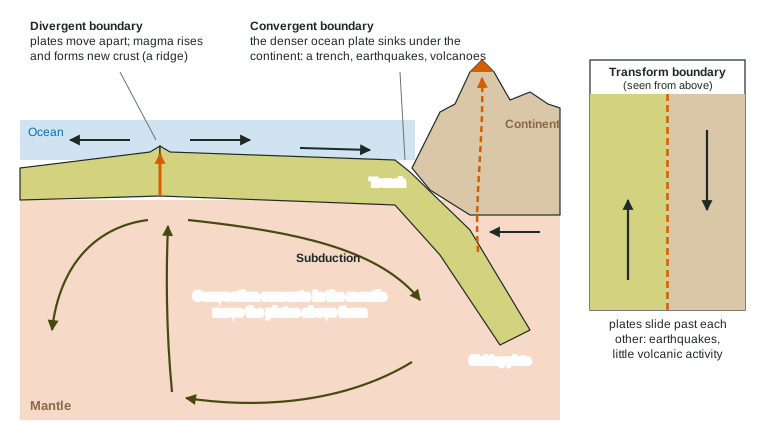
Heat from deep inside Earth warms the lower mantle. Warm rock is less dense, so it rises. Near the top it spreads sideways, cools, becomes denser and sinks again. This loop of rising, spreading and sinking is a convection current, the same pattern you see in a pot of soup heated from below. The moving mantle drags the plates above it. That is plate tectonics: the theory that Earth's surface is made of moving plates, driven by heat from inside.
Three kinds of plate boundary
What happens at a plate's edge depends on which way the two plates move. Learn the three boundaries as a set.
| Boundary | Plate motion | What forms | Example |
|---|---|---|---|
| Divergent | apart | new crust, a mid-ocean ridge or a rift valley; mild earthquakes and volcanoes | the Mid-Atlantic Ridge and Iceland; the East African Rift |
| Convergent (ocean and another plate) | together; the denser ocean plate sinks (subduction) | a deep trench, strong earthquakes, a chain of volcanoes | the Andes; Japan |
| Convergent (continent and continent) | together; neither sinks far | crust crumples into very high mountains; earthquakes | the Himalayas |
| Transform | sliding past each other | earthquakes along a fault; little volcanic activity | the San Andreas Fault |
Divergent boundaries
Where plates pull apart, the gap lets hot mantle rock rise. As it rises, the pressure on it drops, so part of it melts. The magma fills the gap and cools into new crust. Under the ocean this builds a long underwater mountain chain, a mid-ocean ridge, and the new crust moves away on both sides: seafloor spreading. On land, pulling apart makes a rift valley, a long sinking trough such as the East African Rift.
Convergent boundaries
Ocean crust is made of dense rock; continental crust is lighter. When an ocean plate meets a continent, or an older, colder ocean plate, the denser plate bends down and sinks into the mantle. This is a subduction zone. The seafloor bends down into a deep trench. The sinking plate sticks and slips, causing the strongest earthquakes on Earth. As it sinks it carries water down, which helps the rock above it melt, and that magma rises to form a chain of volcanoes. When two continents collide, neither is dense enough to sink far, so the crust folds and stacks into high mountains.
Transform boundaries
At a transform boundary two plates slide past each other sideways. The rock locks, stress builds for years, then the rock suddenly slips: an earthquake. No crust is made or destroyed, so there are few volcanoes.
Hot spots
A hot spot is a column of unusually hot mantle rock that stays in one place while a plate moves over it. Magma punches through the plate and builds a volcano. As the plate carries that volcano away, a new one forms over the hot spot. The result is a chain of volcanic islands that get older in the direction the plate moves. The Hawaiian Islands are the classic example: the island of Hawaii, over the hot spot, still erupts, and the islands to the northwest are older and more worn down.
Reading a map of plate boundaries
On a map, earthquakes and volcanoes are not scattered at random. They trace the plate edges. About three quarters of the world's active volcanoes ring the Pacific Ocean, where subduction zones line most of the coast. When an exam question shows a map, find the boundary first, then ask which way the plates move. That tells you what to expect: ridges and new crust, trenches and volcanoes, or a sliding fault.
Why this matters for the environment
- Hazards. Cities near subduction zones face strong earthquakes, volcanic eruptions and tsunamis. A tsunami starts when an undersea earthquake suddenly lifts or drops the seafloor, which moves all the water above it.
- Resources. Plate motion concentrates useful minerals and metals, and it brings heat close to the surface in volcanic regions.
- Landscapes and climate. Colliding plates build mountain ranges that change where rain falls and where rivers run. The weathering of their rock, which you met in the phosphorus cycle, slowly releases nutrients into ecosystems.
Calculating how fast a plate moves
A spreading rate is a distance divided by a time. Rock on the seafloor gets older the farther it is from the ridge, so its age and its distance give the rate.
Worked example. Seafloor rock 50 km from a ridge is 2,000,000 years old. How fast did this side of the ridge spread, in cm per year?
Convert the distance so the units match the answer:
Divide distance by time:
The kilometers cancel in the first step, and the answer keeps its unit, cm/yr.
Check yourself
- Which boundary makes new crust? (Divergent.)
- Why does the ocean plate sink when it meets a continent? (It is denser.)
- Why does a transform fault have earthquakes but few volcanoes? (The plates slide past each other; no plate sinks and little magma rises.)