Plate Tectonics
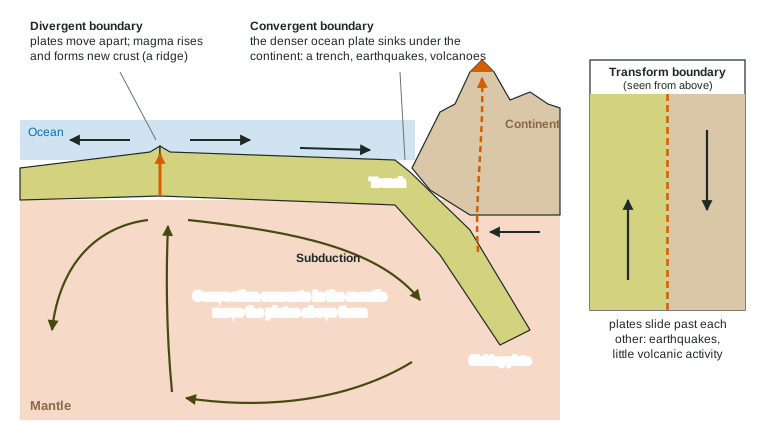
Convection in the mantle moves Earth's plates.
Part 1 · Hook
Why this matters
Part 2 · Prerequisite check
Quick check before you start
1. Which process breaks rock into smaller pieces at Earth's surface?
- Weathering
- Photosynthesis
- Transpiration
- Nitrogen fixation
Show the answer
Weathering breaks rock down by water, ice, temperature changes and living things.
- Correct: Weathering:
- Photosynthesis:
- Transpiration:
- Nitrogen fixation:
2. Which is an abiotic part of an ecosystem?
- Rock
- A fungus
- A tree
- A beetle
Show the answer
Rock is not living, so it is abiotic.
- Correct: Rock:
- A fungus:
- A tree:
- A beetle:
Part 3 · See it
See it first
Part 4 · Step by step
How it works, step by step
- Heat from deep inside Earth warms mantle rock, which rises, cools and sinksslow convection currents form in the mantle
- Convection currents drag the rigid plates above themplates move a few centimeters a year, apart, together or past each other
- Plates pull apartmagma rises and forms new crust: mid-ocean ridges and rift valleys
- A dense ocean plate meets a lighter plate and sinksa trench, strong earthquakes and a chain of volcanoes form
- Plates grind past each other and then suddenly slipearthquakes shake the land, and a slip under the sea can launch a tsunami
Part 5 · Key ideas
Key ideas
- Earth's outer layer is broken into rigid tectonic plates that ride on the hotter, slowly flowing mantle, moved by convection currents.
- Divergent boundary: plates move apart; magma forms new crust (mid-ocean ridges, rift valleys, seafloor spreading).
- Convergent boundary: plates move together. Ocean meets plate: the denser ocean plate sinks (subduction), making a trench, earthquakes and volcanoes. Continent meets continent: crust crumples into high mountains.
- Transform boundary: plates slide past each other; earthquakes, little volcanic activity (the San Andreas Fault).
- A hot spot is a fixed plume of magma under a plate; the plate moving over it leaves a chain of volcanoes that get older in one direction (Hawaii).
Part 6 · Misconception
A common mistake
The wrong idea: Volcanoes and earthquakes happen at random places on Earth.
What actually happens: Most cluster along plate boundaries, especially subduction zones such as the ring around the Pacific. Hot spots are the main exception, and even they make a predictable chain.
Part 7 · Check yourself
Check yourself
Exam-style questions. Anything you miss goes into your review queue.
1. The Himalayas are still rising where the plate carrying India pushes into the plate carrying most of Asia. Which kind of boundary is this?
- A convergent boundary between two continental plates
- A divergent boundary where two plates spread apart
- A transform boundary where plates slide side by side
- A hot spot under the middle of one plate
Show the answer
Two continents collide. Continental crust is too light to sink far, so the crust crumples and stacks up into very high mountains.
- Correct: A convergent boundary between two continental plates: Right: the plates move toward each other, and the crust folds into mountains.
- A divergent boundary where two plates spread apart: Spreading plates form ridges and rift valleys, not the highest mountains on Earth.
- A transform boundary where plates slide side by side: At a transform boundary the plates slide past each other; they do not push crust upward this much.
- A hot spot under the middle of one plate: A hot spot forms volcanoes in the middle of a plate, not a long mountain range at a plate edge.
2. The San Andreas Fault in California causes frequent earthquakes but has few volcanoes. Which kind of plate boundary is it?
- Transform
- Divergent
- Convergent, with subduction
- Convergent, between two continents
Show the answer
At a transform boundary the plates grind past each other. Stress builds and is released as earthquakes, but no plate sinks and little magma rises.
- Correct: Transform: Right: the Pacific Plate slides past the North American Plate.
- Divergent: A divergent boundary would let magma rise and form new crust, with volcanic activity.
- Convergent, with subduction: Subduction makes trenches and chains of volcanoes, which this fault does not have.
- Convergent, between two continents: A collision of continents builds high mountain ranges, not a long sliding fault.
3. An ocean plate sinks under a continental plate. Which features form at this boundary? Select all that apply.
- A deep ocean trench
- A chain of volcanoes on the continent
- A rift valley that splits the continent
- A mid-ocean ridge with new seafloor
Show the answer
Where the denser ocean plate sinks, the seafloor bends down into a trench, and the melting rock above the sinking plate feeds volcanoes, as in the Andes.
- Correct: A deep ocean trench: Right: the sinking plate forms a trench.
- Correct: A chain of volcanoes on the continent: Right: rock above the sinking plate melts, and the magma rises to form volcanoes.
- A rift valley that splits the continent: A rift valley forms where plates pull apart, at a divergent boundary.
- A mid-ocean ridge with new seafloor: A mid-ocean ridge forms where ocean plates move apart, not where they collide.
Model or diagram
A cross-section of three plate boundaries
4. In the diagram, what is happening at the boundary on the left, where the arrows point away from each other?
- Two plates move apart and magma forms new crust
- Two plates collide and one sinks into the mantle
- Two plates slide past each other without new crust
- A plate moves over a hot spot in the mantle
Show the answer
Arrows pointing apart mark a divergent boundary. Rising magma fills the gap and builds a ridge of new crust.
- Correct: Two plates move apart and magma forms new crust: Right: the boundary is divergent, with magma rising between the plates.
- Two plates collide and one sinks into the mantle: Colliding plates are shown in the middle, where one plate sinks.
- Two plates slide past each other without new crust: Sliding plates are shown in the inset seen from above.
- A plate moves over a hot spot in the mantle: The diagram shows the magma at a plate edge, not under the middle of a plate.
5. According to the diagram, why does the ocean plate, and not the continent, sink at the convergent boundary?
- Ocean crust is denser than continental crust
- Ocean crust is thicker than continental crust
- The ocean pushes the plate down with its weight
- The continent is moving faster than the ocean plate
Show the answer
Ocean crust is made of dense basalt; continental crust is lighter. When they meet, the denser plate sinks into the mantle.
- Correct: Ocean crust is denser than continental crust: Right: the denser plate sinks below the lighter one.
- Ocean crust is thicker than continental crust: Ocean crust is thinner than continental crust, not thicker.
- The ocean pushes the plate down with its weight: The water above is not what makes the plate sink; the rock is denser.
- The continent is moving faster than the ocean plate: Speed does not decide which plate sinks; density does.
6. A city is built on the continent shown in the diagram, near the trench. Which natural hazards is it most likely to face?
- Strong earthquakes and volcanic eruptions
- Rift valleys opening under the city each year
- Hurricanes caused by the sinking plate
- Volcanic eruptions but no earthquakes
Show the answer
A subduction zone produces some of the strongest earthquakes on Earth, and the melting plate feeds explosive volcanoes, as along the Andes and in Japan.
- Correct: Strong earthquakes and volcanic eruptions: Right: subduction brings both strong earthquakes and volcanoes.
- Rift valleys opening under the city each year: Rift valleys form where plates pull apart, not where they collide.
- Hurricanes caused by the sinking plate: Hurricanes form over warm ocean water; plate motion does not cause them.
- Volcanic eruptions but no earthquakes: The grinding and sudden slipping of the sinking plate causes frequent earthquakes too.
Part 8 · Summary
Summary
Part 9 · Up next
What comes next
Part 10 · Connections