Soil Formation and Erosion
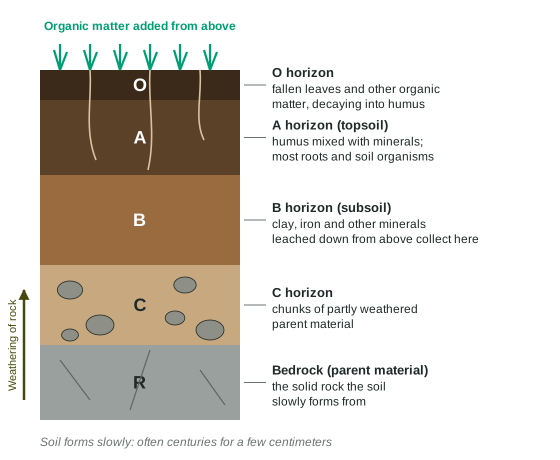
Soil forms slowly from weathered parent material and humus from decomposed organisms, and it sorts into horizons: O, A (topsoil), B (subsoil), C and bedrock.
Part 1 · Hook
Why this matters
Part 2 · Before you start
What this builds on
Part 3 · Prerequisite check
Quick check before you start
1. What does weathering do?
- Breaks rock into smaller pieces
- Turns nitrogen gas into ammonium
- Moves water from leaves to the air
- Builds new rock at the surface
Show the answer
Weathering breaks rock down by water, ice, temperature changes and living things, releasing minerals.
- Correct: Breaks rock into smaller pieces:
- Turns nitrogen gas into ammonium:
- Moves water from leaves to the air:
- Builds new rock at the surface:
2. What do decomposers do in an ecosystem?
- Break down dead matter and return nutrients to the soil
- Make sugar from sunlight
- Eat only living plants
- Turn rock into sand
Show the answer
Decomposers such as bacteria and fungi break down dead organisms, releasing nutrients.
- Correct: Break down dead matter and return nutrients to the soil:
- Make sugar from sunlight:
- Eat only living plants:
- Turn rock into sand:
3. What is runoff?
- Water that flows over the land surface
- Water that soaks into the ground
- Water vapor that forms clouds
- Water taken up by plant roots
Show the answer
Runoff is water moving over the surface toward streams; it carries soil with it.
- Correct: Water that flows over the land surface:
- Water that soaks into the ground:
- Water vapor that forms clouds:
- Water taken up by plant roots:
Part 4 · See it
See it first
Part 5 · Step by step
How it works, step by step
- Weathering breaks parent material (bedrock or deposited sediment) into small mineral particlesthe mineral part of soil forms
- Dead plants and animals are broken down by decomposershumus forms and is mixed into the top of the soil
- Water soaking down carries minerals and fine particles from the top layersthe soil sorts itself into horizons: O, A, B, C
- Plants are removed and the soil is left barewind and water carry topsoil away, far faster than new soil forms
Part 6 · Key ideas
Key ideas
- Soil forms from parent material (bedrock, or sediment carried by rivers, glaciers or wind) broken down by weathering, plus humus from decomposed organisms.
- Climate, organisms, the shape of the land, the parent material and time control how fast soil forms. Warm, wet places weather rock and decompose matter fastest.
- A soil profile has layers called horizons: O (organic matter), A (topsoil: humus and minerals), B (subsoil: minerals leached from above), C (partly weathered parent material), then bedrock.
- Erosion is the removal and transport of soil by wind and water. Plant roots hold soil and plant cover shields it, so bare soil erodes fastest.
- Eroded soil fills streams with sediment, carries nutrients and pesticides with it, and leaves farms with poorer subsoil.
Part 7 · Misconception
A common mistake
The wrong idea: Soil keeps forming, so losing some to erosion is quickly made up.
What actually happens: New soil does form, but only over centuries: a few centimeters can take hundreds of years to form, but a bare field can lose that much in a few years.
Part 8 · Check yourself
Check yourself
Exam-style questions. Anything you miss goes into your review queue.
1. Which two processes form soil?
- Weathering of parent material and the decay of organic matter
- Erosion of topsoil and the deposit of salt by floodwater
- Photosynthesis in roots and evaporation from the soil surface
- Compaction by heavy machines and the melting of bedrock
Show the answer
Soil forms where rock is broken down into mineral particles by weathering and dead plants and animals decay into humus, mixing over long periods.
- Correct: Weathering of parent material and the decay of organic matter: Right: weathered rock supplies minerals, and decayed organisms supply humus.
- Erosion of topsoil and the deposit of salt by floodwater: Erosion removes soil; it does not form it where it starts.
- Photosynthesis in roots and evaporation from the soil surface: Roots do not photosynthesize, and evaporation does not make soil.
- Compaction by heavy machines and the melting of bedrock: Compaction damages soil, and bedrock is not melted at the surface.
2. Why does wind remove more soil from a field after it is plowed than from the same field covered in grass?
- Plowed soil is loose and bare, with no roots to hold it
- Plowing adds organic matter that is light enough for the wind to lift
- Grass makes the wind blow faster over a field than over bare soil
- Plowing moves the C horizon to the surface, which is lighter than topsoil
Show the answer
Roots bind soil particles together and leaves and stalks shield the surface. Plowing breaks up the soil and leaves it bare, so wind can lift it.
- Correct: Plowed soil is loose and bare, with no roots to hold it: Right: bare, loose soil has nothing holding it down.
- Plowing adds organic matter that is light enough for the wind to lift: Plowing turns plant matter under; it does not make the soil lighter.
- Grass makes the wind blow faster over a field than over bare soil: Grass slows the wind at the ground; it does not speed it up.
- Plowing moves the C horizon to the surface, which is lighter than topsoil: Ordinary plowing turns the topsoil, not the deep C horizon.
Model or diagram
A soil profile
3. In the soil profile, which horizon is topsoil, with the most humus mixed into the minerals and most of the roots?
- The A horizon
- The B horizon
- The C horizon
- The O horizon
Show the answer
The A horizon is topsoil: humus mixed with mineral particles. It is dark and full of roots, worms and microbes.
- Correct: The A horizon: Right: topsoil is the A horizon.
- The B horizon: The B horizon is subsoil, where minerals leached from above collect.
- The C horizon: The C horizon is partly weathered parent material with little humus.
- The O horizon: The O horizon is mostly undecayed leaves and organic matter above the mineral soil.
4. The diagram says minerals leached from above collect in the B horizon. What carries them down?
- Water soaking down through the soil
- Roots pulling minerals down from the surface
- Wind blowing minerals into cracks in the soil
- Heat rising from the bedrock below the soil
Show the answer
Rain soaks into the soil and dissolves or carries fine particles and minerals downward. They build up in the subsoil: this is leaching.
- Correct: Water soaking down through the soil: Right: water moving down leaches minerals into the B horizon.
- Roots pulling minerals down from the surface: Roots take minerals up from the soil, the opposite direction.
- Wind blowing minerals into cracks in the soil: Wind moves surface soil; it does not move minerals down through the profile.
- Heat rising from the bedrock below the soil: Heat from bedrock does not move minerals in a soil profile.
Data
Soil lost from four test plots on one hillside
| Plot | Ground cover | Soil lost (metric tons per hectare per year) |
|---|---|---|
| 1 | Native grass, never plowed | 0.4 |
| 2 | Crop with leftover stalks kept on the ground | 2.5 |
| 3 | Crop planted in plowed, bare soil | 12.0 |
| 4 | Bare, plowed soil with no crop | 30.0 |
5. What pattern does the table show?
- Less ground cover goes with more soil lost
- Plowing the soil reduces the amount of soil lost
- Each plot loses roughly the same amount of soil each year
- Leaving stalks on the ground increases soil loss
Show the answer
Soil loss rises from 0.4 to 30.0 metric tons per hectare as cover goes from never-plowed grass to bare, plowed soil.
- Correct: Less ground cover goes with more soil lost: Right: bare ground loses the most soil, grass the least.
- Plowing the soil reduces the amount of soil lost: The plowed plots (3 and 4) lose the most soil.
- Each plot loses roughly the same amount of soil each year: Losses range from 0.4 to 30.0 metric tons per hectare, a large difference.
- Leaving stalks on the ground increases soil loss: The plot with stalks loses less than the bare, plowed plots.
6. Which conclusion do the data support?
- More plant cover goes with less soil loss on this slope
- Growing a crop doubles soil loss compared with leaving soil bare
- Plowing makes little difference to soil loss on this slope
- Native grass loses more soil than any field with a crop
Show the answer
The more cover the ground keeps, the less soil it loses: grass loses 0.4, stalks 2.5, a crop on bare soil 12.0 and bare soil 30.0 metric tons per hectare.
- Correct: More plant cover goes with less soil loss on this slope: Right: every step toward more cover lowers soil loss.
- Growing a crop doubles soil loss compared with leaving soil bare: Bare soil with no crop (30.0) loses more than a crop on plowed soil (12.0), not less.
- Plowing makes little difference to soil loss on this slope: The plowed plots lose far more soil than the unplowed grass.
- Native grass loses more soil than any field with a crop: Native grass loses the least, 0.4 metric tons per hectare.
Part 9 · Summary
Summary
Part 10 · Up next
What comes next
Part 11 · Connections