Insects, weeds and fungi destroy a large share of the world's crops in the field and in storage. Pesticides are the fastest way to fight back, and they have helped make cheap, plentiful food possible. This page covers the types of pesticides, their costs to other organisms, and the most important problem with them: pests evolve resistance.
Types of pesticides
| Type | Targets | Example of use |
|---|---|---|
| Insecticide | insects | killing caterpillars on cotton or aphids in an orchard |
| Herbicide | weeds and other unwanted plants | clearing weeds between rows of corn |
| Fungicide | fungi | stopping mold on grapes or potatoes |
| Rodenticide | rats and mice | protecting stored grain |
The benefit is plain: fewer crops lost to pests means bigger harvests and cheaper food. Pesticides also kill insects that spread human diseases.
Costs to other organisms
Most pesticides are not specific. An insecticide that kills a caterpillar may also kill the bees that pollinate the crop and the wasps, ladybugs and beetles that eat the pest. Those are nontarget organisms. When predators die, the pest can bounce back faster than before. Rain carries pesticides off fields into streams and lakes (runoff), where they can kill fish, frogs, water insects, and the algae and plants at the base of the food web. Some pesticides stay in the environment for a long time; you will meet them again in a later unit.
Pesticide resistance
In any large population of pests, a few individuals happen to carry a gene that lets them survive a given pesticide. Spraying kills the others. The survivors breed, and their offspring carry the gene. Repeat this for many generations and most of the population is resistant: pesticide resistance. This is natural selection, with people supplying the selection pressure. No pest "gets used to" the chemical or learns to avoid it; the population changes because of who survives to breed.
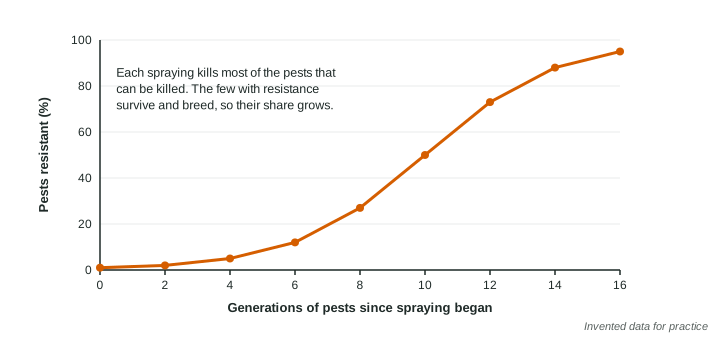
Insects, which can have several generations a year and many offspring, evolve resistance fast. Hundreds of insect species and many weeds are now resistant to at least one pesticide.
A field holds 2,000,000 caterpillars and one spraying kills 98% of them. How many survive?
Setup:
If a farm's insecticide use rises from 1.0 to 3.5 kg per hectare:
The pesticide treadmill
When a pesticide stops working, the easy response is to spray more often, use more, or switch to a new chemical. Each step costs more, kills more nontarget organisms, and starts the selection process over again. Farmers call this the pesticide treadmill: running harder to stay in place. Ways to step off it include rotating pesticides that work in different ways, spraying only when pests reach a damaging level, and protecting the pests' natural enemies, which come together in a later topic of this unit.
Genetically modified crops and pests
Some genetically modified crops make their own insecticide, a protein from a soil bacterium that kills certain caterpillars. Farmers growing them can spray less insecticide. Other GM crops survive a herbicide, so farmers can spray the whole field to kill weeds. Both are selection pressures: caterpillars resistant to the protein and weeds resistant to the herbicide have spread where these crops are grown everywhere with no breaks. Leaving strips of ordinary crops (refuges) and rotating crops slow it down.