In the middle of the twentieth century, many experts expected mass famine as populations grew. Instead, grain harvests in much of the world rose faster than population for decades. This page explains the Green Revolution that made that possible, what it cost, and how genetically modified crops fit the same pattern of benefits and trade-offs.
What changed
Starting in Mexico in the 1940s and spreading to India, Pakistan and much of Asia in the 1960s, plant breeders such as Norman Borlaug developed new varieties of wheat and rice. The key trait was a short, stiff stem. Tall traditional wheat given lots of fertilizer grows heavy heads of grain and falls over; dwarf varieties stay upright, so extra nutrients become extra grain. The Green Revolution combined these seeds with four other inputs:
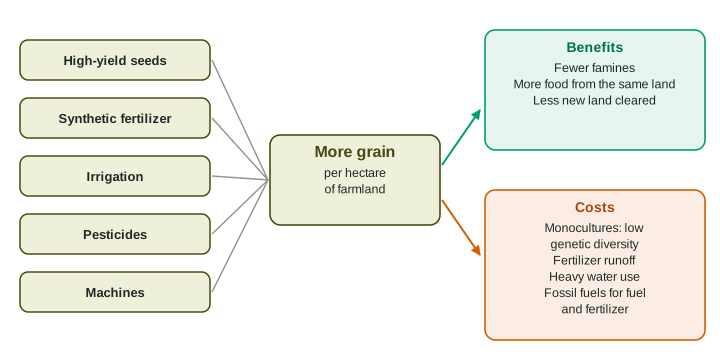
- Synthetic fertilizer, made in factories. Most nitrogen fertilizer starts as ammonia made from nitrogen in the air and hydrogen from natural gas. It supplies the limiting nutrients (nitrogen, phosphorus, potassium) in forms plants take up at once.
- Irrigation, so the thirsty new varieties get water on time.
- Pesticides, to protect fields of identical plants.
- Machines: tractors, harvesters and pumps that run on fossil fuels.
Yields of wheat and rice roughly doubled in the regions that adopted the package.
Benefits and costs
| Benefits | Costs |
|---|---|
| Much more grain per hectare | Monocultures: one variety over huge areas, low genetic diversity, so a single pest or disease can sweep through |
| Fewer famines and cheaper food | Fertilizer the crop does not use runs off or leaches into rivers, lakes and drinking water |
| Less forest and grassland cleared, because the same land feeds more people | Heavy water use; groundwater pumped faster than it refills in some regions |
| Higher incomes for many farmers | Dependence on fossil fuels for fertilizer and machines; costly inputs that put some small farmers in debt; loss of traditional varieties |
When you explain a cost, give every link. Not just "fertilizer pollutes water", but: farmers apply more fertilizer than the crop takes up, rain carries the extra nitrate and phosphate off the field, and they pollute rivers, lakes and wells.
Calculating yields and inputs
A village grows 1.2 metric tons of rice per hectare on 400 hectares, then 3.0 metric tons per hectare after switching varieties. How much more rice does it harvest?
Before:
Percent change in yield:
If the farmer applies 120 kg of nitrogen per hectare to 35 hectares and 30% is not taken up:
Watch for falling returns in data tables. If each added kilogram of fertilizer adds less grain than before, more of it is left unused in the field, and more ends up in water.
Genetically modified crops
A genetically modified organism (GMO) has had its DNA changed in a laboratory, often by adding a gene from another species. Traditional breeding, like Borlaug's, only chooses among plants that already exist. Common GM crops include corn and cotton that make a protein from a soil bacterium that kills certain caterpillars, and crops bred to survive a weed-killing spray. Benefits include higher yields, less spraying for some pests, and added nutrients (golden rice carries a gene for a vitamin A precursor). Concerns include lower crop genetic diversity when a few varieties are planted everywhere, pests and weeds evolving to overcome the trait by natural selection, genes spreading to wild relatives, and seed costs. Major scientific reviews have found the GM foods on the market as safe to eat as their conventional versions.
The pattern to remember: the Green Revolution and GM crops trade higher yields on less land for more inputs and less diversity.