Walk through a rainforest and then through a wheat field. Both are full of life, but one has thousands of kinds of plants, insects and birds, and the other has mostly one plant. Biodiversity is the word for that difference: the variety of life in a place. This page explains the three levels of biodiversity, how to compare the diversity of two communities from data, and why diversity helps populations and ecosystems survive hard times.
Three levels of biodiversity
| Level | What varies | Example |
|---|---|---|
| Genetic diversity | genes among individuals of one population or species | trout in one lake that differ in size, color and how well they handle warm water |
| Species diversity | the kinds of species in a community, and how many of each | a reef with 300 fish species compared with a pond with 6 |
| Habitat diversity | the kinds of habitats in an area | a park with forest, meadow, stream and marsh compared with a park that is all lawn |
The levels build on each other. More habitats offer more niches, so they support more species. Each species, in turn, holds its own genetic variety.
Species diversity: richness and evenness
Species richness is the number of different species. Species evenness is how equal their population sizes are. A community is more diverse when it has more species, when its species are more evenly balanced, or both.
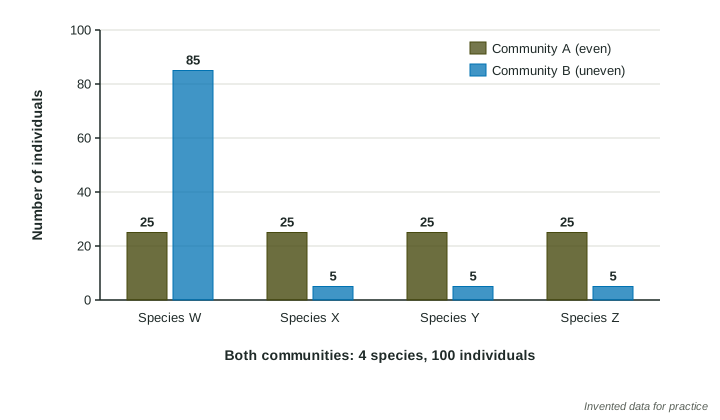
In the figure, both communities have 4 species and 100 individuals. Their richness is equal, so evenness decides. Community A, with 25 of each species, is more diverse than community B, where species W is 85 of the 100 animals.
Worked example. A survey nets 200 animals in a pond, and 185 are pond snails. What percent of the community is the most common species?
Setup: . Answer: .
A single species making up more than 90% of the animals is a sign of very low evenness. Always compare richness first (count the species), then evenness (look at how the totals are split).
Why diversity matters: recovering from stress
A population with high genetic diversity has many different traits. When a new disease, a drought or a change in temperature arrives, some individuals are likely to have traits that let them survive and reproduce, so the population recovers. A population of near-identical individuals tends to respond as one: if one is vulnerable, most are.
The same logic works one level up. In a species-rich, even community, several species often do similar jobs (several pollinators, several decomposers, several grazers). If one species is lost, others can keep the job going. In an uneven community, losing the one dominant species can remove most of the community at once.
Population bottlenecks
A population bottleneck is a sharp drop in population size, from hunting, a disease or a disaster. The few survivors carry only part of the original population's genes. Even when the population grows back, its genetic diversity stays low, because the lost gene variants are gone.
Northern elephant seals are a well-known case. Hunting cut them to perhaps a few dozen animals by the 1890s. With protection they grew back to more than 200,000, but studies of their DNA show far less variety than in seals from before the hunting. Large numbers do not mean high genetic diversity.
Keystone species
A keystone species has an effect on its community much larger than its numbers suggest. Sea otters eat sea urchins, and urchins eat kelp. Where otters disappear, urchins multiply and graze kelp forests down to bare rock, and the fish, crabs and other animals that live in the kelp lose their habitat. Bring the otters back and the kelp, and the community it shelters, return. Many keystone species are predators, but not all: beavers build dams that create ponds and wetlands used by many other species.
On the exam
- When asked which community is more diverse, compare richness, then evenness, and quote the numbers.
- Name the level: genetic (within a population), species (within a community) or habitat (within an area).
- Explain recovery with a full chain: more variety, so some individuals or species survive the stress, so the population or ecosystem recovers.