Living things fit their environments remarkably well: cacti store water, arctic foxes blend into snow, deep-sea fish make their own light. These fits are adaptations, and they come from a process that works on whole populations over many generations: natural selection. This page explains how it works, what it can and cannot do, and why the speed of environmental change matters.
How natural selection works
- Variation. Individuals in a population differ in traits: beak depth, fur color, how well they tolerate heat.
- Inheritance. Many of these traits are passed from parents to offspring in their genes.
- Different survival and reproduction. In a given environment, some traits help individuals survive and reproduce more than others.
- Change over generations. Individuals with helpful traits leave more offspring, so those traits become more common in the next generation, and the next.
An adaptation is a heritable trait that has become common because it helps survival or reproduction in that environment.
A drought on an island
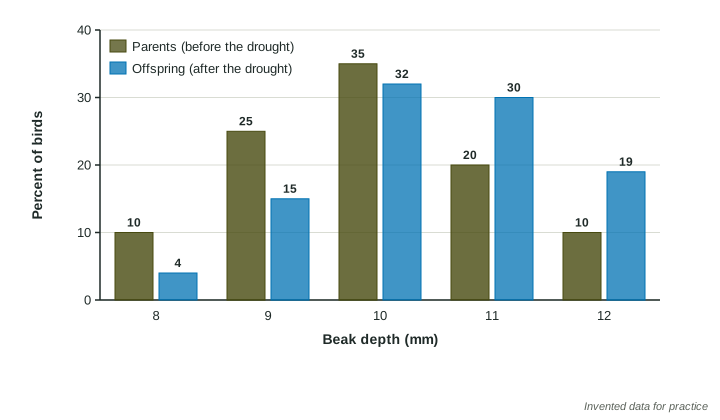
A drought kills the plants that make small, soft seeds, leaving mostly large, hard seeds. Birds with deep beaks can crack them; birds with shallow beaks starve. The survivors are mostly deep-beaked, and they pass their beak depth to their chicks. In the figure, the share of offspring with 11 mm or deeper beaks is higher than among the parents.
Worked example. What percent of the parents, and of the offspring, had beaks 11 mm deep or deeper?
Parents: . Offspring: .
The deep-beaked share rose from 30% to 49% in one generation. No bird's beak grew; the population changed because of which birds survived to breed.
Populations change, individuals do not
This is the most common mistake on the exam. An individual does not adapt to its environment during its life by changing its inherited traits. A finch cannot grow a deeper beak because it needs one, and a moth cannot change its wing color to match the bark. What changes is the population: the share of individuals with each trait, from one generation to the next.
| Natural selection | A change within one life | |
|---|---|---|
| Who changes | the population | one individual |
| Over what time | generations | days to years |
| Passed to offspring? | yes, the trait is inherited | no |
| Example | dark moths become common on sooty bark | a person gets a tan in summer |
When the environment changes
Natural selection follows the environment. In forests near industrial cities, soot from coal smoke darkened tree bark, and birds ate more of the light moths that stood out against it. Dark moths became most of the population. When clean-air laws cut the soot and the bark turned light again, light moths became common again.
Selection needs two things to keep up with change: genetic variety (some individuals with helpful traits) and time (enough generations). A population with little variety, such as one that went through a bottleneck, may have no individuals suited to a new condition. A species that reproduces slowly, such as many corals, large mammals and long-lived trees, has few generations in which to adapt. If the environment changes faster than the population can adapt, the population declines and may die out.
On the exam
- Explain an adaptation with the full sequence: variation, survival and reproduction, inheritance, more common over generations.
- Never write that an individual "adapted" or "evolved" during its life.
- Link speed to risk: fast change plus slow reproduction or low genetic variety means a high risk of decline.