No ecosystem stays the same forever. Rivers flood, rains fail, lightning starts fires, storms flatten forests, and over thousands of years whole climates change. A natural disruption is any natural event that changes an ecosystem. This page sorts disruptions by their timing and their length, and explains how living things respond.
Kinds of natural disruption
- Weather and climate: floods, droughts, hurricanes, tornadoes, heat waves, long shifts in temperature or rainfall.
- Fire: wildfires, often started by lightning.
- Earth events: volcanic eruptions, earthquakes, landslides.
- Living causes: outbreaks of insects or disease that kill many trees or animals.
Timing: periodic, episodic or random
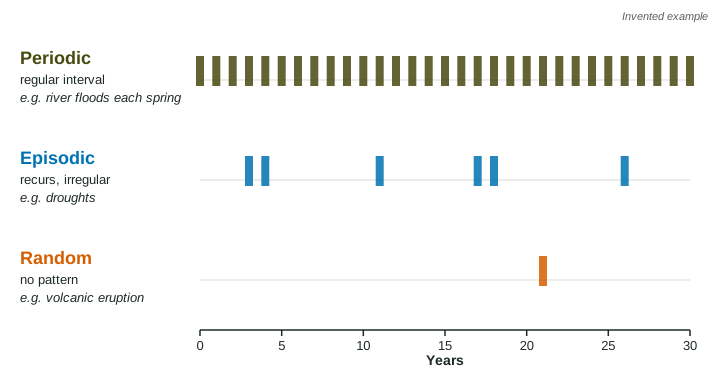
| Timing | Pattern | Examples |
|---|---|---|
| Periodic | regular intervals | spring floods, wet and dry seasons, yearly freezing of a lake |
| Episodic | recurs, but at irregular intervals | droughts, many wildfires, outbreaks of tree-killing insects |
| Random | no pattern | a volcanic eruption, an earthquake |
Timing matters because species can match their lives to regular events. Many floodplain fish breed when the spring flood spreads water over the land. A random event gives no such warning.
Short-term and long-term change
A storm or a fire is short-term: within years or decades, the ecosystem often returns close to its earlier state. Other changes are long-term. Over Earth's history the climate has warmed and cooled many times. During cold periods, huge glaciers covered land and held so much water that sea level fell: about 20,000 years ago it was roughly 120 meters lower than today. As the glaciers melted, the water flowed back into the ocean, which flooded low coasts. Slow changes like these can replace one kind of ecosystem with another, such as a forest turning into a grassland as a region dries.
Worked example. A forest plot had 640 living trees the year before a hurricane and 256 the year after. What was the percent change?
Setup: . The value before the storm is the starting value, and the difference is in brackets.
Answer: . The negative sign means a decrease: the storm removed 60% of the trees. Fifteen years later the plot had 590 trees, so this was a short-term disruption.
How organisms respond
When a disruption pushes conditions outside a species' range of tolerance, its population can:
- Survive in place, if some individuals tolerate the new conditions or find shelter.
- Migrate: move to places that still suit them. Some migrations are seasonal, like wildebeest following the rains or birds flying south for winter; others are permanent shifts as the climate changes.
- Die out locally, if they cannot survive or move.
Some ecosystems even depend on disruption. Spring floods bring nutrient-rich silt to floodplains. Regular fires keep some grasslands open by killing shrub seedlings, while grasses regrow from their roots. When people stop these disruptions, the ecosystem changes.
On the exam
- Classify a disruption by its timing (periodic, episodic, random) and say why, using the pattern of events.
- Read recovery data: compare each year with the starting value and say whether the change was short-term or long-term.
- Explain effects as a chain: the event, the changed conditions, the effect on individuals, the effect on the population.