Look at a map of islands and you can predict which ones hold the most species. Island biogeography is the study of how many species islands support and why. Its two rules are simple, and they now guide how parks and nature reserves are planned, because a patch of forest surrounded by farms behaves a lot like an island in the sea.
Two rules: size and distance
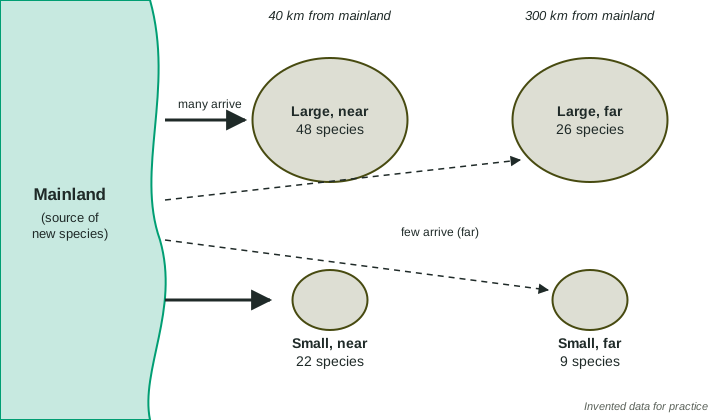
Larger islands hold more species. A large island has more kinds of habitat (beaches, forests, streams, hills) and room for larger populations. A large population is less likely to be wiped out by a storm, a disease or a bad year. So on a large island, fewer species die out.
Islands closer to the mainland hold more species. Species reach islands by flying, swimming, floating on debris or being carried as seeds. The closer the island, the more often new arrivals land. A far island gets few colonists, so species that die out there are rarely replaced.
Put together: the number of species on an island settles where arrivals of new species balance the loss of species already there. Large, near islands settle high; small, far islands settle low.
| Island | New species arrive | Species die out | Species richness |
|---|---|---|---|
| Large and near | often | rarely | highest |
| Small and near | often | often | middle |
| Large and far | rarely | rarely | middle |
| Small and far | rarely | often | lowest |
Reading island data
To see the effect of one variable, compare islands that match on the other. Two islands of the same area at different distances show the effect of distance. Two islands at the same distance with different areas show the effect of area.
Worked example. Island 4 (100 km², 300 km away) has 12 bird species. Island 2 (1,000 km², also 300 km away) has 30. What is the percent change in species from island 4 to island 2?
Setup: . The brackets make sure the subtraction happens first, and island 4 is the starting value.
Answer: . An island ten times larger at the same distance holds 150% more species. Notice that species did not rise tenfold: richness grows much more slowly than area.
Habitat islands and fragmentation
An island does not need water around it. A lake is an island for fish, a mountaintop meadow is an island for meadow plants, and a city park is an island for beetles that need trees. Any patch of suitable habitat surrounded by habitat a species cannot use works the same way.
Habitat fragmentation happens when roads, farms or towns break one large habitat into smaller, separated patches. Each patch then acts like an island. The smallest, most isolated fragments lose species over time, because their populations are small and few individuals can cross the farmland or pavement to replace the ones lost. Keeping fragments large and linking them with strips of habitat, for example forest along a stream, makes them less like small, far islands.
Evolution on islands
Islands are colonized by species that arrive from elsewhere. Over many generations, island populations can evolve into new species found nowhere else. Because islands have limited food and space, many island species come to depend on a narrow set of foods or places. That makes them vulnerable when people bring in species from elsewhere, such as rats, cats or goats, that can live on many foods and outcompete them.
On the exam
- Use both variables in an explanation: distance changes how many species arrive; size changes how many die out.
- When comparing islands in a table, pick pairs that differ in only one variable, and quote the numbers.
- Apply the idea to fragments: "The forest patch acts like a small, isolated island, so it will lose species."