How much of the Earth does it take to support one person? An ecological footprint puts a number on that question. This page explains what a footprint counts, how it differs from a carbon footprint, and how to work the calculations the exam asks for.
What an ecological footprint counts
An ecological footprint is the area of productive land and water needed to supply everything a person or population uses and to absorb its carbon dioxide waste. It adds up:
- cropland for food, animal feed and fibers such as cotton;
- pasture for meat, milk, leather and wool;
- forest for wood and paper;
- fishing grounds for seafood;
- built-up land for homes, roads and factories;
- forest needed to absorb the carbon dioxide from burning fossil fuels.
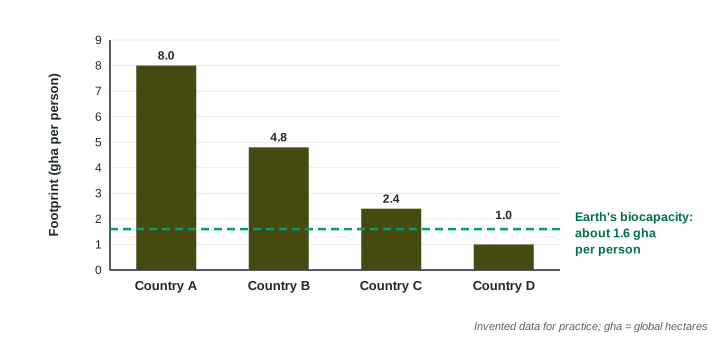
Footprints are given in global hectares (gha), hectares of land with world-average productivity, so different kinds of land can be added together. The world's biocapacity, the productive area actually available, works out to about 1.5 to 1.6 gha per person in recent Global Footprint Network estimates (it slowly shrinks as population grows). The world's average footprint is larger, about 2.6 to 2.7 gha per person, so people use resources about 1.7 to 1.8 times as fast as nature renews them. In wealthy countries the largest single part of the footprint is usually the forest needed to absorb carbon dioxide.
Carbon footprints
A carbon footprint counts only greenhouse emissions, usually in metric tons of carbon dioxide per year. It is a mass, not an area. Driving, home energy, flights and food are the big parts for most people. The two measures are linked: the carbon footprint becomes the "forest to absorb carbon dioxide" part of the ecological footprint.
| Ecological footprint | Carbon footprint | |
|---|---|---|
| Measures | land and water area used | greenhouse emissions |
| Units | global hectares (per person) | kg or metric tons of carbon dioxide (per year) |
| Includes | food, wood, fish, built land, carbon absorption | emissions from energy, travel, food and goods |
Calculations
Per person. A country of 25 million people has a total footprint of 130 million gha. Footprint per person:
Total from per person. A town of 40,000 people at 6.5 gha each:
How many Earths. A footprint of 8.0 gha per person against 1.6 gha of biocapacity per person: Earths if everyone lived that way.
A carbon footprint. 8,000 km of driving at 0.2 kg of carbon dioxide per km:
What makes a footprint large or small
Footprints rise with consumption. Diet matters a great deal, because meat, especially beef, needs far more land per kilogram than grain or beans. Energy use, cars and flights add carbon dioxide. Bigger homes and more goods add land and energy. Footprints per person in the wealthiest countries are often four or more times those in the poorest. A country's total footprint is its footprint per person times its population, so both consumption and population count.
Reducing a footprint works at every scale: a person can eat less meat, drive and fly less, and use less energy; a city can build transit and denser housing; a country can switch to energy sources that release less carbon dioxide.