Fish provide a large share of the animal protein for billions of people. For most of history the ocean seemed too big to empty. Modern fleets proved otherwise: the UN Food and Agriculture Organization estimates that more than a third of the fish stocks it tracks are fished faster than they can recover. This page covers how overfishing happens, why bycatch and trawling matter, and what brings fisheries back.
How a fishery is overfished
A fish stock replaces the fish it loses through reproduction and growth. As long as the catch is smaller than what the stock replaces, the stock holds steady. Overfishing is catching more than that, year after year, so the stock shrinks. It is the tragedy of the commons at sea: each boat keeps the full value of the fish it catches, while the smaller stock is everyone's loss.
Modern technology speeds this up. Sonar and satellite positioning find schools of fish; huge nets and factory ships catch and freeze them at sea. Fishing usually takes the biggest fish first, and large older females lay far more eggs than small ones, so the stock's ability to rebuild drops even faster than its size.
A stock of 800,000 metric tons replaces about 12% of its mass each year. The fleet catches 150,000 metric tons a year. What happens?
Replaced:
Collapse
A fishery collapse is a fall of the stock to a small part of its former size. Northwest Atlantic cod is the classic case. Catches rose with bigger trawlers through the 1960s, fell, were pushed up again in the 1980s, and then the stock crashed. Canada closed the fishery in 1992, about 30,000 people lost their jobs, and the cod have been slow to come back.
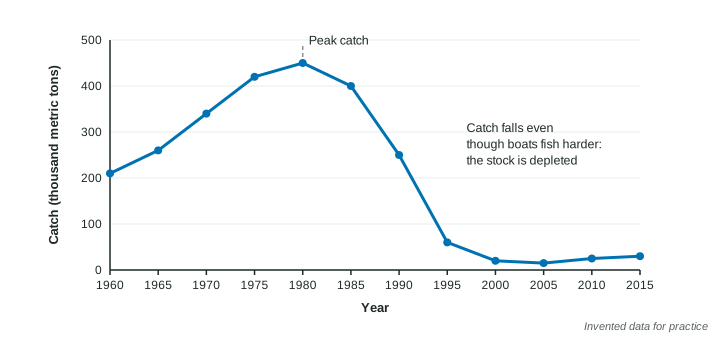
A steady catch can hide a falling stock. If a fleet adds boats or better gear, it can keep catching the same tonnage from fewer fish. Catch per boat, or per day of fishing, falls first. That is why exam data tables often give both the total catch and the effort.
A catch falls from 450 thousand metric tons in 1980 to 20 thousand in 2000. Percent change:
Bycatch and the sea floor
Bycatch is everything caught that was not the target. Shrimp trawls can bring up several kilograms of other animals for every kilogram of shrimp; longlines set for tuna hook sea turtles, sharks and seabirds; drift nets tangle dolphins. Much of the bycatch dies before it is thrown back.
Bottom trawling drags weighted nets across the sea floor, flattening corals, sponges and other structures that shelter young fish. A trawled area can take years to decades to recover.
Removing fish also changes food webs. Taking top predators such as sharks lets their prey increase; taking small forage fish such as anchovies leaves seabirds, seals and larger fish with less to eat.
Bringing fisheries back
| Approach | How it works |
|---|---|
| Catch limits (quotas) | A law caps the yearly catch below what the stock replaces; shares can be assigned to each boat so they do not race. |
| Size limits | Fish below a minimum size are released, so they breed at least once. |
| Closed seasons and areas | No fishing while fish spawn, or where young fish gather. |
| Marine protected areas | No-fishing zones where fish grow large and breed; young and adults spill over into fished waters. |
| Gear rules | Turtle excluder devices, bycatch-reduction devices, bans on bottom trawling over sensitive habitat. |
In the United States, a federal fisheries law requires managers to end overfishing and rebuild overfished stocks, and many stocks have recovered under it. Each of these is a policy: a rule, enforced, that changes what boats gain from catching more.