Soil forms slowly, on the order of a centimeter in a century or more, but a badly farmed field can lose that much in a few years. Sustainable agriculture is the set of practices that keeps farmland productive for generations. This page sorts them by what they do: protect soil from erosion, keep it fertile, and manage water and pests.
Stopping erosion
Soil erodes when water or wind moves faster than the soil can resist. Every erosion control practice either slows the water or wind, or covers the soil.
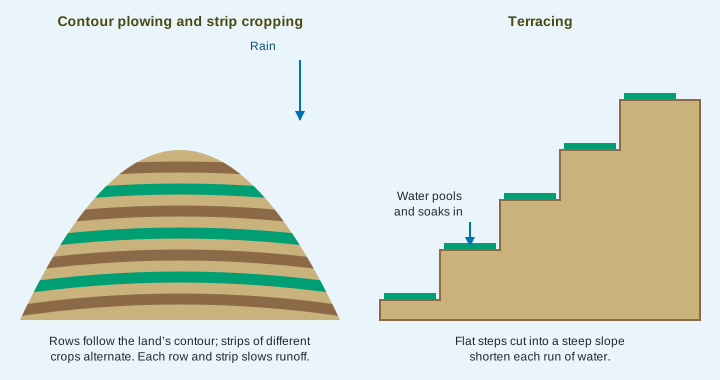
| Practice | What it is | How it protects soil |
|---|---|---|
| Contour plowing | rows run across the slope, along lines of equal height | each furrow holds back water, so it soaks in instead of rushing downhill |
| Strip cropping | strips of a row crop (corn) alternate with a dense crop (hay, clover) | dense strips slow runoff and catch soil washed from the row-crop strips |
| Terracing | a steep slope is cut into flat steps | each step holds water and soil, so water cannot run the whole slope |
| No-till farming | seeds are planted through the last crop's residue without plowing | residue shields soil from rain and wind; more water soaks in; organic matter builds |
| Windbreaks | rows of trees or shrubs along field edges | slow the wind near the ground, so less soil is blown away |
| Perennial and cover crops | plants that live for years, or crops grown between main crops | roots hold soil all year; leaves cover it |
Keeping soil fertile
- Crop rotation: growing different crops in a field from year to year. It breaks the life cycles of pests that feed on one crop, and including legumes such as soybeans or clover adds nitrogen through the bacteria in their root nodules.
- Organic fertilizer: manure, compost and plowed-in green plants. It releases nutrients slowly, so less washes away, and adds organic matter that helps soil hold water and nutrients. Its drawbacks: lower nutrient content per kilogram, so more must be spread, and less precise amounts.
- Liming: spreading crushed limestone to raise the pH of acidic soil, so plants can take up nutrients.
- Rotational grazing keeps pasture covered and lets it recover between grazing.
Comparing practices with numbers
A field plowed up and down a slope loses 20 metric tons of soil per hectare per year; under no-till with contour rows it loses 2. Percent change: .
Corn yield falls from 9.6 to 9.2 metric tons per hectare under strip cropping:
A 40-hectare field that cuts its soil loss from 18 to 3 metric tons per hectare saves
Water and pests
Sustainable farms also use water efficiently, with drip irrigation where it pays, and manage pests with the integrated pest management methods from the previous topic. When you write a solution, match the practice to the problem and the place: terraces for steep slopes, windbreaks for flat windy plains, strip cropping or contour plowing for rolling fields, and say how each one works.