Two fields side by side can behave completely differently. One dries out two days after rain; the other stays soggy for a week. Most of that difference comes from the size of the particles that make up each soil. This page explains soil texture, how to read the soil texture triangle, and how texture controls drainage, water-holding capacity and fertility.
Sand, silt and clay
The mineral part of soil is made of particles of three sizes:
| Particle | Size | Feels like | Behavior |
|---|---|---|---|
| Sand | largest (0.05 to 2 mm) | gritty | large pores; drains fast; holds little water or nutrients |
| Silt | medium (0.002 to 0.05 mm) | smooth, like flour | in between |
| Clay | smallest (under 0.002 mm) | sticky when wet | tiny pores; drains slowly; holds water and nutrients |
Soil texture is the share of each, as percentages that add up to 100%. A soil with 40% sand, 40% silt and 20% clay has a different texture from one with 70% sand, 10% silt and 20% clay, even though both have the same amount of clay.
Reading the soil texture triangle
The soil texture triangle turns three percentages into one named class. Each side is a scale from 0 to 100%: clay on the left side, silt on the right side, sand along the bottom.
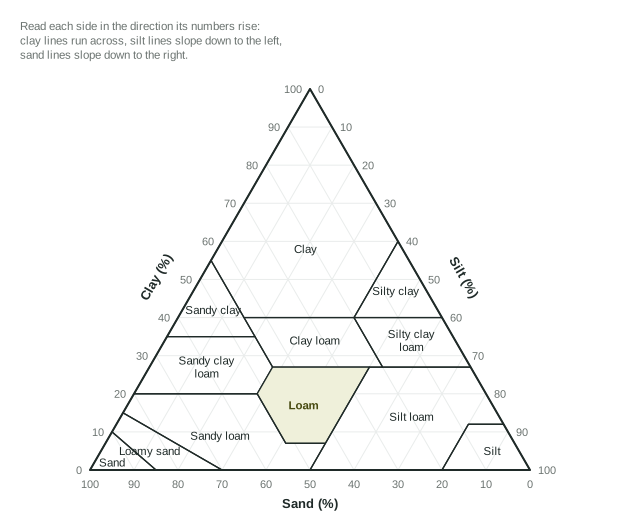
To place a sample, follow its clay percentage straight across, its silt percentage along the lines that slope down to the left, and its sand percentage along the lines that slope down to the right. The three lines meet at one point, and the region that point falls in is the texture class. Because the three add to 100%, you only need two of them; the third is a check.
Worked example. A sample is 40% sand and 40% silt. What is its clay content, and what is its texture class?
Clay is what is left: clay.
Go to 20 on the clay side and follow it straight across. Go to 40 on the silt side and follow its line down to the left. They meet in the shaded region: the soil is a loam. Check: the sand line from 40 passes through the same point.
Loam is the gardener's favorite: a balanced mix of sand, silt and clay (roughly 40%, 40% and 20%) that drains well enough for roots to get air but holds enough water and nutrients for plants.
Porosity, permeability and water-holding capacity
These three words are easy to mix up, and the exam tests the difference.
- Porosity is how much of the soil's volume is pore space, the gaps between particles. Surprisingly, clay often has as much or more total pore space than sand; its pores are just tiny.
- Permeability is how easily water flows through the soil. It depends on pore size and how well the pores connect. Sand, with large connected pores, is highly permeable; clay is not.
- Water-holding capacity is how much water a soil keeps after gravity has drained the rest. Tiny pores and humus cling to water, so clay and soils rich in humus hold the most; sand holds the least.
| Property | Sand | Loam | Clay |
|---|---|---|---|
| Permeability (drainage) | high | medium | low |
| Water-holding capacity | low | medium | high |
| Air for roots | plenty | good | can run short when wet |
| Nutrients held | few | good | many |
These properties matter beyond farms. A septic drain field needs soil permeable enough for wastewater to soak in. Highly permeable soil lets fertilizer and other pollutants reach groundwater quickly. Clay soils can flood at the surface after heavy rain because water cannot soak in fast enough, which increases runoff and erosion.
Soil fertility and pH
Soil fertility is the soil's ability to supply the nutrients plants need, such as nitrogen, phosphorus and potassium. Clay particles and humus hold nutrients on their surfaces, so water does not leach them away as fast. Humus also releases nutrients as it decays. Sandy soil with little humus loses nutrients quickly.
pH measures how acidic or basic the soil water is, on a scale from 0 to 14: 7 is neutral, below 7 is acidic, above 7 is basic. Each step of 1 is a tenfold change. Most crops grow best around pH 6 to 7. In strongly acidic soil some nutrients become hard for roots to take up, and some metals, such as aluminum, dissolve and can harm roots. Farmers add crushed limestone to raise the pH of acidic soil.
Measuring soil properties
Soil scientists test soil in simple ways you could do in class. To compare permeability, pour the same volume of water onto equal columns of different soils and time how long it takes to pass through. To compare water-holding capacity, measure how much water each column keeps. Keep everything the same except the soil (column depth, water volume, temperature), so that any difference can be blamed on the soil itself.
Worked example. Water poured on a 10 cm column of sandy soil comes out the bottom after 2 minutes. What is its percolation rate in cm per hour?
The minutes cancel, leaving cm per hour. A clay column that takes 50 minutes gives
Check yourself
- Which particle is smallest? (Clay.)
- Which soil is most permeable? (Sand.) Which holds the most water? (Clay.)
- A sample is 60% clay and 30% silt. What percent is sand, and what is its class? (10%; clay.)