Every place on land is in a watershed. Wherever you are standing, rain falling at your feet has a path downhill to some stream, river or lake. Knowing that path explains why a factory far upstream can pollute a town's water, why paving a hillside can flood a neighborhood, and why protecting a river means caring for land far from its banks.
What a watershed is
A watershed, also called a drainage basin, is all the land that drains into one body of water. Water flows downhill, so the shape of the land decides which way rain goes. The high ground that separates one watershed from the next is a divide, often a ridge or a line of hills. Rain falling on one side of the divide flows into one watershed; rain on the other side flows into the next.
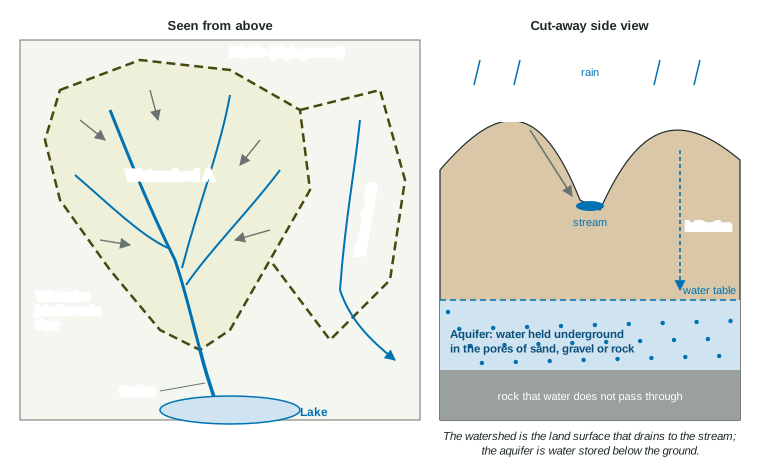
Inside a watershed, small streams called tributaries join to form larger ones, and those join the main river, which leaves the watershed at its outlet. Watersheds nest like boxes: the watershed of a small creek is part of the watershed of the river it joins, and that river's watershed may be part of an enormous basin like the Mississippi's, which drains about 40% of the lower 48 states.
Watershed vs aquifer
These two terms are tested often because students mix them up.
| Watershed | Aquifer | |
|---|---|---|
| What it is | an area of land | underground rock or sediment whose pores hold water |
| Where it is | on the surface | below the water table |
| Water moves by | runoff into streams, rivers and lakes | slow flow through pores toward wells, springs and streams |
| Bounded by | a divide (high ground) | layers of rock that water cannot pass through |
They are connected. Water that infiltrates anywhere in a watershed can soak down to recharge an aquifer, and an aquifer can feed water back into streams, keeping them flowing in dry weather.
What shapes a watershed's water
When rain falls, some soaks in and some runs off. The share that runs off, and how fast, depends on the watershed's features:
- Area. A larger watershed collects more water, so its river carries more.
- Slope. Water runs off steep slopes quickly, with more force to carry soil.
- Soil. Permeable, sandy soil lets water soak in; clay or packed soil sheds it.
- Vegetation. Plants, roots and leaf litter slow water, let it soak in and hold soil in place.
- Land use. Pavement and roofs let almost no water soak in. Plowed fields and construction sites leave bare soil that erodes easily.
More runoff means higher, faster floods after storms, more eroded soil in streams, and more pollutants washed off the land: fertilizer and animal waste from farms, oil and salt from roads, and trash from streets. Less infiltration also means less water recharging the aquifer.
Calculating runoff
The volume of rain falling on a watershed is the rain's depth times the area it falls on. The runoff is the share of that volume that does not soak in.
Worked example. A storm drops 20 mm of rain on a 2 km² watershed. Forty percent of it runs off. What volume of runoff reaches the stream?
Convert so the units match: 20 mm = 0.02 m, and 2 km² = 2,000,000 m².
Setup: .
Answer:
Protecting a watershed
Because everything in a watershed flows downstream, protection works at the scale of the whole watershed:
- Keep forests and wetlands, which slow water, let it soak in and filter it.
- Plant strips of grass and trees along streams, which slow runoff so sediment settles out and roots hold the banks.
- Keep soil covered on farms and building sites so less of it washes away.
- Manage what is applied to land upstream, since fertilizer and chemicals can wash into the water that towns downstream drink.
Many cities protect forests in the watersheds of their water supplies instead of building larger treatment plants, because the forest cleans the water for free.
Check yourself
- What separates two watersheds? (A divide of high ground.)
- Is an aquifer a kind of watershed? (No: an aquifer is underground water storage; a watershed is land.)
- Why does a paved watershed flood faster than a forested one? (Pavement lets little water soak in, so more runs off, faster.)