The atmosphere is a thin shell of gas held to Earth by gravity. If Earth were an apple, the air that matters for weather and life would be thinner than the apple's skin. That thin shell supplies the oxygen and carbon dioxide living things use, carries water around the planet, and shields the surface from harmful light. This page covers what air is made of and its four layers.
What air is made of
| Gas | Share of dry air by volume | Why it matters |
|---|---|---|
| Nitrogen (N2) | about 78% | mostly unreactive; bacteria fix it into forms living things can use (the nitrogen cycle) |
| Oxygen (O2) | about 21% | used in cellular respiration and combustion; made by photosynthesis |
| Argon (Ar) | about 0.9% | an unreactive gas |
| Carbon dioxide (CO2) | about 0.04% (about 420 parts per million) | used in photosynthesis; helps keep Earth warm; rising because of burning fossil fuels |
| Water vapor | about 0% to 4%, varies | forms clouds and precipitation |
Small shares can matter a lot. Carbon dioxide is only about 4 molecules in every 10,000, yet it feeds every food chain through photosynthesis and helps hold heat near the surface. Unit 9 returns to that second role.
Worked example: percent to parts per million. Carbon dioxide is 0.042% of dry air. What is that in parts per million (ppm), molecules per 1,000,000?
A percent is parts per 100, so
A shortcut: 1% is 10,000 ppm, so multiply the percent by 10,000.
Four layers, set by temperature
The layers of the atmosphere are not separated by walls. They are defined by which way temperature changes as you go up.
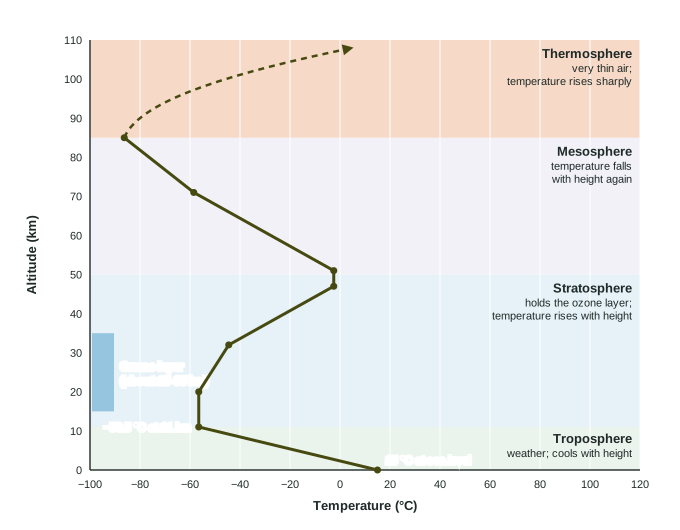
| Layer | Height (about) | Temperature with height | What happens there |
|---|---|---|---|
| Troposphere | 0 to 10-16 km | falls (about 6.5 °C per km) | almost all weather; about 75% of the air's mass; nearly all water vapor |
| Stratosphere | to about 50 km | rises | the ozone layer absorbs ultraviolet light; very dry and calm |
| Mesosphere | to about 85 km | falls; the coldest part of the atmosphere | most meteors burn up here |
| Thermosphere | above about 85 km | rises sharply | very thin air heated by high-energy sunlight; auroras |
The thin outer edge of the thermosphere, where air fades into space, is sometimes called the exosphere.
The troposphere: heated from below
Sunlight passes through the air and warms the ground. The ground then warms the air touching it. So the troposphere is warmest at the bottom. Warm air near the ground rises, and as it rises the pressure on it drops, so it expands and cools. That cooling makes water vapor condense into clouds, which is why weather happens here. The troposphere is about 16 km thick over the equator, where the air is warmest, and about 8 to 10 km thick over the poles.
Worked example: the lapse rate. The standard atmosphere is 15 °C at sea level and −56.5 °C at 11 km. What is the average change in temperature per kilometer?
The negative sign means the air cools by 6.5 °C for each kilometer you climb. Brackets matter: the whole difference is divided by 11.
The stratosphere and the ozone layer
Ozone (O3) is a molecule of three oxygen atoms. About 90% of it is in the stratosphere, most of it about 15 to 35 km up: the ozone layer. Ozone absorbs most of the Sun's ultraviolet (UV) radiation, especially the high-energy UV-B and UV-C. UV light damages DNA, causing skin cancer and cataracts in people, and it harms plants and the plankton at the base of ocean food chains. The energy ozone absorbs warms the stratosphere, so temperature rises with height there.
That warm layer on top of the cooler troposphere acts like a lid: rising air stops climbing once it is no colder than the air around it. This is why even the tallest storm clouds flatten out near the top of the troposphere.
Ozone is the same molecule wherever it is, but where it is changes what it does. High in the stratosphere it protects life. Near the ground, people and plants take it in, and it damages lung tissue and leaves. Unit 7 covers ozone near the ground, and Unit 9 covers how some human-made chemicals thin the ozone layer.
Thinner with height
Gravity holds most air close to the ground. About half of the atmosphere's mass is below 5.5 km, and about 99% is below 30 km. Climbers on Mount Everest (8.8 km) breathe air with the same 21% oxygen as at sea level, but each breath holds only about a third as many molecules.
Check yourself
- Which layer holds the weather? (The troposphere.)
- Why does the stratosphere warm with height? (Ozone absorbs ultraviolet light.)
- Is oxygen the most common gas in air? (No: nitrogen, about 78%.)