Earth's Atmosphere
The atmosphere is about 78% nitrogen and 21% oxygen, layered by how temperature changes with height.
Part 1 · Hook
Why this matters
Part 2 · Prerequisite check
Quick check before you start
1. What do convection currents do?
- Carry warm material up and cool material down
- Turn nitrogen gas into nitrate
- Move plates only at transform boundaries
- Keep the temperature the same everywhere
Show the answer
Warm, less dense material rises; cool, denser material sinks. Air moves this way too.
- Correct: Carry warm material up and cool material down:
- Turn nitrogen gas into nitrate:
- Move plates only at transform boundaries:
- Keep the temperature the same everywhere:
2. Which gas do plants take from the air for photosynthesis?
- Carbon dioxide
- Nitrogen
- Argon
- Oxygen
Show the answer
Photosynthesis uses carbon dioxide and water to make sugar.
- Correct: Carbon dioxide:
- Nitrogen:
- Argon:
- Oxygen:
Part 3 · See it
See it first
Part 4 · Step by step
How it works, step by step
- Sunlight warms the ground, and the ground warms the air above itthe troposphere is warmest at the bottom and cools with height
- Warm air near the ground rises, expands and coolswater vapor condenses into clouds, and weather forms in the troposphere
- Ozone in the stratosphere absorbs ultraviolet lightthe stratosphere warms with height, and most harmful UV never reaches the surface
- Warmer air sits on top of colder air at the bottom of the stratosphererising air stops near the top of the troposphere, so weather stays below about 10 to 16 km
Part 5 · Key ideas
Key ideas
- Dry air is about 78% nitrogen, 21% oxygen and 0.9% argon; carbon dioxide is about 0.04%. Water vapor varies from about 0% to 4%.
- The layers are defined by how temperature changes with height: the troposphere cools upward, the stratosphere warms upward, the mesosphere cools upward, the thermosphere warms upward.
- The troposphere (ground to about 10-16 km, highest over the equator) holds about 75% of the air's mass and nearly all the weather.
- The ozone layer, about 15 to 35 km up in the stratosphere, absorbs most of the Sun's ultraviolet (UV) radiation, which causes skin cancer and cataracts and harms plants and plankton.
- Air gets thinner with height: about half of the air's mass is below 5.5 km.
Part 6 · Misconception
A common mistake
The wrong idea: The higher you go, the colder it gets, all the way up.
What actually happens: Temperature falls with height only in the troposphere and mesosphere. In the stratosphere, ozone absorbing UV light makes it warmer with height, and the thin thermosphere is heated strongly by the Sun.
Part 7 · Check yourself
Check yourself
Exam-style questions. Anything you miss goes into your review queue.
1. In which layer of the atmosphere does almost all weather happen?
- Troposphere
- Stratosphere
- Mesosphere
- Thermosphere
Show the answer
The troposphere, the lowest layer, holds about three quarters of the air's mass and nearly all its water vapor, so clouds, rain and storms form there.
- Correct: Troposphere: Right: weather happens in the troposphere.
- Stratosphere: The stratosphere is dry and stable; it holds the ozone layer.
- Mesosphere: The mesosphere is far above the clouds.
- Thermosphere: The thermosphere is extremely thin air, far above the weather.
2. What does the ozone layer do for life on Earth's surface?
- Absorbs most harmful ultraviolet light
- Traps heat near the ground to warm Earth
- Supplies the oxygen that animals breathe
- Reflects sunlight to keep the surface cool
Show the answer
Ozone in the stratosphere absorbs most UV-B and nearly all UV-C, which would otherwise damage DNA, cause skin cancer and cataracts, and harm plants and plankton.
- Correct: Absorbs most harmful ultraviolet light: Right: the ozone layer filters out most harmful UV radiation.
- Traps heat near the ground to warm Earth: Keeping Earth warm is a different job, done mostly by gases such as water vapor and carbon dioxide in the troposphere.
- Supplies the oxygen that animals breathe: The oxygen animals breathe is O2 made by photosynthesis, not ozone.
- Reflects sunlight to keep the surface cool: Ozone absorbs UV light; it does not act as a mirror for sunlight.
3. Why does air get colder as you climb a mountain?
- The air is heated from the ground, and rising air cools
- Air higher up sits closer to the cold ozone layer
- Mountains block sunlight from reaching their peaks
- Air higher up holds more oxygen, which absorbs heat
Show the answer
Sunlight warms the ground, which warms the air above it. Air that rises meets lower pressure, expands and cools, so the troposphere cools by about 6.5 °C per kilometer on average.
- Correct: The air is heated from the ground, and rising air cools: Right: heating from below plus cooling of rising air makes the troposphere colder with height.
- Air higher up sits closer to the cold ozone layer: The ozone layer is where the air starts to warm, not a cold source.
- Mountains block sunlight from reaching their peaks: Mountain peaks get plenty of sunlight.
- Air higher up holds more oxygen, which absorbs heat: The share of oxygen stays about 21% with height; the air just gets thinner.
Data
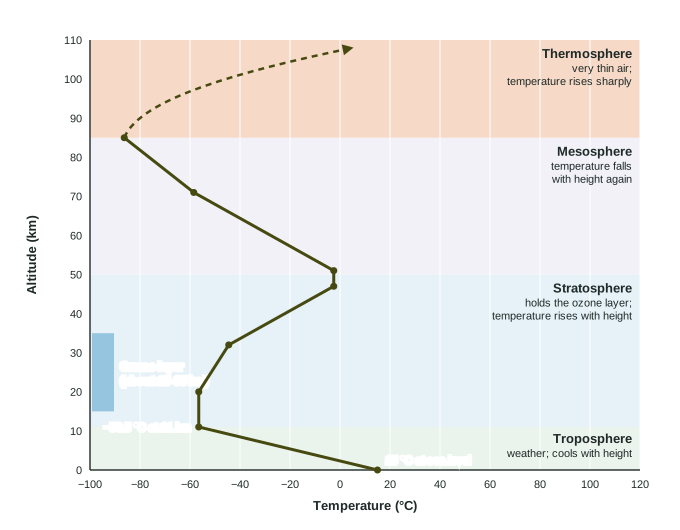
Temperature and altitude in the standard atmosphere
4. According to the graph, how does temperature change from the ground up to about 11 km?
- It falls steadily, from 15 °C to −56.5 °C
- It rises steadily, from 15 °C to −56.5 °C
- It stays the same at about 15 °C
- It falls, then rises, then falls again
Show the answer
The line slopes from 15 °C at 0 km to −56.5 °C at 11 km. This lowest layer, where temperature falls with height, is the troposphere.
- Correct: It falls steadily, from 15 °C to −56.5 °C: Right: temperature falls with height in the troposphere.
- It rises steadily, from 15 °C to −56.5 °C: −56.5 °C is colder than 15 °C, so temperature falls.
- It stays the same at about 15 °C: The line moves left (colder) as altitude rises.
- It falls, then rises, then falls again: That pattern describes the whole graph up to 85 km, not the first 11 km.
5. Use the graph. From 0 km to 11 km the temperature goes from 15 °C to −56.5 °C. What is the average change in temperature per kilometer?
Type a number, then its unit (°C/km). Scale words (2.5 million) and powers of ten (2.5 × 10^6) are read.
Show the answer
- Answer: -6.5 °C/km
6. The graph shows temperature rising from about 20 km to 47 km. Which layer is this, and what causes the warming?
- The stratosphere, where ozone absorbs UV light
- The troposphere, where the ground heats the air
- The mesosphere, where the air is heated by meteors
- The thermosphere, where clouds trap heat
Show the answer
From about 11 to 50 km is the stratosphere. Its ozone absorbs ultraviolet light, so it warms with height.
- Correct: The stratosphere, where ozone absorbs UV light: Right: ozone in the stratosphere absorbs UV and warms the air.
- The troposphere, where the ground heats the air: The troposphere ends near 11 km and cools with height.
- The mesosphere, where the air is heated by meteors: The mesosphere, above 50 km, cools with height.
- The thermosphere, where clouds trap heat: The thermosphere starts at about 85 km, at the very top of this graph, and it has no clouds.
Part 8 · Summary
Summary
Part 9 · Up next
What comes next
Part 10 · Connections