Wind looks random from day to day, but averaged over a year, Earth's winds follow a steady pattern. That pattern carries heat from the tropics toward the poles, decides which places are wet and which are dry, and explains why rainforests and deserts sit in bands around the globe. This page builds the pattern from two ideas: uneven heating and Earth's rotation.
Step 1: uneven heating makes air rise and sink
Sunlight hits the equator most directly, so the equator heats up most. Air touching the warm ground warms, expands and becomes less dense, so it rises. You met this pattern as convection in the mantle; the air does the same thing.
As the warm, moist air rises, it cools. Cool air cannot hold as much water vapor, so the vapor condenses into clouds and falls as heavy rain. That is why the equator is so wet, and why tropical rainforests grow there.
The air, now dry, spreads toward the poles high in the troposphere. By about 30° N and 30° S it has cooled and piled up, so it sinks. Sinking air is squeezed by the air above it and warms. Warm air can hold more water vapor, so clouds evaporate instead of forming. That is why many of the world's great deserts, such as the Sahara, the Arabian Desert and the Australian deserts, lie near 30°.
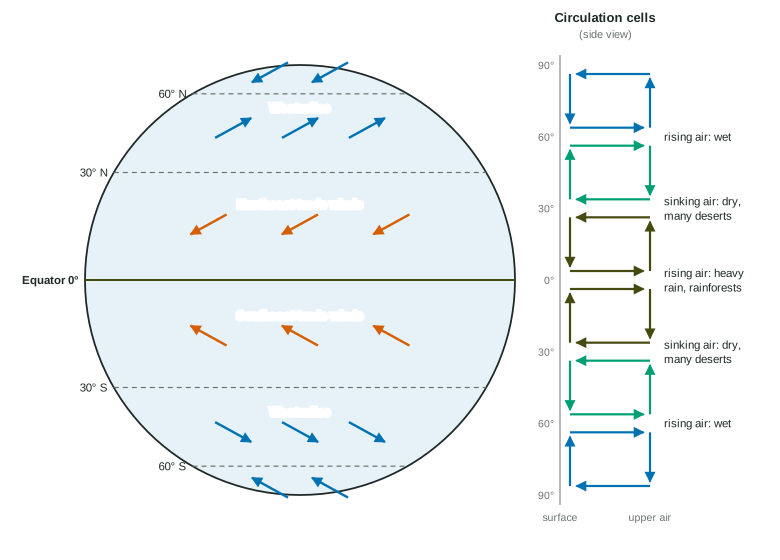
At the surface, the sunken air flows back toward the equator, closing the loop. This loop is the Hadley cell. Two more cells sit beyond it in each hemisphere:
| Cell | Latitudes | Air rises at | Air sinks at |
|---|---|---|---|
| Hadley cell | 0° to about 30° | the equator (wet) | about 30° (dry) |
| Ferrel cell | about 30° to 60° | about 60° (wet) | about 30° (dry) |
| Polar cell | about 60° to 90° | about 60° (wet) | the poles (dry, cold desert) |
The rule to remember: rising air means rain; sinking air means dry.
Step 2: Earth's rotation bends the winds
If Earth did not spin, the surface winds would blow straight north or south. But Earth rotates toward the east, and the ground at the equator moves much faster than the ground near the poles. Air moving across the surface is deflected sideways: to the right in the Northern Hemisphere and to the left in the Southern Hemisphere. This is the Coriolis effect.
So air flowing toward the equator from 30° N is turned to the right and comes from the northeast. Air flowing poleward from 30° N is turned to the right and comes from the southwest, then the west.
The three wind belts
Winds are named for the direction they come from. A westerly blows from the west toward the east.
| Wind belt | Latitudes | Blows from | An effect you can see |
|---|---|---|---|
| Trade winds | 0° to 30° | the northeast (north) and southeast (south) | carried sailing ships west across the Atlantic; push warm surface water west across the Pacific |
| Westerlies | 30° to 60° | the west (southwest in the north) | weather, smoke and storms in the United States usually move from west to east |
| Polar easterlies | 60° to 90° | the east | cold, dry air flowing off the poles |
Where the trade winds from both hemispheres meet near the equator, the winds are often light and the air rises in towering storms. Where the westerlies meet the polar easterlies near 60°, the air is pushed up and storms form; this is why places like the Pacific Northwest and northern Europe get frequent rain.
Reading wind data
A graph of yearly precipitation against latitude has a recognizable shape: a peak at the equator, a low near 30°, a second peak near 40-60° and a low near the poles. When you see it, match the peaks to rising air and the lows to sinking air.
Worked example. A band near the equator gets 2,400 mm of rain a year; a band near 25° N gets 300 mm. How many times more rain falls near the equator?
Divide the larger by the smaller: times.
The millimeters cancel, so "times" has no unit. Subtracting would tell you how many more millimeters (2,100 mm), which answers a different question.
Why it matters
- Biomes. Wet bands host rainforests and temperate forests; dry bands host deserts. The terrestrial biomes you studied in Unit 1 line up with the wind belts.
- Heat transport. The cells carry heat from the tropics toward the poles, so the equator is not as hot, and the poles not as cold, as they would be otherwise.
- Pollution and dust. Prevailing winds carry air pollution, smoke and dust far downwind, so a problem made in one place can land in another.
Check yourself
- Where does air sink, and what kind of climate does that make? (Near 30° and the poles; dry.)
- Which way does the Coriolis effect turn air in the Northern Hemisphere? (To the right.)
- Which way do the westerlies blow? (From the west toward the east.)