Soil is not just dirt. It is a mix of broken-down rock, decayed living things, water, air and billions of organisms, and it is the base of almost every land ecosystem and every farm. This page explains how soil forms, how it sorts itself into layers, and how wind and water carry it away.
Where soil comes from
Soil starts with parent material: the rock or sediment it forms from. Parent material can be the bedrock right under the soil, or sediment that rivers, glaciers or wind carried in and dropped. Weathering breaks the parent material into smaller and smaller mineral particles. Physical weathering cracks rock apart (water freezing in cracks, roots growing into them); chemical weathering changes the minerals themselves (rainwater, slightly acidic, slowly dissolves some of them).
The second ingredient is organic matter. Leaves, roots and dead animals fall onto the ground, and decomposers break them down. What is left is humus: dark, crumbly organic matter that holds water and slowly releases nutrients. Worms, insects and burrowing animals mix the humus into the mineral particles.
Five things control how fast soil forms and what it is like:
- Climate. Warmth and water speed up both weathering and decomposition. Soil forms fastest in warm, wet places and slowest in cold or dry ones.
- Organisms. Plants add organic matter; decomposers and burrowing animals turn it into humus and mix it in.
- Topography (the shape of the land). Steep slopes lose soil downhill; flat valleys collect it.
- Parent material. It sets which minerals the soil starts with.
- Time. A few centimeters of soil can take centuries to form.
Horizons: the layers of a soil profile
Dig a deep hole and look at its side, a soil profile, and you see layers called soil horizons. They form because organic matter is added from the top while rock weathers from the bottom, and because water soaking down carries material with it.
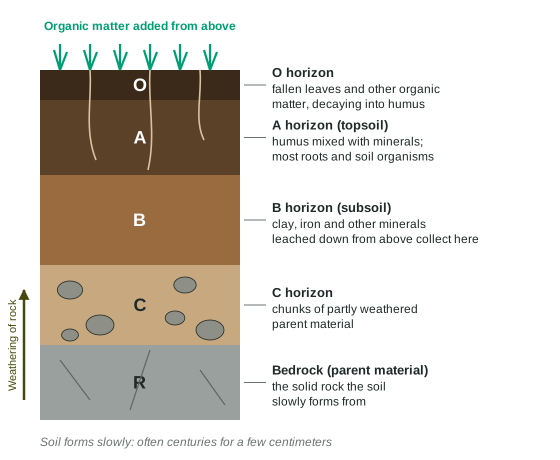
| Horizon | What it is | What to remember |
|---|---|---|
| O | fallen leaves and organic matter, partly decayed | the source of humus |
| A (topsoil) | humus mixed with mineral particles | dark, fertile; most roots and soil organisms; the layer erosion removes first |
| B (subsoil) | minerals and clay carried down from above | where leaching deposits iron, clay and other minerals |
| C | partly weathered parent material | chunks of rock, little humus |
| R | bedrock | the parent material itself |
Leaching, which you met in the nitrogen cycle, is water dissolving substances as it soaks down. In soil it moves minerals and fine clay out of the upper layers and into the B horizon.
Erosion: soil on the move
Erosion is the removal and transport of soil (or rock) by wind, water or ice. Erosion is natural: rivers have always carried sediment. The problem is speed. When people remove the plants that cover soil, erosion can run tens or hundreds of times faster than soil forms.
Plants protect soil in two ways. Their roots bind soil particles together, and their leaves and stalks shield the surface from raindrops and slow the wind at the ground. So anything that leaves soil bare speeds up erosion: plowing, clearing forests, too many grazing animals, building sites and fires.
- Water erosion. Raindrops knock particles loose, and runoff carries them downhill. It is worst on steep, bare slopes during heavy rain.
- Wind erosion. Wind lifts dry, loose particles. It is worst on flat, dry, bare land: the Dust Bowl of the 1930s on the southern Great Plains is the classic example.
Why erosion matters
Erosion causes harm in two places:
- Where the soil leaves. Topsoil, the most fertile layer, goes first. What is left is subsoil with less humus, fewer nutrients and less ability to hold water, so crops grow poorly.
- Where the soil goes. Eroded soil becomes sediment in streams and lakes. It makes water cloudy, so less sunlight reaches underwater plants; it buries the gravel where fish lay eggs; and it carries fertilizer and pesticides with it.
The fixes all work the same way: keep the soil covered and slow down the wind and water. Leaving crop stalks on a field, planting trees along streams and keeping grass on steep slopes all help. Later topics on farming and land use look at these methods in detail.
Comparing soil loss with a percent change
Erosion studies often compare how much soil is lost before and after a change. The percent change says how big the change is compared with where you started.
Worked example. A field lost 8.0 metric tons of soil per hectare each year. After the farmer planted grass on its steepest part, it lost 2.0 metric tons per hectare. What is the percent change in soil lost?
Setup, with the difference in brackets and the old value on the bottom: .
Answer: . The soil loss fell by 75%.
The negative sign means a decrease. Dividing by 2.0, the new value, would give −300%, a common slip.
Check yourself
- What are the two main ingredients of soil? (Weathered parent material and humus.)
- Which horizon is topsoil, and why is it lost first? (The A horizon; it is on top.)
- Why does a plowed, bare field erode faster than a grassy one? (No roots hold the soil and nothing shields it from rain and wind.)