Watersheds
A watershed is all the land that drains into one stream, river or lake, bounded by high ground called a divide.
Part 1 · Hook
Why this matters
Part 2 · Before you start
What this builds on
Part 3 · Prerequisite check
Quick check before you start
1. What is the difference between runoff and infiltration?
- Runoff flows over the surface; infiltration soaks into the ground
- Runoff soaks into the ground; infiltration flows over the surface
- Both mean water evaporating from the ground
- Both mean water taken up by plant roots
Show the answer
Runoff moves over the land toward streams; infiltration moves water down into soil.
- Correct: Runoff flows over the surface; infiltration soaks into the ground:
- Runoff soaks into the ground; infiltration flows over the surface:
- Both mean water evaporating from the ground:
- Both mean water taken up by plant roots:
2. What is an aquifer?
- Underground rock or sediment that stores groundwater
- A river and the streams that feed it
- A lake made by a dam
- Clouds that drop rain
Show the answer
An aquifer is an underground layer whose pores hold water.
- Correct: Underground rock or sediment that stores groundwater:
- A river and the streams that feed it:
- A lake made by a dam:
- Clouds that drop rain:
3. Why does a bare, plowed field erode faster than a grassy one?
- No roots hold the soil and nothing shields it
- Grass makes the soil lighter
- Plowing adds humus
- Bare soil has more organic matter
Show the answer
Roots bind soil and plant cover shields it from rain and wind.
- Correct: No roots hold the soil and nothing shields it:
- Grass makes the soil lighter:
- Plowing adds humus:
- Bare soil has more organic matter:
Part 4 · See it
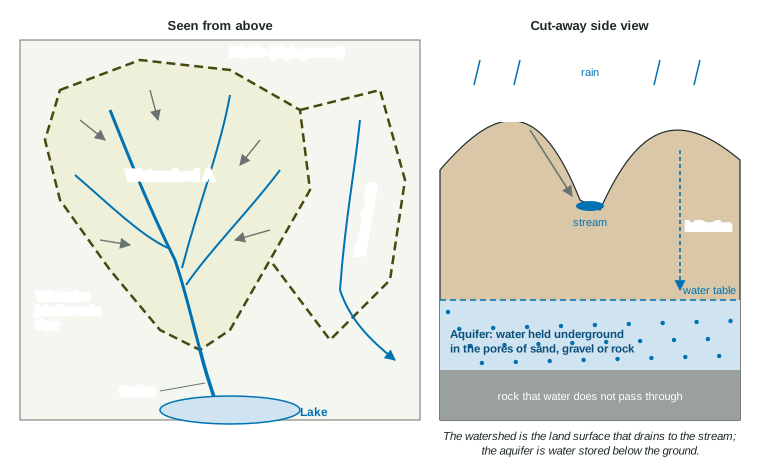
See it first
Part 5 · Step by step
How it works, step by step
- Rain falls anywhere inside a watershed's divideit runs downhill toward the same stream, river or lake, or soaks in
- Steep slopes, bare soil and pavement let less water soak inmore water runs off, faster, carrying soil and pollutants with it
- Runoff collects in tributaries that join the main riverwhat enters anywhere upstream can reach every community downstream
- Forests, wetlands and plant cover slow water and let it soak infloods are smaller, streams are cleaner and aquifers are recharged
Part 6 · Key ideas
Key ideas
- A watershed (drainage basin) is all the land that drains into one body of water. High ground called a divide separates one watershed from the next.
- Small watersheds nest inside larger ones: a creek's watershed is part of a river's, which is part of a larger basin.
- Its area, slope, soil, vegetation and land use shape how much rain runs off, how fast, and how much soil and pollution the water carries.
- A watershed is land that drains to surface water; an aquifer is water stored underground in rock and sediment. Water soaking in across a watershed can recharge an aquifer.
- Protecting a stream means protecting its whole watershed, because water from all of it ends up there.
Part 7 · Misconception
A common mistake
The wrong idea: A watershed is the body of water, such as a lake or an underground aquifer, that collects water.
What actually happens: A watershed is the land that drains into a body of water. An aquifer is something else: groundwater stored underground. The exam often tests this difference.
Part 8 · Check yourself
Check yourself
Exam-style questions. Anything you miss goes into your review queue.
1. What is a watershed?
- The land that drains into one stream, river or lake
- A layer of rock and sediment that stores groundwater
- A dam built to hold water for a city
- The point where a river reaches the ocean
Show the answer
A watershed (drainage basin) is an area of land: every drop that falls inside its divide runs off or flows underground toward the same body of water.
- Correct: The land that drains into one stream, river or lake: Right: a watershed is the land that drains to one body of water.
- A layer of rock and sediment that stores groundwater: Water stored underground in rock and sediment is an aquifer, not a watershed.
- A dam built to hold water for a city: A dam holds water, but a watershed is the land around it that drains in.
- The point where a river reaches the ocean: That is the river's mouth; the watershed is all the land upstream that drains to it.
2. Two watersheds get the same storm. One is mostly forest and the other is mostly pavement and rooftops. Which statement best describes the difference?
- The paved one has more runoff and higher floods
- The forested one has more runoff, as trees block infiltration
- Both have equal runoff, because they got the same rain
- The paved one has more infiltration into groundwater
Show the answer
Forest soils, leaf litter and roots let rain soak in and slow its flow. Pavement and roofs shed water, so more runs off and reaches streams quickly, raising flood peaks.
- Correct: The paved one has more runoff and higher floods: Right: pavement turns rain into fast runoff.
- The forested one has more runoff, as trees block infiltration: Tree roots and leaf litter help water soak in, not block it.
- Both have equal runoff, because they got the same rain: The same rain can produce very different runoff depending on land cover.
- The paved one has more infiltration into groundwater: Pavement blocks infiltration, so less water recharges groundwater.
3. A news report says a city "draws its water from the Ogallala Aquifer, in the Platte River watershed." What is the difference between the two terms?
- A watershed is land draining to a river; an aquifer stores water underground
- An aquifer is land draining to a river; a watershed stores water underground
- Both mean the same thing: an area of land that collects rainwater
- The aquifer is the river's main channel; the watershed is the tributaries
Show the answer
A watershed is defined by the land surface and where it drains. An aquifer is underground: a layer of sand, gravel or rock whose pores hold groundwater. One region can contain both.
- Correct: A watershed is land draining to a river; an aquifer stores water underground: Right: a watershed is surface land; an aquifer is underground water storage.
- An aquifer is land draining to a river; a watershed stores water underground: This swaps the two definitions.
- Both mean the same thing: an area of land that collects rainwater: They are different: one is land surface, the other underground storage.
- The aquifer is the river's main channel; the watershed is the tributaries: An aquifer is underground, not a river channel.
Model or diagram
A watershed seen from above and in a cut-away view
4. In the map view, rain falls just outside the dashed divide of watershed A, on the side toward watershed B. Where does that water go?
- Into the streams of watershed B
- Into the lake at the outlet of watershed A
- Straight into the aquifer under watershed A
- It stays where it fell
Show the answer
The divide is the high ground. Rain on the far side runs downhill away from watershed A and into watershed B.
- Correct: Into the streams of watershed B: Right: water on the far side of the divide drains to watershed B.
- Into the lake at the outlet of watershed A: Only rain inside the divide drains to watershed A's lake.
- Straight into the aquifer under watershed A: Water first runs downhill on the surface; the divide decides which watershed it joins.
- It stays where it fell: Water on a slope moves downhill as runoff or infiltration.
5. In the cut-away view, what happens to rain that does not run off into the stream?
- It soaks in and can recharge the aquifer
- It flows over the divide into the next watershed
- It is held on the land surface as runoff
- It moves up into the stream through the bedrock
Show the answer
Water that soaks in moves down through soil until it reaches the water table, refilling the aquifer.
- Correct: It soaks in and can recharge the aquifer: Right: infiltration recharges the aquifer.
- It flows over the divide into the next watershed: Water soaking in moves down, not over the divide.
- It is held on the land surface as runoff: Runoff is water moving over the surface, the water that did not soak in.
- It moves up into the stream through the bedrock: The rock at the bottom of the diagram does not let water pass.
6. A county wants to protect both its stream and its well water. Using the diagram, why should it protect land across the whole watershed, not just the stream banks?
- Water from across the watershed reaches the stream and the aquifer
- Land along the banks is the main source of the stream's water
- The aquifer is refilled by the ocean, not by the land above it
- Protecting the banks would keep rain from reaching the stream
Show the answer
Rain falling anywhere inside the divide either runs off to the stream or soaks down toward the aquifer, carrying whatever is on the land with it.
- Correct: Water from across the watershed reaches the stream and the aquifer: Right: the whole watershed feeds both the stream and the aquifer.
- Land along the banks is the main source of the stream's water: All the land inside the divide drains to the stream, not just the banks.
- The aquifer is refilled by the ocean, not by the land above it: The diagram shows infiltration from the land surface recharging the aquifer.
- Protecting the banks would keep rain from reaching the stream: Rain still reaches the stream as runoff from the rest of the watershed.
Part 9 · Summary
Summary
Part 10 · Up next
What comes next
Part 11 · Connections