People eat about 350 million metric tons of meat a year, and the amount keeps rising as incomes rise. How that meat is produced changes how much land, water and feed it takes, and what happens to the manure. This page compares the two main methods, explains overgrazing and desertification, and shows why eating lower on the food chain uses less of everything.
Feedlots and pastures
A concentrated animal feeding operation (CAFO, or feedlot) keeps thousands of cattle, hogs or chickens close together and brings feed to them. Animals gain weight fast on corn and soybeans, so meat is cheap, and the facility itself needs little land.
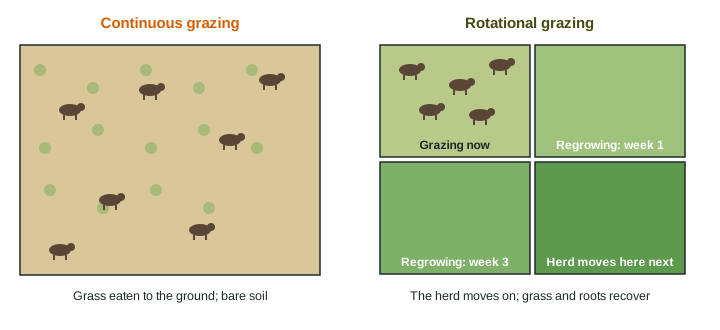
In free-range grazing, animals roam large areas of pasture or rangeland and eat grass. In rotational grazing, the land is fenced into paddocks and the herd is moved from one to the next, so each paddock rests and regrows.
| CAFO (feedlot) | Free-range or rotational grazing | |
|---|---|---|
| Land on site | small | large |
| Feed | grain grown on cropland elsewhere, with its fertilizer, water and fuel | grass and other plants on the pasture |
| Manure | concentrated in lagoons or piles; can leak or wash into water | spread over the land, where it fertilizes the grass |
| Antibiotics | used heavily to prevent disease in crowded animals; resistant bacteria can evolve | used less |
| Cost of meat | low | higher |
| Risk to the land | water pollution near the site | overgrazing if too many animals stay too long |
Overgrazing and desertification
Overgrazing happens when more animals graze land than its plants can support, so grass is eaten faster than it regrows. Roots die, hooves pack the bare soil, rain runs off instead of soaking in, and wind and water erode the topsoil. It is the tragedy of the commons on rangeland: each rancher gains from one more animal, and everyone shares the damaged land.
In dry regions overgrazing can lead to desertification: land loses its plant cover and soil, holds little water, and becomes far less productive, behaving more like a desert. The Sahel, the dry belt south of the Sahara, has lost productive land this way, along with drought, firewood cutting and poor farming. Rotational grazing, fewer animals per hectare, and resting damaged land help plants recover.
Why meat takes so much feed
Meat animals are consumers, one trophic level above the plants they eat. Most of the energy in their feed is used for moving, staying warm and other life processes, and lost as heat, so only a small fraction becomes meat. That is why it takes several kilograms of feed to make one kilogram of meat, and why beef, from large animals that live a long time before slaughter, takes the most. Cattle and other cud-chewing animals also release methane as they digest grass.
A feedlot steer needs about 8 kg of feed for each kilogram of weight it gains. How much feed does it eat to gain 250 kg?
Setup:
A family switches from 60 kg of beef a year (40 m² of land per kg) to 60 kg of chicken (8 m² per kg). Land saved:
Solutions at different scales: a person can eat less beef or more plant protein; a rancher can rotate paddocks; a government can set limits on animals per hectare on public land, or require feedlots to store and treat manure so it cannot reach rivers.
Reading a passage about grazing
On the exam, a text set gives you a short argument. Find the author's claim (what they want), the evidence they give, the assumptions the argument depends on, and the author's perspective. A rancher writing about grazing limits may have good evidence from their own land, and also an interest in keeping their herd; your job is to see what the evidence does and does not show.