When a city replaces fields and forests with roofs and pavement, rain that used to soak in runs off, causing floods, dirty streams and low groundwater. This page covers the ways cities can turn that around by letting rain soak in, or be held and released slowly, close to where it falls.
The idea: slow it, spread it, soak it in
Old-style storm water systems collect runoff in pipes and send it to the nearest stream as fast as possible. That moves the problem downstream: the flood peak arrives faster and higher, and in cities where storm drains share pipes with sewers, heavy rain overflows the pipes and sends untreated sewage into rivers. The newer approach, often called green infrastructure, keeps rain where it falls.
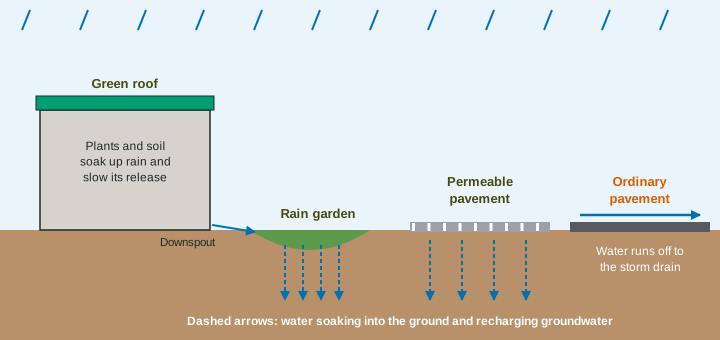
The main methods
| Method | How it works | Drawbacks |
|---|---|---|
| Permeable pavement | gaps between pavers or pores in porous asphalt or concrete let rain drain into a gravel bed and the soil | costs more; pores clog with sediment unless vacuumed; not for heavy truck traffic |
| Rain gardens and swales | shallow planted basins or ditches collect runoff from roofs and streets; deep roots and soil soak it in and trap sediment | need space and some upkeep |
| Green roofs | soil and plants on a roof hold rain and release it slowly; they also cool the building and the air | cost more; the roof must carry the weight |
| Rain barrels and cisterns | store roof water to use later for gardens or toilets | small; must be emptied between storms |
| Trees and parks | leaves catch rain; roots and soil soak it in | take land and time to grow |
| Building up and public transit | more people on less land; fewer roads and parking lots | need planning and investment |
Calculating runoff and savings
How much rain falls on a 120-m² roof in a 15-mm storm?
Change millimeters to meters: 15 mm = 0.015 m. Volume: . In liters:
A test lot of ordinary asphalt sheds 27 m³ in a storm; a lot of permeable pavers sheds 6 m³. Percent change: .
Cost: pavers at 90 dollars per m² against asphalt at 40 dollars per m², for 1,000 m²:
Choosing among methods
No single method fits every place. Dense downtowns with little open ground lean on green roofs and permeable sidewalks; neighborhoods with yards can add rain gardens and rain barrels; new developments can be planned with fewer, narrower streets and more trees. Comparing methods by the runoff they cut for each dollar spent helps a city choose.
Writing a solution the exam will score
Readers give credit for a solution that fits the scenario's scale and says how it works. "Use green infrastructure" earns nothing. "Replace the school's asphalt parking lot with permeable pavers, which let rain drain through into the gravel and soil below, so less water runs onto the street" earns the point: it names a specific method, the place it goes, and the mechanism. If the question asks for a policy, give a rule: "a city ordinance requiring new parking lots over 1,000 m² to use permeable pavement or drain to a rain garden."