Wood is one of the most useful things people take from forests: lumber for houses, pulp for paper, fuel for heat. How the trees are cut matters as much as how many are cut. This page covers the cheapest way to harvest a forest, clearcutting, what it does to soil, water and wildlife, and how it differs from deforestation.
What clearcutting is
Clearcutting means cutting down all, or nearly all, of the trees in an area in one harvest. Logging companies use it because it is fast and cheap: the machines move through once, every log goes to the mill, and there is no need to work around standing trees. Some tree species that need full sunlight to grow from seed, such as many pines, regrow well on a clearcut, much as they do after a natural fire or windstorm.
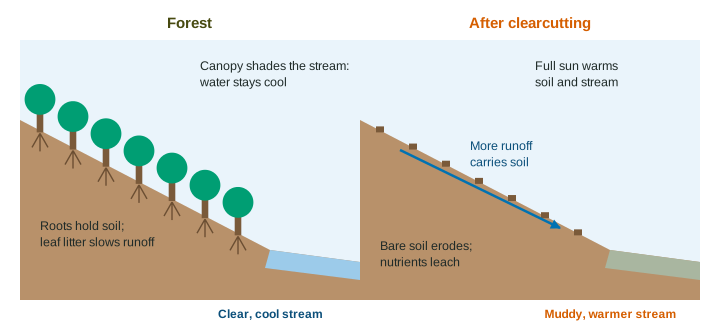
What happens to the soil and the stream
A forest protects its own soil. Roots bind the soil together, leaf litter on the ground soaks up rain and slows it down, and the canopy breaks the force of falling drops. Take all of that away at once and several things follow:
- Erosion. Rain lands on bare soil and runs off instead of soaking in. The runoff carries soil downhill and into streams as sediment.
- Sediment in streams. Muddy water blocks light to algae and water plants, and settling mud smothers the gravel where trout and salmon lay their eggs.
- Warmer water. Without shade, sunlight heats the stream. Warm water holds less dissolved oxygen, so cold-water fish decline.
- Nutrient loss. Living roots take up nitrate. With the trees dead, nitrate leaches out of the soil into the stream, where it is a pollutant and the soil is left poorer.
- Faster runoff and flooding. Water that once soaked in reaches the stream all at once, so floods downstream can be higher.
- Lost habitat. Animals that need mature forest, such as some owls and woodpeckers, lose their homes until the forest grows back, which takes decades.
A famous experiment at Hubbard Brook in New Hampshire in the 1960s cut all the trees in one small watershed, kept new plants from growing for a few years, and compared its stream with streams in uncut watersheds. The stream from the cut watershed carried more water and many times more nitrate.
Reading data from a clearcut
Exam questions often give measurements from a forested stream and a clearcut one. Read the change with numbers and units, then explain it with a complete chain.
A forested watershed loses 40 kg of soil per hectare per year; after clearcutting it loses 260 kg per hectare per year. What is the percent change?
Setup:
Now explain the trout. A full chain: the trees that shaded the stream are gone, so the water warms from 13 to 18 °C, so it holds less dissolved oxygen, so trout, which need cold water rich in oxygen, decline. Each "so" is one link; a reader wants every link, not just "clearcutting killed the trout".
Carbon and climate
Trees store carbon, not carbon dioxide: photosynthesis turns carbon dioxide from the air into the carbon compounds of wood, leaves and roots. A forest is a carbon sink. When it is clearcut, the slash left behind decays or is burned, and that carbon returns to the air as carbon dioxide. Wood made into lumber keeps its carbon for years, but the cleared land takes up little carbon until new trees grow.
A forest stores about 150 metric tons of carbon per hectare. How much carbon is on 250 hectares?
Setup:
Clearcutting and deforestation
Deforestation is the lasting loss of a forest: the land becomes something else, such as cattle pasture, cropland, a mine or a town. A clearcut that is allowed to regrow is not deforestation, although it changes the forest for decades. The difference is what happens next.
| Clearcut that regrows | Deforestation | |
|---|---|---|
| Land afterward | young forest, then mature forest over decades | pasture, cropland, mines or buildings |
| Carbon | released at first, taken up again as trees regrow | released and not taken up again |
| Habitat | changes from mature to young forest | forest habitat lost |
Ways to harvest wood with less harm come later in this unit; for now, be able to name the cost of clearcutting, explain each one with its full chain, and weigh it against the low cost of the timber.