In 1950 about 30% of the world's people lived in cities. Today more than half do, and the UN expects about two thirds by 2050. Urbanization is the growth of cities and the movement of people into them. Cities can be efficient places to live, but they change how water moves, how warm the land is, and how much land is covered. This page covers those changes.
Impervious surfaces and runoff
An impervious surface is one water cannot soak through: roofs, roads, sidewalks, parking lots and packed ground. In a forest or meadow, about half of the yearly rain soaks in, and much of the rest is returned to the air by evaporation and transpiration. In a city center, more than half can run off. Storm drains and pipes then carry that runoff straight to the nearest stream.
Three things follow:
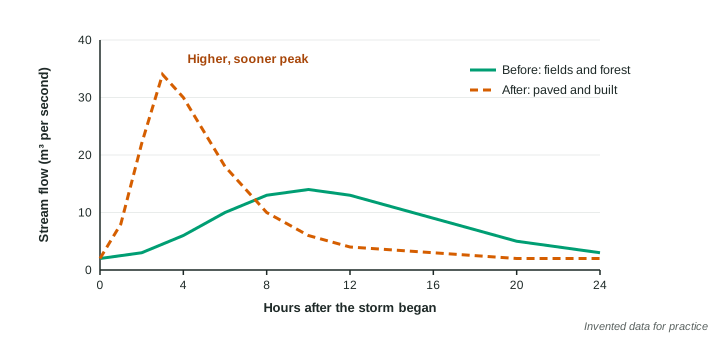
- Bigger, faster floods. The stream gets the same storm's water in a rush, so it rises higher and sooner.
- Less groundwater recharge. Less rain soaks in to refill aquifers, and since groundwater feeds streams between storms, city streams can run low in dry months.
- Dirtier, warmer water. Runoff picks up oil, metals from brakes and tires, road salt, pet waste, litter and fertilizer from lawns, and it is heated by hot pavement.
A 2.5-cm rain falls on a 4,000-m² parking lot, and 90% runs off. How much water reaches the storm drain?
Change centimeters to meters first: 2.5 cm = 0.025 m. Rain:
The flood peak in the graph rose from 14 to 34 m³ per second: .
Saltwater intrusion
Under a coast, fresh groundwater sits on top of and pushes against denser salt water. When a growing city pumps fresh water out faster than rain recharges it, the fresh water's push weakens and seawater moves inland underground. Wells near the shore start pumping salty water: saltwater intrusion. Coastal cities from Florida to Bangladesh face it. Pumping limits, recharging aquifers with treated water, and moving wells inland help.
The urban heat island
Cities are warmer than the countryside around them, often by several degrees Celsius at night. This urban heat island has three main causes: dark asphalt and roofs have a low albedo, so they absorb sunlight and release the heat at night; there are fewer plants to cool the air by transpiration; and cars, air conditioners and factories release waste heat. Heat islands raise energy use for cooling and make heat waves more dangerous. Light-colored roofs, street trees and parks cool them.
Urban sprawl
Urban sprawl is low-density growth spreading out from a city: subdivisions, strip malls and the roads that connect them. Compared with compact growth, sprawl converts more farmland and natural land per person, adds impervious surface, breaks habitat into pieces, and makes people drive farther, burning more fuel. Zoning laws that allow denser housing, public transit, and protecting a green belt of open land around a city slow it.
| Change | Cause | Effect |
|---|---|---|
| More flooding | impervious surfaces and storm drains | higher, faster flood peaks |
| Lower groundwater | less infiltration; more pumping | low streams in dry months; saltwater intrusion on coasts |
| Heat island | low-albedo surfaces, few plants, waste heat | hotter nights, more energy for cooling |
| Sprawl | low-density development | lost farmland and habitat, more driving |
Ways to slow runoff in cities come later in this unit.