Geothermal Energy
Geothermal energy is heat from Earth's interior.
Part 1 · Hook
Why this matters
Part 2 · Before you start
What this builds on
Part 3 · Prerequisite check
Quick check before you start
1. What causes plate tectonics and volcanoes?
- Heat from Earth's interior driving convection in the mantle
- Sunlight heating the crust
- The moon's gravity
- Wind erosion
Show the answer
Interior heat drives mantle convection, which moves plates and feeds volcanoes.
- Correct: Heat from Earth's interior driving convection in the mantle:
- Sunlight heating the crust:
- The moon's gravity:
- Wind erosion:
2. In a power plant, what turns the generator?
- A turbine spun by steam or another moving fluid
- The boiler
- The cooling tower
- The power lines
Show the answer
A turbine spun by steam turns the generator.
- Correct: A turbine spun by steam or another moving fluid:
- The boiler:
- The cooling tower:
- The power lines:
3. What is radioactive decay?
- Unstable nuclei giving off radiation and changing into other elements
- Burning of uranium
- Splitting of water
- Rusting of metals
Show the answer
Decay of radioactive elements also heats Earth's interior.
- Correct: Unstable nuclei giving off radiation and changing into other elements:
- Burning of uranium:
- Splitting of water:
- Rusting of metals:
Part 4 · See it
See it first
Part 5 · Step by step
How it works, step by step
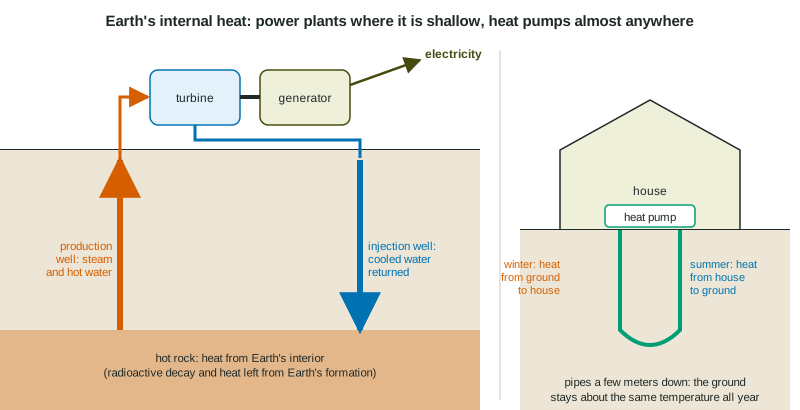
- Radioactive decay and leftover heat warm Earth's interiorheat flows outward and is close to the surface near plate boundaries and volcanoes
- Wells bring up underground steam and hot waterthe steam spins a turbine and generator, day and night, with no fuel burned
- Cooled water is pumped back downthe reservoir is refilled so the heat source is not depleted
- A few meters down, the ground stays about the same temperature all yeara ground source heat pump can heat a building in winter and cool it in summer almost anywhere
Part 6 · Key ideas
Key ideas
- Geothermal energy is heat from Earth's interior, from radioactive decay and heat left from Earth's formation. It is renewable when managed.
- Power plants need very hot water or steam near the surface, found near plate boundaries and hot spots (Iceland, New Zealand, California). They run day and night.
- A ground source heat pump uses electricity to move heat between a building and shallow ground, which stays at a steady temperature, so it works almost anywhere.
- Drawbacks: few suitable sites for power plants, high drilling costs, release of hydrogen sulfide and dissolved minerals, and depletion if water is withdrawn faster than it is replaced.
Part 7 · Misconception
A common mistake
The wrong idea: Geothermal energy is the sun's heat stored in the ground, so it stops working on cloudy winter days.
What actually happens: Geothermal power comes from Earth's interior heat, so it runs day and night in any weather. Heat pumps use shallow ground, which stays at a steady temperature year-round.
Part 8 · Check yourself
Check yourself
Exam-style questions. Anything you miss goes into your review queue.
1. Where does geothermal energy come from?
- Sunlight that warms the soil
- Natural gas burned underground
- Friction from flowing water
- Heat from Earth's interior
Show the answer
Geothermal heat comes from Earth's interior: roughly half from radioactive decay deep in Earth, the rest heat left over from Earth's formation.
- Sunlight that warms the soil: Sunlight warms only the top few meters; geothermal plants tap heat from far deeper.
- Natural gas burned underground: No fuel is burned in a geothermal plant.
- Friction from flowing water: Water flow does not make meaningful heat.
- Correct: Heat from Earth's interior: Right: heat from Earth's interior.
2. Why are geothermal power plants built in places like Iceland, New Zealand and California but rarely in the middle of continents?
- Geothermal plants have to be built next to an ocean for cooling
- The middle of a continent has no heat at any depth beneath it
- Hot rock is close to the surface near plate boundaries
- Those places get more sunlight to heat the ground than other places
Show the answer
Making electricity needs very hot water or steam at depths that can be drilled. That happens near plate boundaries, hot spots and volcanic areas.
- Geothermal plants have to be built next to an ocean for cooling: Coastal cooling is not the reason.
- The middle of a continent has no heat at any depth beneath it: Heat exists everywhere at depth; it is just too deep to reach cheaply in most places.
- Correct: Hot rock is close to the surface near plate boundaries: Right: plate boundaries bring heat near the surface.
- Those places get more sunlight to heat the ground than other places: Geothermal heat comes from below, not from sunlight.
3. How does a ground source heat pump heat a house in winter?
- It burns natural gas that is stored in the soil
- It uses sunlight that is stored in the roof shingles
- It makes electricity from hot steam under the house
- It moves heat from the ground into the house
Show the answer
A few meters down, the ground stays about 10 to 16 °C all year. Fluid in buried pipes picks up that heat, and the heat pump concentrates it into the house.
- It burns natural gas that is stored in the soil: No fuel is burned.
- It uses sunlight that is stored in the roof shingles: Roof sunlight is solar energy, not a heat pump.
- It makes electricity from hot steam under the house: Heat pumps work with mild ground temperatures, not steam.
- Correct: It moves heat from the ground into the house: Right: the pump moves heat from the ground into the house.
Model or diagram
Geothermal power plant and ground source heat pump
4. In the power plant on the left of the diagram, what spins the turbine?
- Steam from the production well
- Cooled water in the injection well
- Burning fuel in a boiler
- Wind blowing across the surface
Show the answer
Steam and hot water rise up the production well and spin the turbine.
- Correct: Steam from the production well: Right: steam from underground.
- Cooled water in the injection well: The injection well returns water after it has done its work.
- Burning fuel in a boiler: Nothing is burned.
- Wind blowing across the surface: Wind is not part of the diagram.
5. On the right of the diagram, why does the heat pump move heat into the house in winter but out of it in summer?
- The ground heats up in winter and cools in summer
- The house makes its own heat in winter from the pipes
- The pump runs on sunlight, which changes with the season
- The ground is warmer than winter air and cooler than summer air
Show the answer
A few meters down, the ground stays about the same temperature all year: warmer than the winter air, cooler than the summer air.
- The ground heats up in winter and cools in summer: The ground's temperature stays nearly steady.
- The house makes its own heat in winter from the pipes: The pipes carry heat from the ground; they do not make it.
- The pump runs on sunlight, which changes with the season: The pump runs on electricity.
- Correct: The ground is warmer than winter air and cooler than summer air: Right: the ground's steady temperature is between winter and summer air.
6. Both systems in the diagram use heat from the ground. Which statement compares them correctly?
- The heat pump makes electricity and the power plant makes heat
- Neither one uses electricity or fuel to run
- Only the plant needs hot rock near the surface
- Both need hot rock near a plate boundary to work
Show the answer
The power plant needs very hot water or steam, found near plate boundaries. The heat pump needs only the mild, steady temperature of shallow ground, found almost everywhere.
- The heat pump makes electricity and the power plant makes heat: It is the other way round.
- Neither one uses electricity or fuel to run: A heat pump uses electricity to run.
- Correct: Only the plant needs hot rock near the surface: Right: very different temperatures needed.
- Both need hot rock near a plate boundary to work: Heat pumps work far from plate boundaries.
Part 9 · Summary
Summary
Part 10 · Up next
What comes next
Part 11 · Connections