Energy Conservation
Energy conservation means using less energy; energy efficiency means using less for the same service.
Part 1 · Hook
Why this matters
Part 2 · Before you start
What this builds on
Part 3 · Prerequisite check
Quick check before you start
1. What is efficiency?
- Useful energy out divided by energy in, times 100
- Energy in minus energy out
- The amount of fuel burned
- The price of energy
Show the answer
Efficiency = output ÷ input × 100.
- Correct: Useful energy out divided by energy in, times 100:
- Energy in minus energy out:
- The amount of fuel burned:
- The price of energy:
2. How do you convert watt-hours to kilowatt-hours?
- Divide by 1,000
- Multiply by 1,000
- Divide by 60
- Multiply by 3,600
Show the answer
1 kWh = 1,000 Wh.
- Correct: Divide by 1,000:
- Multiply by 1,000:
- Divide by 60:
- Multiply by 3,600:
3. Which source releases carbon dioxide when used to make electricity?
- Coal
- Wind
- Sunlight
- Moving water
Show the answer
Burning coal releases carbon dioxide; wind, sunlight and water do not while running.
- Correct: Coal:
- Wind:
- Sunlight:
- Moving water:
Part 4 · See it
See it first
Part 5 · Step by step
How it works, step by step
- A family replaces bulbs, adds insulation or lowers the thermostatthe home uses fewer kWh of electricity and less fuel for the same comfort and light
- Fewer kWh are neededpower plants burn less fuel to meet demand
- Less fuel is burnedless carbon dioxide and other pollution is released, and the family pays less
- Governments set efficiency standards and invest in public transportationsavings are multiplied across millions of homes and vehicles
Part 6 · Key ideas
Key ideas
- Energy conservation is using less energy (turning things off, lowering the thermostat, driving less). Energy efficiency is getting the same service with less energy (LEDs, insulation, efficient appliances).
- Energy (kWh) = power (kW) × time (h). Set up chains so units cancel: W × h/day × day/yr × 1 kWh/1,000 Wh.
- Then convert: cost = kWh × price per kWh; carbon dioxide = kWh × kg per kWh; payback = extra cost ÷ yearly savings.
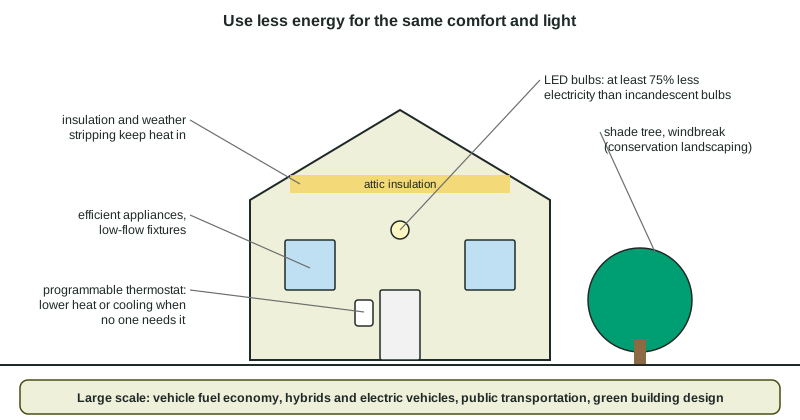
- At home: insulation, programmable thermostats, LEDs, efficient appliances, shade trees and windbreaks. Large scale: fuel economy standards, hybrid vehicles and electric vehicles, public transportation, green building design.
Part 7 · Misconception
A common mistake
The wrong idea: To find the savings from switching bulbs, multiply the old bulb's watts by the hours.
What actually happens: Savings come from the difference: (old watts - new watts) × hours, then convert Wh to kWh. Using only the old bulb's watts gives what it used, not what you saved.
Part 8 · Check yourself
Check yourself
Exam-style questions. Anything you miss goes into your review queue.
1. What is the difference between energy conservation and energy efficiency?
- Conservation means making more energy; efficiency means storing it
- They mean the same thing in environmental science and on the exam
- Conservation applies to homes; efficiency applies to power plants
- Conservation is using less; efficiency is the same service for less
Show the answer
Turning off lights you are not using is conservation. Replacing a bulb with an LED that gives the same light with less electricity is efficiency. Both cut energy use.
- Conservation means making more energy; efficiency means storing it: Neither term means making or storing energy.
- They mean the same thing in environmental science and on the exam: They are related but different ideas.
- Conservation applies to homes; efficiency applies to power plants: Efficiency applies to any device, from bulbs to cars to power plants.
- Correct: Conservation is using less; efficiency is the same service for less: Right: using less versus doing the same with less.
2. A 60 W incandescent bulb is replaced by a 9 W LED that gives the same light. The light is on 5 hours a day. Write the setup for the electricity saved in a year, with units that cancel, then give the answer in kWh.
Type the setup as on the exam, with brackets and units, then the answer.
Show the answer
- Setup: ; answer 93.08 kWh
Data
A family's lighting change
| Item | Value |
|---|---|
| Bulbs replaced | 20 |
| Old incandescent bulb | 60 W |
| New LED bulb (same light) | 9 W |
| Time each light is on | 4 hours a day, 365 days a year |
| Electricity price | $0.15 per kWh |
| Carbon dioxide from the local grid | 0.4 kg per kWh |
3. How many kWh a year does the family save by replacing all 20 incandescent bulbs with LEDs?
Type a number, then its unit (kWh). Scale words (2.5 million) and powers of ten (2.5 × 10^6) are read.
Show the answer
Per bulb:
- Answer: 1489 kWh
4. Write the setup for the money the family saves each year on lighting, using 1,489.2 kWh and the price in the table, then give the answer.
Type the setup as on the exam, with brackets and units, then the answer.
Show the answer
- Setup: ; answer 223.4 $
5. How many kilograms of carbon dioxide does the lighting change avoid each year, using the emission factor in the table?
Type a number, then its unit (kg). Scale words (2.5 million) and powers of ten (2.5 × 10^6) are read.
Show the answer
- Answer: 595.7 kg
6. A student wants the yearly kWh used by a 1,500 W space heater run 3 hours a day. Which calculation is set up correctly?
- 1,500 W × 3 h/day × 365 day/yr × 1 kWh/1,000 Wh
- 1,500 W × 3 h/day ÷ 365 day/yr
- 1,500 W ÷ 3 h/day × 365 day/yr × 1,000
- 1,500 W × 365 day/yr ÷ 1,000
Show the answer
Energy = power × time. Multiply watts by hours per day and days per year, then convert Wh to kWh:
- Correct: 1,500 W × 3 h/day × 365 day/yr × 1 kWh/1,000 Wh: Right: every unit cancels except kWh.
- 1,500 W × 3 h/day ÷ 365 day/yr: Dividing by days per year does not give a yearly total.
- 1,500 W ÷ 3 h/day × 365 day/yr × 1,000: Dividing watts by hours does not give energy, and the 1,000 should divide.
- 1,500 W × 365 day/yr ÷ 1,000: This leaves out the 3 hours a day.
Part 9 · Summary
Summary
Part 10 · Up next
What comes next
Part 11 · Connections