Introduction to Air Pollution
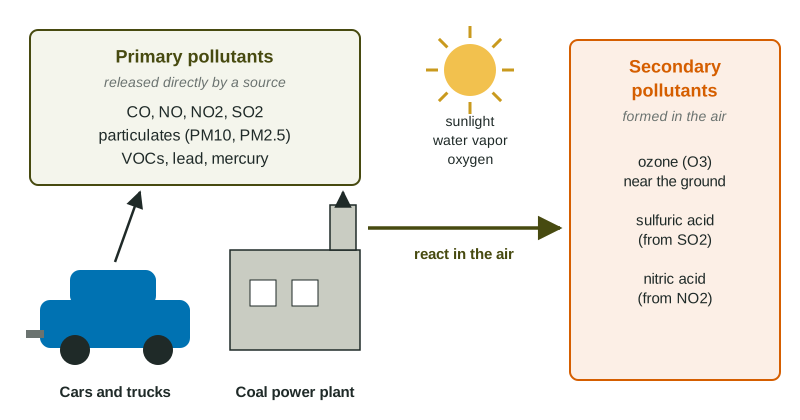
Air pollutants are primary (released directly: CO, NOx, SO2, particulates, VOCs) or secondary (formed in the air: ozone near the ground, sulfuric and nitric acid).
Part 1 · Hook
Why this matters
Part 2 · Prerequisite check
Quick check before you start
1. Which fuel naturally contains sulfur and mercury as impurities?
- Coal
- Wind
- Uranium
- Sunlight
Show the answer
Coal formed from buried plants and holds sulfur and metals; burning it releases them.
- Correct: Coal:
- Wind:
- Uranium:
- Sunlight:
2. Which layer of the atmosphere do we live and breathe in?
- The troposphere
- The stratosphere
- The mesosphere
- The thermosphere
Show the answer
The troposphere is the lowest layer, where weather happens and where we breathe.
- Correct: The troposphere:
- The stratosphere:
- The mesosphere:
- The thermosphere:
Part 3 · See it
See it first
Part 4 · Step by step
How it works, step by step
- Fuel burns in an engine, furnace or power plantprimary pollutants (CO, NOx, SO2, particulates, VOCs) leave the tailpipe or smokestack
- The primary pollutants mix with air, water vapor and sunlightthey react with one another and with oxygen and water
- Those reactions run through the daysecondary pollutants form: ozone near the ground, and sulfuric and nitric acid
- People breathe both kinds of pollutantlungs, heart and blood are harmed, so the Clean Air Act sets limits on six criteria pollutants
Part 5 · Key ideas
Key ideas
- A primary pollutant is released directly by a source (CO from a tailpipe). A secondary pollutant forms in the air from primary ones (ozone near the ground, sulfuric acid).
- Coal burning releases CO2, SO2, particulates and metals such as mercury. Burning any fossil fuel at high temperature also makes NOx from nitrogen in the air.
- CO keeps blood from carrying oxygen. PM2.5 reaches deep into the lungs. VOCs come from gasoline vapor, paints and solvents.
- The Clean Air Act lets the EPA set limits for six criteria pollutants: CO, lead, NO2, ozone, particulate matter and SO2. Taking lead out of gasoline cut airborne lead sharply.
Part 6 · Misconception
A common mistake
The wrong idea: The ozone in city air comes out of tailpipes and smokestacks.
What actually happens: No tailpipe or smokestack releases ozone. Ozone near the ground is a secondary pollutant: it forms in the air when NOx and VOCs react in sunlight.
Part 7 · Check yourself
Check yourself
Exam-style questions. Anything you miss goes into your review queue.
1. Which of these is a primary air pollutant?
- Carbon monoxide leaving a car's tailpipe
- Ozone that forms near the ground on a sunny afternoon
- Sulfuric acid droplets that form from SO2 in a cloud
- Nitric acid that forms from NO2 in moist air
Show the answer
A primary pollutant leaves its source as it is. Carbon monoxide comes straight out of a tailpipe; the other three form later, in the air.
- Correct: Carbon monoxide leaving a car's tailpipe: Right: it is emitted directly, so it is primary.
- Ozone that forms near the ground on a sunny afternoon: Ozone near the ground forms from NOx and VOCs in sunlight, so it is secondary.
- Sulfuric acid droplets that form from SO2 in a cloud: The acid forms in the air from SO2 and water, so it is secondary.
- Nitric acid that forms from NO2 in moist air: The acid forms in the air from NO2, so it is secondary.
2. Where does most of the sulfur dioxide in the air of an industrial country come from?
- Exhaust from gasoline cars on city streets
- Decomposition of plant matter in wetlands
- Paints and solvents drying in homes and shops
- Burning coal in power plants and industrial boilers
Show the answer
Coal contains sulfur as an impurity. Burning it in power plants and industrial boilers turns the sulfur into SO2, the largest human source.
- Exhaust from gasoline cars on city streets: Gasoline is refined to be low in sulfur; cars are a major source of CO and NOx instead.
- Decomposition of plant matter in wetlands: Wetland decomposition releases methane and CO2, not much SO2.
- Paints and solvents drying in homes and shops: Drying paints and solvents release VOCs, not SO2.
- Correct: Burning coal in power plants and industrial boilers: Right: sulfur in the coal becomes SO2 when it burns.
Data
Air pollutant emissions in a river-valley city
| Source | NOx | SO2 | CO | PM2.5 | VOCs |
|---|---|---|---|---|---|
| Coal power plant | 2,400 | 6,000 | 300 | 400 | 50 |
| Cars and trucks | 4,200 | 60 | 18,000 | 250 | 3,000 |
| Factories | 1,000 | 1,500 | 1,200 | 300 | 2,200 |
| Home heating and wood stoves | 400 | 440 | 2,500 | 650 | 750 |
| Total | 8,000 | 8,000 | 22,000 | 1,600 | 6,000 |
3. Which source in the table releases the most sulfur dioxide?
- The cars and trucks
- The coal power plant
- The factories
- The home heating and wood stoves
Show the answer
The coal power plant releases 6,000 of the 8,000 tons of SO2. Coal contains sulfur, and burning it turns that sulfur into SO2.
- The cars and trucks: Cars and trucks lead for CO (18,000 tons) and NOx, but release just 60 tons of SO2.
- Correct: The coal power plant: Right: 6,000 tons, three quarters of the city total, because coal contains sulfur.
- The factories: Factories release 1,500 tons of SO2, far less than the 6,000 tons from the coal plant.
- The home heating and wood stoves: Wood stoves lead for PM2.5 (650 tons), not SO2 (440 tons).
4. What percent of the city's NOx comes from cars and trucks?
Type a number, then its unit (%). Scale words (2.5 million) and powers of ten (2.5 × 10^6) are read.
Show the answer
Part over whole, times 100:
- Answer: 52.5 %
5. The city replaces its coal power plant with a wind farm. Which pollutant's city total falls by the largest percent?
- Sulfur dioxide
- Nitrogen oxides
- Fine particulate matter
- Carbon monoxide
Show the answer
The coal plant made 6,000 of 8,000 tons of SO2, so SO2 falls by
- Correct: Sulfur dioxide: Right: the plant was 75% of the SO2, so closing it cuts SO2 by 75%.
- Nitrogen oxides: The plant made 2,400 of 8,000 tons of NOx, a 30% cut. Vehicles make most NOx.
- Fine particulate matter: The plant made 400 of 1,600 tons of PM2.5, a 25% cut. Wood stoves make more.
- Carbon monoxide: The plant made 300 of 22,000 tons of CO, about 1%. Vehicles make almost all of it.
6. A family runs a gas generator in a closed garage and starts to feel dizzy. Which pollutant is the danger, and why?
- Sulfur dioxide, which turns the air in the garage brown and hazy
- Carbon monoxide, which keeps blood from carrying oxygen
- Carbon dioxide, which thins the ozone layer overhead
- Lead, which a gasoline engine releases as a gas
Show the answer
Carbon monoxide from incomplete burning binds to hemoglobin in red blood cells more tightly than oxygen, so the blood carries less oxygen. It has no color or smell.
- Sulfur dioxide, which turns the air in the garage brown and hazy: SO2 irritates airways but is not the brown gas; NO2 is brownish.
- Correct: Carbon monoxide, which keeps blood from carrying oxygen: Right: CO binds hemoglobin and starves the body of oxygen.
- Carbon dioxide, which thins the ozone layer overhead: CO2 traps heat; it does not thin the ozone layer, and it is not the dizzy-making gas here.
- Lead, which a gasoline engine releases as a gas: Gasoline sold today has no lead; the danger in a closed garage is CO.
7. A delivery truck drives 30,000 miles a year and releases 4 grams of NOx per mile. Write the setup, with units, for the NOx it releases in a year in kilograms, then give the answer.
Type the setup as on the exam, with brackets and units, then the answer.
Show the answer
Let the units cancel:
- Setup: ; answer 120 kg
Part 8 · Summary
Summary
Part 9 · Up next
What comes next
Part 10 · Connections