On a hot summer afternoon a brownish layer can settle over a city even though the morning air looked clear. That layer is photochemical smog: "photo" because it needs light, "chemical" because it forms by reactions in the air. Nothing emits it. It is made from car exhaust by the sun.
The ingredients
Photochemical smog needs three things: nitrogen oxides (NOx), volatile organic compounds (VOCs) and sunlight. Vehicles supply both chemical ingredients. Hot engines make NO from the nitrogen and oxygen in the air, and gasoline vapor, along with paints, solvents and some trees, supplies VOCs. Warm weather speeds the reactions, and still air lets the products build up.
How the smog forms, step by step
- Morning traffic releases NO.
- In the air, NO reacts to form NO2, a brown gas.
- Sunlight splits NO2 into NO and a single oxygen atom (O).
- The oxygen atom joins an ordinary oxygen molecule: O + O2 makes O3, ozone.
- Normally NO would react with the ozone and break it back down. But VOCs react with the NO first, forming other irritating chemicals called photochemical oxidants, so the ozone is not used up. It accumulates.
The ozone made this way is ground-level ozone, a secondary pollutant. It is the same molecule as the protective ozone high in the stratosphere, but down here we breathe it. It inflames the airways, triggers asthma attacks, reduces lung function and damages the leaves of crops and trees.
Reading a day of smog data
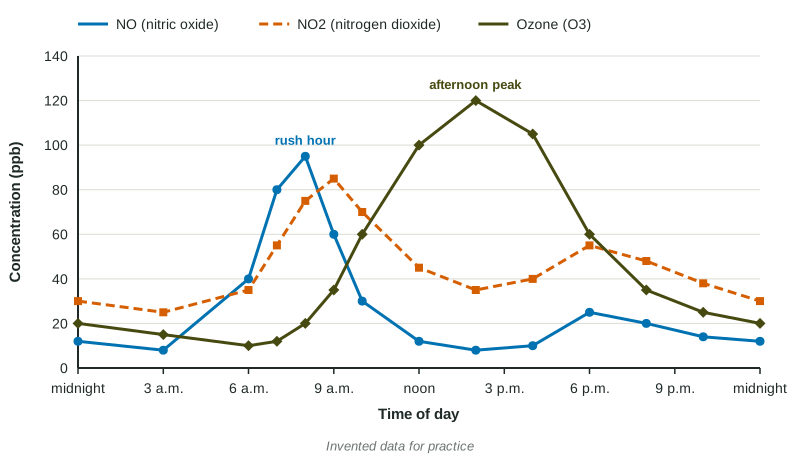
Exams often show three curves over 24 hours. Read them in order. NO peaks first, with the morning commute. NO2 peaks about an hour later, because it is made from the NO. Ozone climbs as the sun gets stronger and peaks in the early to mid afternoon, while NO2 falls, because NO2 is being split to make it. After sunset, no new ozone forms and NO from evening traffic uses up the ozone that is left, so ozone drops through the night.
Worked example: percent change through the day. Ozone is 10 ppb at 6 a.m. and 120 ppb at 2 p.m. What is the percent change?
Setup: . The ppb cancel. Answer: .
Notice the brackets: subtract first, then divide by the old value, then multiply by 100.
When and where smog is worst
| Makes more smog | Makes less smog |
|---|---|
| strong sunlight, summer | cloudy days, winter |
| hot weather | cool weather |
| heavy traffic (lots of NOx and VOCs) | light traffic |
| still air, cities ringed by mountains | windy, open places |
Smog also drifts. Ozone can be higher in suburbs downwind of a city than in the city center, because the city's NO, which destroys ozone, has thinned out there.
Photochemical smog is different from the gray, sooty smog of coal-burning cities, which is mostly sulfur dioxide and particulates and is worst in cold, damp weather. The brown kind needs sun.
Cutting smog
Because ozone is secondary, you cut it by cutting its ingredients: fewer vehicle miles (public transit, carpooling, walkable neighborhoods), cleaner engines, and rules that limit VOCs from fuel, paints and solvents. A solution should say which ingredient it reduces and how.