Some of the worst air pollution disasters in history did not happen because a city suddenly released more pollution. They happened because the air stopped moving it away. The weather pattern behind them is a thermal inversion.
How air normally clears
The sun heats the ground, and the ground heats the air touching it. So in the lowest layer of the atmosphere, air is normally warmest near the ground and cooler higher up, by roughly 6.5 °C for every 1,000 m. Warm air is less dense than cool air, so the warm air near the ground rises, carrying smoke, exhaust and dust upward, where they spread out and thin.
What an inversion is
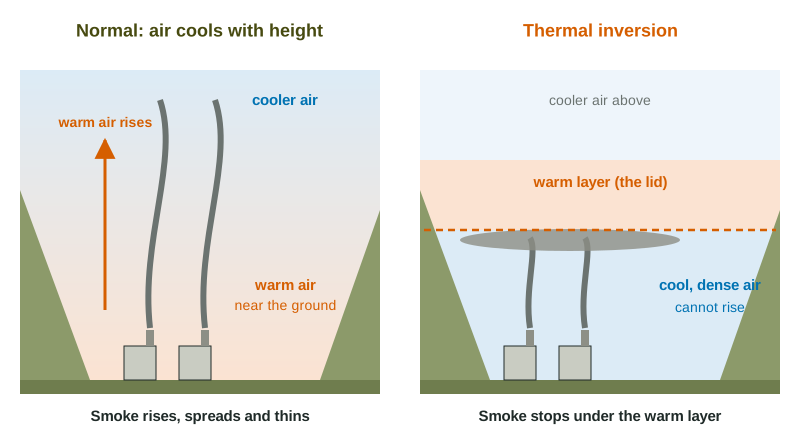
In a thermal inversion the pattern flips for a layer of the atmosphere: a warm layer sits on top of cooler air near the ground, so temperature rises with height. The cool air near the ground is denser than the warm air above it. It cannot rise through it, so it stays put, and so does everything released into it. The warm layer acts like a lid.
Worked example: spotting the inversion in a table. At 6 a.m. the air is -8 °C at the valley floor, -5 °C at 200 m, -1 °C at 400 m, 0 °C at 600 m and -1.5 °C at 800 m.
From the floor to 600 m the temperature rises with height: that is the inversion. The warming across it is . Above 600 m the air cools again, the normal pattern. Smoke from the town rises only to about 600 m and spreads out under the lid.
When and where inversions form
- Clear, calm nights. With no clouds, the ground loses heat to space quickly and cools the air touching it. By dawn there is cold air under warmer air. This is why inversions are common on winter mornings.
- Valleys and basins. Cold, dense air drains downhill and pools at the bottom. Mountains on the sides block wind. Los Angeles, Mexico City and many valley towns have frequent inversions.
- Snow cover. Snow reflects sunlight, so the ground stays cold and an inversion can last for days.
An inversion ends when the sun warms the ground enough that the lowest air becomes warmer than the layer above and rises, or when a weather front brings wind that mixes the layers.
Why it matters for health
During a long inversion, a town keeps adding smoke, exhaust and particles to the same shallow layer of air, so the concentration climbs each day. Particles and gases irritate the lungs, and hospital visits for asthma and heart and lung disease rise. In December 1952 a cold inversion held London's coal smoke near the ground for several days, and thousands of people died. Inversions also hold the ingredients of photochemical smog close to the ground in sunny basin cities.
What can be done
Nobody can stop the weather, so the answer is to cut emissions when an inversion is forecast: no-burn days for wood stoves and fireplaces, fewer car trips, and limits on industrial emissions during alerts. Longer term, cleaner heating and transport lower what is there to trap.