Every pollutant in this unit can be cut. There are three places to do it: before the fuel burns (use a cleaner fuel), while it burns (burn it better), or after it burns (catch or change the pollutant before it leaves the stack or tailpipe). Laws and rules decide that the cuts happen.
Devices matched to pollutants
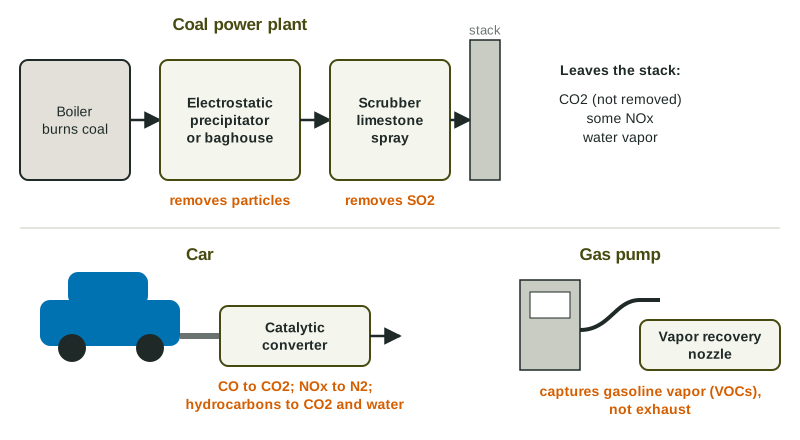
| Method | Removes | How it works |
|---|---|---|
| Wet or dry scrubber | SO2 (and some particles) | a spray or powder of limestone or lime reacts with the acidic SO2; it is captured as a solid |
| Electrostatic precipitator | particles | charges the particles, then collects them on oppositely charged plates |
| Baghouse filter | particles | forces the gas through fabric bags that trap the particles |
| Catalytic converter | CO, NOx, hydrocarbons (VOCs) in car exhaust | catalysts change CO to CO2, NOx to N2, hydrocarbons to CO2 and water |
| Vapor recovery nozzle | gasoline vapor (VOCs) at the pump | captures vapor pushed out of the tank while filling and returns it to storage |
| Low-sulfur coal; fluidized bed combustion | SO2 (and NOx) | less sulfur to burn; coal burned with limestone at a lower temperature |
| Cooler burning | NOx | less nitrogen from the air combines with oxygen |
Two traps to avoid. A vapor recovery nozzle never touches exhaust; it catches fuel vapor at the pump. And none of these devices removes CO2. CO2 is the main product of burning carbon, so cutting it means burning less fossil fuel.
Policies that make the cuts happen
A device is a technology. A policy is a rule that makes people use one, or cut emissions some other way:
- Emission limits under the Clean Air Act for power plants, factories and new vehicles.
- Cap and trade: a total limit (cap) on a pollutant, divided into permits that companies can buy and sell. Since 1995 a national United States program has used this for SO2 from power plants, and emissions fell sharply.
- Fuel standards, such as low-sulfur diesel, and fuel economy rules.
- Tax credits and incentives for clean energy, efficient vehicles and public transit.
When a question asks for a policy, name the rule (a law requiring scrubbers), not just the device (scrubbers).
Each approach has trade-offs. A device such as a scrubber works well but costs money to build and run, and it makes its own waste: the solid waste it captures must go somewhere. Switching to low-sulfur coal may mean shipping coal from farther away. Cap and trade lowers the total at the lowest cost, but a plant that buys many permits can keep polluting its own neighborhood, so some programs add a limit for each plant. Cutting fuel use, through efficiency, transit or renewable energy, is the only approach that lowers every pollutant at once, including CO2.
Measuring how well a device works
Worked example: what is still released. A cement plant makes 5,000 metric tons of particulates a year, and its baghouse captures 99.5% of them. How much is still released?
The share released is . Setup: . Answer: metric tons a year.
Worked example: percent removed. A scrubber cuts SO2 from 40,000 to 2,000 metric tons a year. What percent does it remove?
Removed: