Acid rain is a pollution problem that crosses borders. The gases that cause it can travel hundreds of kilometers before they fall, so the region that suffers is often not the region that released them.
What makes rain acidic
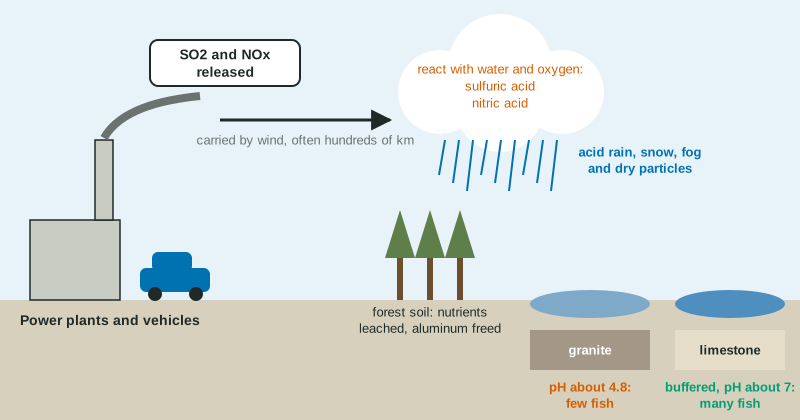
Even clean rain is slightly acidic, about pH 5.6, because CO2 in the air dissolves in raindrops and forms a weak acid. Acid rain is rain with a pH below that, and it comes from two gases:
- Sulfur dioxide (SO2), mainly from burning coal, reacts with water and oxygen to form sulfuric acid.
- Nitrogen oxides (NOx), from vehicles and power plants, form nitric acid.
Both acids are secondary pollutants. They fall as wet deposition (rain, snow, fog) or dry deposition (acidic particles and gases that settle on surfaces), so scientists call the whole thing acid deposition. VOCs, particulates and CO2 are not the cause; this is a common exam trap.
The pH scale is logarithmic
A drop of 1 on the pH scale means the water is 10 times more acidic. A drop of 2 means times.
Worked example: how many times more acidic? A lake fell from pH 6.5 to pH 4.5. How many times more acidic did it become?
The drop is . Setup: . Answer: times more acidic.
The trap is to say "2 times" or "20 times". Each unit of pH multiplies by 10.
Effects
| Where | What acid deposition does |
|---|---|
| Lakes and streams | pH falls; below about 5 many fish, frogs and insects cannot reproduce; aluminum washed from soil damages fish gills |
| Forests and soils | calcium and magnesium are leached out; aluminum is freed and harms roots; trees weaken and become prone to cold, insects and disease |
| Buildings and statues | limestone and marble react with acid and dissolve; metal corrodes |
Buffering: why some lakes survive
Limestone is a base. Where soils and bedrock contain it, they neutralize the acid before it builds up, so lakes stay near pH 7. That ability is buffering capacity. Lakes on granite with thin soil have little buffering, so the same rain makes them acidic. When two lakes get the same rain but have different pH, look at the rock under them.
Solutions
The lasting fix is to cut SO2 and NOx at the source: scrubbers, low-sulfur coal, switching to natural gas or renewables, catalytic converters, and policies such as cap and trade for SO2. In the United States, SO2 from power plants fell by more than 90% after 1990, and rain pH has risen. Adding crushed limestone to a lake (liming) raises its pH quickly, but it treats the symptom and must be repeated. Tall smokestacks only move the problem downwind.
Recovery is slow. Even after emissions fall, leached soils take decades to rebuild their calcium, so some lakes and forests stay damaged long after the rain improves. That is why a solution question should say both what the action cuts (the SO2 or NOx) and how that lowers the acid reaching the ground. Read every graph of rain pH with the scale in mind: a rise from 4.2 to 5.2 looks small, but it means the rain became ten times less acidic.