Acid Rain
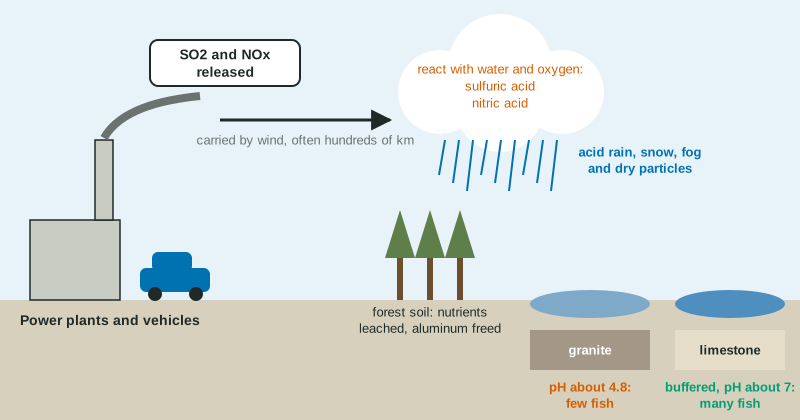
Acid deposition forms when sulfur dioxide and nitrogen oxides from power plants and vehicles react in the air to make sulfuric and nitric acid, which fall in rain, snow and fog or as dry particles, often far downwind.
Part 1 · Hook
Why this matters
Part 2 · Before you start
What this builds on
Part 3 · Prerequisite check
Quick check before you start
1. What does a pH below 7 mean?
- Acidic
- Basic
- Neutral
- Salty
Show the answer
pH below 7 is acidic; above 7 is basic; 7 is neutral.
- Correct: Acidic:
- Basic:
- Neutral:
- Salty:
2. Which device on a coal plant removes sulfur dioxide?
- A scrubber
- A catalytic converter
- A vapor recovery nozzle
- A baghouse filter
Show the answer
Scrubbers remove SO2; baghouses remove particles.
- Correct: A scrubber:
- A catalytic converter:
- A vapor recovery nozzle:
- A baghouse filter:
Part 4 · See it
See it first
Part 5 · Step by step
How it works, step by step
- Coal plants release SO2, and power plants and vehicles release NOxthe gases rise and travel with the wind, often hundreds of kilometers
- In the air they react with water and oxygenthey form sulfuric acid and nitric acid, secondary pollutants
- The acids fall in rain, snow and fog, or settle as dry particlesacid deposition lowers the pH of soils and lakes
- Acidic soil loses calcium and magnesium and releases aluminumtrees weaken and aluminum washes into streams, where it harms fish gills
- Lake pH falls below about 5fish eggs fail and many species disappear, unless limestone buffers the water
Part 6 · Key ideas
Key ideas
- Acid deposition forms from SO2 and NOx, not CO2, VOCs or particles. It falls as wet deposition (rain, snow, fog) and dry deposition (particles and gases).
- Clean rain is about pH 5.6; acid rain is lower. Each drop of 1 in pH is 10 times more acidic.
- Effects: acidic lakes with fewer fish, leached forest soils with toxic aluminum, and stone buildings (limestone, marble) that dissolve.
- Buffering capacity: limestone soils and rock neutralize acid, so lakes on granite suffer most. Fixes: cut SO2 and NOx (scrubbers, cleaner fuels, cap and trade) and, short term, lime lakes.
Part 7 · Misconception
A common mistake
The wrong idea: Acid rain is caused by CO2, VOCs or particulate matter.
What actually happens: Acid rain comes from sulfur dioxide and nitrogen oxides, which form sulfuric and nitric acid in the air. CO2 makes clean rain only slightly acidic.
Part 8 · Check yourself
Check yourself
Exam-style questions. Anything you miss goes into your review queue.
1. Which gases are the main cause of acid deposition?
- Sulfur dioxide and nitrogen oxides
- Carbon monoxide and VOCs
- Particulates and ground-level ozone
- Methane and water vapor
Show the answer
Sulfur dioxide and nitrogen oxides react with water and oxygen in the air to form sulfuric and nitric acid.
- Correct: Sulfur dioxide and nitrogen oxides: Right: they form sulfuric and nitric acid.
- Carbon monoxide and VOCs: CO and VOCs are not the source of acid rain; VOCs help form smog.
- Particulates and ground-level ozone: Neither is the main source of the acid in acid rain.
- Methane and water vapor: Neither forms strong acids in rain.
Model or diagram
Sulfur dioxide emissions and rain pH at a forest monitoring station
2. Describe the relationship between SO2 emissions and rain pH shown in the graph.
- As SO2 emissions fell, rain pH fell too
- As SO2 emissions fell, rain pH rose
- Rain pH stayed at 4.2 while SO2 fell
- Rain pH rose first, and SO2 fell ten years later
Show the answer
As SO2 emissions fell, rain pH rose. Less SO2 means less sulfuric acid in the rain, so the rain became less acidic: an inverse relationship.
- As SO2 emissions fell, rain pH fell too: pH rose from 4.2 to 5.2 while emissions fell.
- Correct: As SO2 emissions fell, rain pH rose: Right: less SO2, less sulfuric acid, so a higher pH.
- Rain pH stayed at 4.2 while SO2 fell: The pH line rises across the whole period.
- Rain pH rose first, and SO2 fell ten years later: The two change over the same decades.
3. Which explanation connects the two lines?
- SO2 forms sulfuric acid, so less SO2 means less acid
- SO2 is a base that raises the pH of rain
- Less SO2 let more CO2 dissolve, which raised pH
- Rain pH depends on temperature, not on emissions
Show the answer
SO2 reacts with water and oxygen in the air to form sulfuric acid, which falls in rain. Cutting SO2 cuts the acid, so the pH rises toward normal rain's 5.6.
- Correct: SO2 forms sulfuric acid, so less SO2 means less acid: Right: the acid comes from the SO2.
- SO2 is a base that raises the pH of rain: SO2 forms an acid, not a base; it lowers pH.
- Less SO2 let more CO2 dissolve, which raised pH: Dissolved CO2 makes rain slightly acidic; it does not raise pH.
- Rain pH depends on temperature, not on emissions: The pH tracks the emissions closely across 40 years.
4. Find the percent change in the region's SO2 emissions from 1980 to 2020.
Type a number, then its unit (%). Scale words (2.5 million) and powers of ten (2.5 × 10^6) are read.
Show the answer
- Answer: -87.5 %
Data
Four lakes that receive the same acid rain
| Lake | Bedrock and soil | Lake pH | Fish species found |
|---|---|---|---|
| North Lake | granite, thin soil | 4.8 | 1 |
| Pine Lake | granite, thin soil | 5.2 | 3 |
| Mill Lake | limestone | 7.1 | 9 |
| Clay Lake | limestone, deep soil | 7.4 | 10 |
5. All four lakes get the same acid rain. Why are Mill Lake and Clay Lake near neutral pH?
- They get less rain than the two granite lakes
- Their fish release a base that cancels the acid
- Granite adds acid, so those two lakes are acidic
- Limestone under them neutralizes the acid
Show the answer
They sit on limestone, which is a base. Limestone in the soil and bedrock neutralizes (buffers) the acid, so the lake pH stays near 7.
- They get less rain than the two granite lakes: The question says all four get the same acid rain.
- Their fish release a base that cancels the acid: Fish do not buffer lakes; the rock and soil do.
- Granite adds acid, so those two lakes are acidic: Granite does not add acid; it simply cannot neutralize the rain.
- Correct: Limestone under them neutralizes the acid: Right: limestone is a base, so it buffers the acid rain.
6. What pattern links lake pH and the number of fish species?
- The lower the pH, the more fish species
- Fish species are about equal across the four lakes
- The lower the pH, the fewer fish species
- The deep soil affects the fish, not the pH
Show the answer
The more acidic the lake (lower pH), the fewer fish species: 1 species at pH 4.8 against 10 at pH 7.4.
- The lower the pH, the more fish species: North Lake, the most acidic, has the fewest species.
- Fish species are about equal across the four lakes: They range from 1 to 10.
- Correct: The lower the pH, the fewer fish species: Right: the most acidic lake has one species, the least acidic ten.
- The deep soil affects the fish, not the pH: Mill Lake has no deep soil yet nine species; pH is the pattern.
7. Acid rain falls on a forest with thin soil over granite. How does it harm the trees?
- It adds so much nitrogen that the trees grow too fast to stand
- It raises the soil pH so roots take in less water
- It leaches soil nutrients and frees toxic aluminum
- It forms ozone on the leaves, which blocks sunlight
Show the answer
Acid washes calcium and magnesium out of the soil (leaching) and releases aluminum, which damages roots, so trees grow weakly and become prone to disease, cold and insects.
- It adds so much nitrogen that the trees grow too fast to stand: Some nitrogen can fertilize, but the main harm is nutrient leaching and aluminum.
- It raises the soil pH so roots take in less water: Acid rain lowers soil pH; it does not raise it.
- Correct: It leaches soil nutrients and frees toxic aluminum: Right: trees weaken from nutrient loss and toxic aluminum.
- It forms ozone on the leaves, which blocks sunlight: Acid rain does not form ozone on leaves.
Part 9 · Summary
Summary
Part 10 · Up next
What comes next
Part 11 · Connections