Not every pollutant is a chemical. Sound can harm people and wildlife too, when it is loud enough or constant enough. Noise pollution is easy to overlook because it leaves no residue, but its effects on health and on animal behavior are well measured.
Measuring sound: the decibel
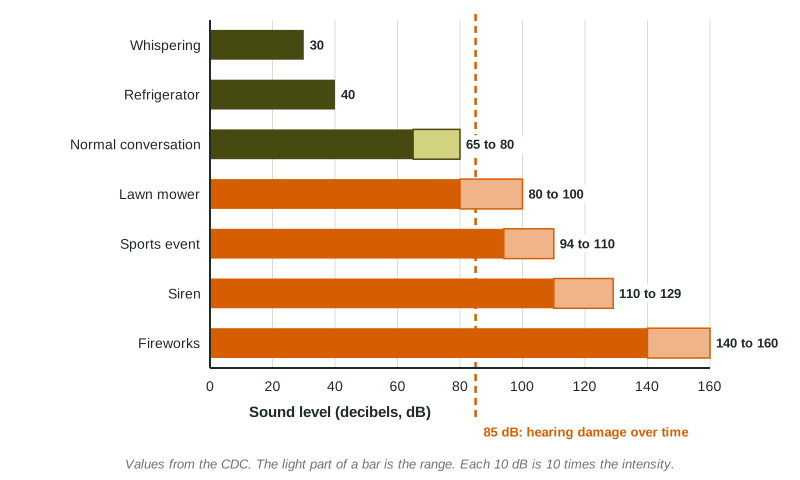
Sound level is measured in decibels (dB). The scale is logarithmic: every increase of 10 dB means 10 times the sound intensity. So 90 dB is 10 times as intense as 80 dB, and 100 dB is 100 times as intense. A small-looking number difference is a big physical difference.
The CDC (the U.S. Centers for Disease Control and Prevention) lists a whisper at about 30 dB, normal conversation at 65 to 80 dB, a lawn mower at 80 to 100 dB, a siren at 110 to 129 dB, and fireworks at 140 to 160 dB. Any sound at or above 85 dB can damage hearing over time, and the louder it is, the faster the damage.
Worked example: comparing two sounds. A machine is 95 dB at the operator's ear. With earmuffs it is 75 dB. How many times less intense is the sound?
The drop is dB, two steps of 10. Setup: . Answer: times less intense.
Effects on people
- Hearing loss and ringing in the ears (tinnitus) from long or very loud exposure.
- Stress: chronic noise raises stress hormones and is linked to high blood pressure and heart disease.
- Poor sleep near airports, highways and busy streets, which affects health and learning.
Effects on wildlife
Many animals live by sound. Songbirds sing to attract mates and hold territory; bats and dolphins find food by echolocation; prey listen for predators; whales call across hundreds of kilometers of ocean. Noise masks these sounds. Near roads, some birds breed less or sing at higher pitches to be heard. In the ocean, ship propellers, sonar and seismic surveys for oil and gas can disrupt whale feeding and migration, and very loud blasts can injure their hearing. Noise also changes where animals live: they may avoid otherwise good habitat beside a highway or an airport, which shrinks the habitat they can use even though no trees were cut.
Timing matters as much as loudness. A sound that is harmless at noon can wake a neighborhood at 3 a.m. or scare nesting birds during the breeding season. That is why many noise rules limit hours and seasons, not just decibels. When you read a noise data table, look for both: how loud, and when and where.
Reducing noise
| Approach | Example | How it works |
|---|---|---|
| Block the path | sound barrier walls, earth berms, thick vegetation belts | absorb or reflect sound before it reaches homes or habitat |
| Quiet the source | mufflers, quieter pavement and tires, slower ships | less sound energy is made |
| Protect the listener | earplugs and earmuffs | lower the dB reaching the ear |
| Policy | limits on hours and zones, aircraft noise standards, ship speed limits in whale areas | rules that keep noise away from people and wildlife |