Before you can fix a pollution problem, you have to know where it comes from. Environmental scientists sort sources into two kinds, and the kind decides what solutions can work.
Point and nonpoint sources
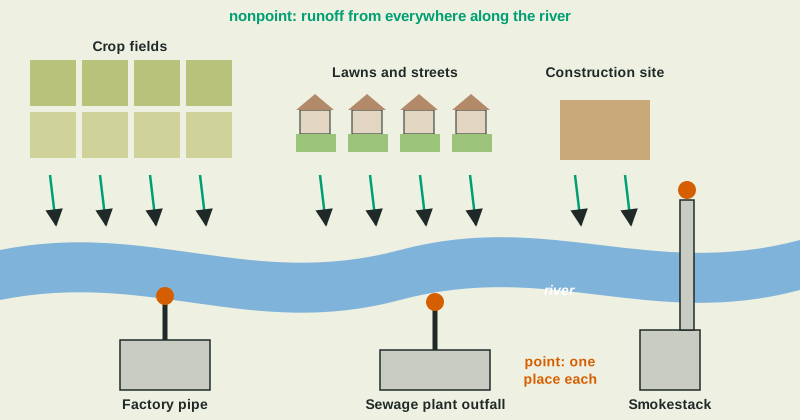
| Point source | Nonpoint source | |
|---|---|---|
| Where it enters | one identifiable place | many diffuse places |
| Water examples | factory discharge pipe, sewage plant outfall, oil tanker spill | runoff from farm fields, lawns, streets, parking lots, construction sites |
| Air examples | smokestack, a single vent | exhaust from all the cars in a city, dust from plowed fields |
| Easy to measure? | yes, at the outlet | no, it arrives everywhere at once |
| Typical fix | permit limits, treatment at the outlet | changes in land use and practice |
Why the difference matters
A point source can be found on a map, sampled at the end of a pipe, given a legal limit and inspected. The Clean Water Act (1972) did exactly that with permits for every pipe that discharges into United States waters, and point-source pollution fell sharply. A nonpoint source has no pipe. Fertilizer, sediment, oil, metals, pesticides and pet waste are picked up by rain across a whole watershed and enter streams along their entire length. Because thousands of landowners each add a little, nonpoint pollution is hard to measure and to assign. It is now the leading cause of water quality problems in the United States.
Worked example: what share is nonpoint? A river receives 2,600 metric tons of nitrogen a year from crop runoff, 700 from streets and lawns, 500 from pasture manure, 900 from a sewage plant and 300 from a food plant.
Nonpoint:
So a permit on the sewage plant could cut at most 18% of the nitrogen. Cleaning up this river means changing what happens on the land.
Reducing nonpoint pollution
- On farms: buffer strips of grass and trees along streams, cover crops, fertilizer applied only as needed, fences that keep livestock out of streams.
- In towns: rain gardens, green roofs and permeable pavement so rain soaks in; street sweeping; pet waste rules.
- On construction sites: silt fences and quick replanting to hold soil in place.
When a question asks for a solution, check which kind of source the scenario describes. A treatment plant upgrade fixes a pipe; it will not touch runoff.
Reading a storm graph
Nonpoint pollution often shows up as a spike after rain. Before a storm, a farm stream may carry 2 mg of nitrate per liter. During and just after the storm, runoff washes fertilizer off the fields and the level can climb to 9 mg per liter, then fall back over a few days as the runoff passes. A point source, by contrast, tends to release a steady flow whether it rains or not. So when a question shows pollution that rises with every storm, think nonpoint, and think of solutions that keep the pollutant on the land: plants that take it up, soil that soaks the water in, and fertilizer applied when rain is not forecast.