Some pollutants break down in days. Others last for decades and turn up in places no one used them. These long-lived, fat-loving chemicals are called persistent organic pollutants, or POPs.
What makes a POP
- Organic: carbon-based molecules, almost all made by people.
- Persistent: their bonds resist breakdown by sunlight, water and microbes, so they last for years to decades.
- Fat-soluble: they dissolve in fat and oil, not water, so animals store them in fatty tissue instead of excreting them.
- Mobile: they travel long distances in air and water.
- Toxic: they harm reproduction, development and the immune system, and some cause cancer. Several are also endocrine disruptors.
| POP | Use or source | Known harm |
|---|---|---|
| DDT | insecticide, from the 1940s; banned for most uses in the United States in 1972 | thin eggshells in eagles, falcons and pelicans |
| PCBs | insulating fluids in electrical equipment; banned in the United States in 1979 | reproductive and immune effects; cancer |
| Dioxins | by-products of burning plastics and some industrial processes | cancer; hormone effects |
The journey to the poles
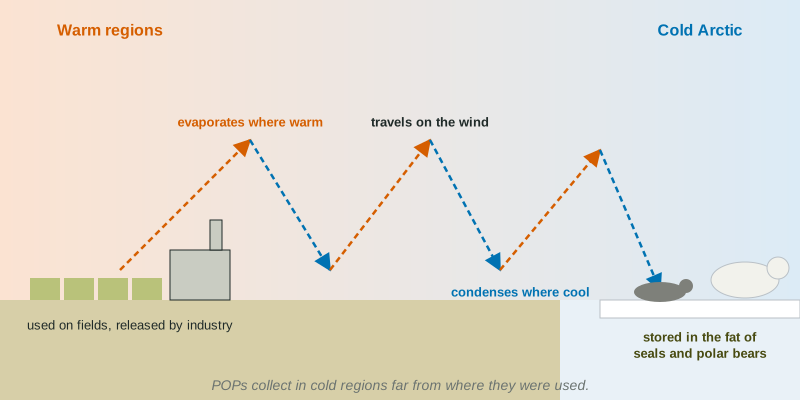
In warm places POPs evaporate. Winds carry them; when the air cools, they condense and fall. Then they evaporate again on the next warm day. These hops move them steadily toward cold regions, where they condense and stay. That is why Arctic seals, whales and polar bears, and the people who eat them, carry high levels of chemicals that were never used nearby.
Persistence in numbers
Worked example: how much is left? A POP has a half-life of 15 years in lake sediment, which now holds 80 ppm. What will the sediment hold after 45 years?
Half-lives:
Compare a pesticide with a half-life of half a year: after 2 years only 6.25% is left. Persistence is what lets a chemical travel and build up.
Reading POP data
Two patterns come up again and again. First, after a ban, levels in animals fall, but slowly and not to zero, because the chemical already in soil, sediment and food webs keeps breaking down at its own slow pace. Second, levels are often highest in places and animals far from any use: polar regions, deep-sea fish and the predators at the top of food chains. When you see either pattern, the explanation is persistence plus fat solubility, and the next topic shows how fat solubility makes concentrations climb up a food chain.
Controlling POPs
Because POPs last so long, the only lasting fix is to stop adding them. The Stockholm Convention (2001) commits more than 180 countries to eliminate or restrict a list of POPs. It allows limited indoor use of DDT against mosquitoes that spread a deadly tropical disease, a real trade-off between saving lives now and adding a persistent chemical. Old stocks must be destroyed safely, and contaminated sediments are sometimes dredged. Safer replacements that break down quickly are the long-term answer.