Persistent Organic Pollutants (POPs)
Persistent organic pollutants are synthetic, carbon-based chemicals such as DDT, PCBs and dioxins that resist breakdown, dissolve in fat, travel long distances on wind and water and stay toxic for decades.
Part 1 · Hook
Why this matters
Part 2 · Before you start
What this builds on
Part 3 · Prerequisite check
Quick check before you start
1. What does half-life mean?
- The time for half of a substance to break down or decay
- Half the age of an organism
- The time to double a population
- Half the depth of a lake
Show the answer
After one half-life, half of the original amount is left.
- Correct: The time for half of a substance to break down or decay:
- Half the age of an organism:
- The time to double a population:
- Half the depth of a lake:
2. What is an endocrine disruptor?
- A chemical that interferes with hormones
- A germ that causes disease
- A gas that blocks oxygen in blood
- A nutrient that feeds algae
Show the answer
It mimics, blocks or alters hormones.
- Correct: A chemical that interferes with hormones:
- A germ that causes disease:
- A gas that blocks oxygen in blood:
- A nutrient that feeds algae:
Part 4 · See it
See it first
Part 5 · Step by step
How it works, step by step
- A synthetic, carbon-based chemical is made and used (a pesticide, an insulator)it enters soil, water and air
- Its chemical bonds resist breakdown by sunlight, water and microbesit persists for years to decades
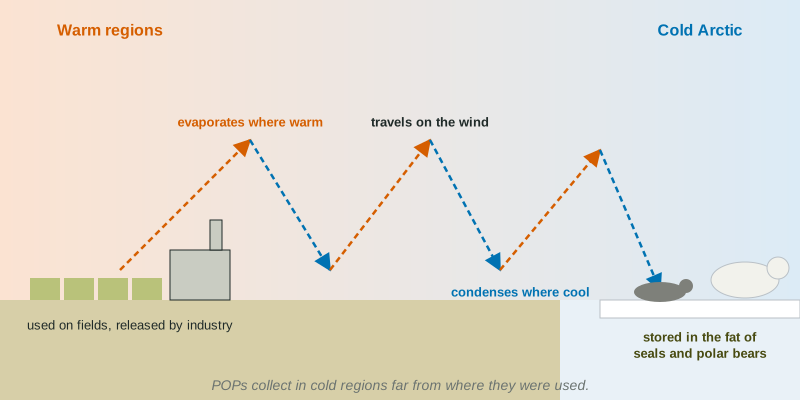
- It evaporates in warm places and condenses in cold onesit travels long distances and collects in the Arctic
- It dissolves in fat rather than wateranimals store it in fatty tissue instead of excreting it
- It stays toxic while storedit harms reproduction, development and the immune system, as DDT did to birds of prey
Part 6 · Key ideas
Key ideas
- A persistent organic pollutant (POP) is a synthetic, carbon-based chemical that resists breakdown, dissolves in fat, travels long distances and is toxic.
- Examples: DDT and other old pesticides, PCBs from electrical equipment, and dioxins from burning plastics and some industrial processes.
- POPs collect in cold regions far from where they were used, and they are stored in fat, so they build up in animals over time.
- Harm: thin eggshells (DDT in birds of prey), reproductive and immune problems, some cancers. The Stockholm Convention (2001) restricts them worldwide.
Part 7 · Misconception
A common mistake
The wrong idea: Once a chemical is banned, it soon disappears from the environment.
What actually happens: A POP breaks down so slowly that it stays in soil, sediment and animal fat for decades after it is banned, falling only gradually.
Part 8 · Check yourself
Check yourself
Exam-style questions. Anything you miss goes into your review queue.
1. What makes a pollutant a persistent organic pollutant (POP)?
- It lasts for years and is stored in fat
- It is a metal that dissolves easily in water
- It is a gas that breaks down in hours in sunlight
- It is a nutrient that feeds algae
Show the answer
POPs are carbon-based synthetic chemicals that resist breaking down, dissolve in fat rather than water, travel long distances, and are toxic.
- Correct: It lasts for years and is stored in fat: Right: those features define a POP.
- It is a metal that dissolves easily in water: POPs are organic (carbon-based), and they dissolve in fat, not water.
- It is a gas that breaks down in hours in sunlight: POPs last for years or decades.
- It is a nutrient that feeds algae: That describes nitrate or phosphate.
2. Which of these is a persistent organic pollutant?
- Nitrate from fertilizer
- Carbon monoxide from car exhaust
- Radon from rock under homes
- PCBs from old electrical gear
Show the answer
DDT, PCBs and dioxins are classic POPs, now restricted worldwide under the Stockholm Convention.
- Nitrate from fertilizer: Nitrate is a nutrient, not a POP.
- Carbon monoxide from car exhaust: CO is an air pollutant gas that does not persist this way.
- Radon from rock under homes: Radon is a radioactive gas, not an organic chemical.
- Correct: PCBs from old electrical gear: Right: PCBs are a classic POP.
Data
A pesticide in the fat of Arctic seals, far from where it was used
| Year | Pesticide in blubber (ppb) | Years since a worldwide ban |
|---|---|---|
| 1985 | 1,200 | before ban |
| 1995 | 900 | before ban |
| 2005 | 600 | 1 |
| 2015 | 420 | 11 |
| 2025 | 300 | 21 |
3. Describe the trend in the pesticide in seal blubber from 1985 to 2025.
- It rises each decade after the ban
- It falls but is still present after the ban
- It drops to zero right after the ban
- It stays near 1,200 ppb throughout
Show the answer
It falls steadily, from 1,200 to 300 ppb, but it is still present 21 years after the ban.
- It rises each decade after the ban: The values fall every decade.
- Correct: It falls but is still present after the ban: Right: 1,200 down to 300 ppb, not zero.
- It drops to zero right after the ban: It is still 300 ppb in 2025.
- It stays near 1,200 ppb throughout: It falls to a quarter of that level.
4. The pesticide was never used within 2,000 km of the seals. How did it reach them?
- It moved north by air and water
- Arctic plants make the pesticide naturally
- Seals swim 2,000 km to farms to feed
- It formed in the seals from carbon dioxide in the air
Show the answer
POPs evaporate in warm places, travel in the air and ocean currents, and condense in cold regions, so they collect in the Arctic far from where they were used.
- Correct: It moved north by air and water: Right: long-range transport carries POPs toward the poles.
- Arctic plants make the pesticide naturally: The pesticide is synthetic; plants do not make it.
- Seals swim 2,000 km to farms to feed: Seals do not feed on farmland; the chemical traveled to them.
- It formed in the seals from carbon dioxide in the air: Animals do not make pesticides from CO2.
5. Find the percent change in the pesticide in blubber from 1985 to 2025.
Type a number, then its unit (%). Scale words (2.5 million) and powers of ten (2.5 × 10^6) are read.
Show the answer
- Answer: -75 %
6. What does the slow decline after the ban show about this chemical?
- The ban had no effect on the pesticide
- It breaks down in a few weeks once it reaches the Arctic
- Seals produce more of it as they age
- It breaks down slowly, lasting decades
Show the answer
Even with no new use, the pesticide breaks down slowly and stays in food webs and fat for decades: it is persistent.
- The ban had no effect on the pesticide: Levels fell after the ban, so it did have an effect.
- It breaks down in a few weeks once it reaches the Arctic: If so, levels would drop to near zero quickly.
- Seals produce more of it as they age: Seals do not make the pesticide.
- Correct: It breaks down slowly, lasting decades: Right: that is what persistent means.
7. Why are birds of prey such as bald eagles and peregrine falcons linked to the story of DDT?
- DDT killed the fish the birds ate, so they starved
- DDT caused thin eggshells that broke
- DDT made the birds grow too large to fly
- DDT attracted birds to farms, where they were shot
Show the answer
DDT and its breakdown products interfered with calcium use in birds, so they laid thin-shelled eggs that broke during incubation. Populations recovered after the 1972 United States ban.
- DDT killed the fish the birds ate, so they starved: The key effect was on eggshells, not food supply.
- Correct: DDT caused thin eggshells that broke: Right: they recovered after DDT was banned.
- DDT made the birds grow too large to fly: DDT did not change body size this way.
- DDT attracted birds to farms, where they were shot: The decline came from failed eggs.
Part 9 · Summary
Summary
Part 10 · Up next
What comes next
Part 11 · Connections