Bioaccumulation and Biomagnification
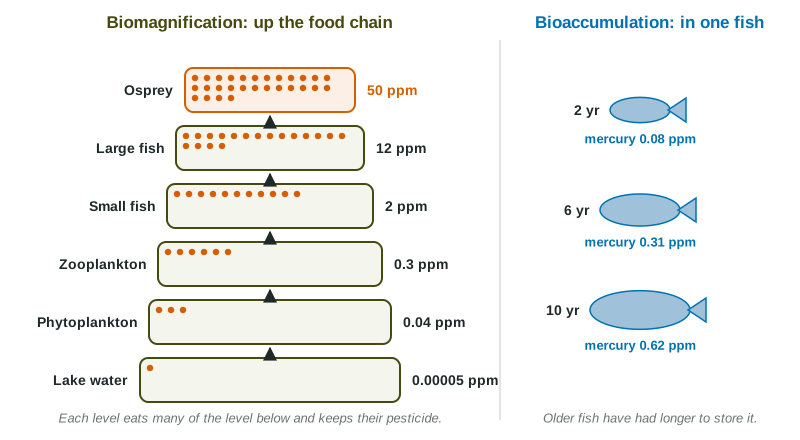
Bioaccumulation is the build-up of a persistent, fat-soluble pollutant in one organism over its life.
Part 1 · Hook
Why this matters
Part 2 · Before you start
What this builds on
Part 3 · Prerequisite check
Quick check before you start
1. About what share of energy passes from one trophic level to the next?
- About 10%
- About 50%
- About 90%
- All of it
Show the answer
By the 10% rule, about 90% is used or lost as heat at each level.
- Correct: About 10%:
- About 50%:
- About 90%:
- All of it:
2. Why are persistent organic pollutants stored in animal fat?
- They dissolve in fat, not water
- They are a source of energy
- They are made by the animals
- They are too large for cells
Show the answer
Fat-soluble chemicals are stored rather than excreted.
- Correct: They dissolve in fat, not water:
- They are a source of energy:
- They are made by the animals:
- They are too large for cells:
Part 4 · See it
See it first
Part 5 · Step by step
How it works, step by step
- A persistent, fat-soluble pollutant (DDT, PCBs, methylmercury) enters the water at a very low levelproducers and small organisms absorb it and store it in fat
- The organism keeps taking it in but cannot break it down or excrete itits body concentration rises over its life: bioaccumulation
- Each consumer eats many organisms from the level belowit takes in all their stored pollutant, while much of the food's mass is used for energy
- This repeats at every trophic levelthe concentration multiplies up the chain: biomagnification
- Top predators carry the highest levelsthey suffer harm, such as thin eggshells in birds of prey, and people who eat top predator fish are exposed
Part 6 · Key ideas
Key ideas
- Bioaccumulation: a substance builds up in one organism over its life, because it is taken in faster than it is removed.
- Biomagnification: the concentration rises at each higher trophic level of a food chain. Top predators carry the most.
- Substances that do this are persistent and fat-soluble: DDT, PCBs and methylmercury, which bacteria make from mercury released by sources such as burning coal and small-scale gold mining.
- Effects: DDT thinned eggshells of eagles, ospreys and pelicans; mercury harms the developing nervous system, so fish advisories limit meals of large predatory fish.
Part 7 · Misconception
A common mistake
The wrong idea: Bioaccumulation and biomagnification are two names for the same thing.
What actually happens: Bioaccumulation is the build-up inside one organism over time. Biomagnification is the increase from one trophic level to the next.
Part 8 · Check yourself
Check yourself
Exam-style questions. Anything you miss goes into your review queue.
1. What is biomagnification?
- The build-up of a pollutant in one organism over its life
- The growth of algae when nutrients are added
- The breakdown of a pollutant by bacteria
- A pollutant rising at each higher trophic level
Show the answer
Biomagnification is the increase in concentration of a persistent, fat-soluble substance at each higher trophic level of a food chain.
- The build-up of a pollutant in one organism over its life: That is bioaccumulation.
- The growth of algae when nutrients are added: That describes an algal bloom.
- The breakdown of a pollutant by bacteria: That is biodegradation, the opposite of building up.
- Correct: A pollutant rising at each higher trophic level: Right: it climbs up the food chain.
Data
A persistent pesticide in a lake food chain
| Level | Example | Pesticide (ppm) |
|---|---|---|
| Water | lake water | 0.00005 |
| Producers | phytoplankton | 0.04 |
| Primary consumers | zooplankton | 0.3 |
| Secondary consumers | small fish | 2 |
| Tertiary consumers | large fish | 12 |
| Top predator | osprey | 50 |
2. How many times greater is the pesticide concentration in the osprey than in the large fish it eats?
Type a number, then its unit (times). Scale words (2.5 million) and powers of ten (2.5 × 10^6) are read.
Show the answer
times (to two decimal places).
- Answer: 4.17 times
3. How many times greater is the pesticide in the osprey than in the lake water?
Type a number, then its unit (times). Scale words (2.5 million) and powers of ten (2.5 × 10^6) are read.
Show the answer
- Answer: 1,000,000 times
4. Why does the concentration rise at each step of the food chain?
- Larger animals make the pesticide in their livers
- Each level keeps the pesticide in what it eats
- Predators drink more lake water than their prey
- The pesticide breaks down faster in small organisms
Show the answer
Each level eats many organisms from the level below. The pesticide is stored in fat and not broken down or excreted, while much of the food's energy is used and lost, so the pesticide is concentrated.
- Larger animals make the pesticide in their livers: Animals do not make the pesticide.
- Correct: Each level keeps the pesticide in what it eats: Right: the chemical is retained while the food's mass is used up.
- Predators drink more lake water than their prey: Most of the pesticide comes from food, not water.
- The pesticide breaks down faster in small organisms: It is persistent at every level; that is why it builds up.
5. The osprey population in the region is falling. Based on the table, which effect is the most likely cause?
- The pesticide thins their eggshells
- The pesticide kills the fish, so ospreys starve
- Ospreys lay more eggs as pesticide levels rise
- The lake water itself is too toxic for ospreys to drink
Show the answer
Ospreys are at the top of the chain, with the highest concentration. Organochlorine pesticides like DDT thinned the eggshells of fish-eating birds of prey, so fewer chicks hatched.
- Correct: The pesticide thins their eggshells: Right: top predators carry the highest load.
- The pesticide kills the fish, so ospreys starve: The table shows fish alive and carrying the pesticide, not gone.
- Ospreys lay more eggs as pesticide levels rise: High levels reduce, not increase, breeding success.
- The lake water itself is too toxic for ospreys to drink: The water has the lowest concentration.
6. Between which two adjacent levels does the concentration rise by the largest factor?
- Large fish to osprey
- Small fish to large fish
- Zooplankton to small fish
- Water to phytoplankton
Show the answer
Water to phytoplankton rises 800 times (0.04 / 0.00005). The later steps are about 7.5, 6.7, 6 and 4.2 times. Producers take up the pesticide from water and store it in fat.
- Large fish to osprey: 50 / 12 is about 4.2 times, the smallest step.
- Small fish to large fish: 12 / 2 = 6 times.
- Zooplankton to small fish: 2 / 0.3 is about 6.7 times.
- Correct: Water to phytoplankton: Right: 0.04 / 0.00005 = 800 times.
7. A pesticide is at 0.02 ppm in zooplankton and increases by a factor of 10 at each step to the next trophic level. Write the setup for its concentration three levels higher, in a fish-eating bird, then the answer.
Type the setup as on the exam, with brackets and units, then the answer.
Show the answer
Three steps of ×10:
- Setup: ; answer 20 ppm
Part 9 · Summary
Summary
Part 10 · Up next
What comes next
Part 11 · Connections