Solid Waste Disposal
Municipal solid waste in the United States is mostly landfilled (about half in 2018), with the rest recycled, composted or burned.
Part 1 · Hook
Why this matters
Part 2 · Prerequisite check
Quick check before you start
1. What do decomposers release when they break down waste with no oxygen?
- Methane
- Ozone
- Sulfur dioxide
- Radon
Show the answer
Without oxygen, decomposition produces methane as well as CO2.
- Correct: Methane:
- Ozone:
- Sulfur dioxide:
- Radon:
2. Which pollutants are stored in fat and build up in food chains?
- Persistent organic pollutants and mercury
- Nitrate and phosphate
- Water vapor and CO2
- Sand and silt
Show the answer
Persistent, fat-soluble pollutants bioaccumulate and biomagnify.
- Correct: Persistent organic pollutants and mercury:
- Nitrate and phosphate:
- Water vapor and CO2:
- Sand and silt:
Part 3 · See it
See it first
Part 4 · Step by step
How it works, step by step
- Households and businesses throw away municipal solid wasteabout half goes to landfills in the United States
- Rain filters through the buried wasteit dissolves chemicals and becomes leachate, which a liner and pipes must catch
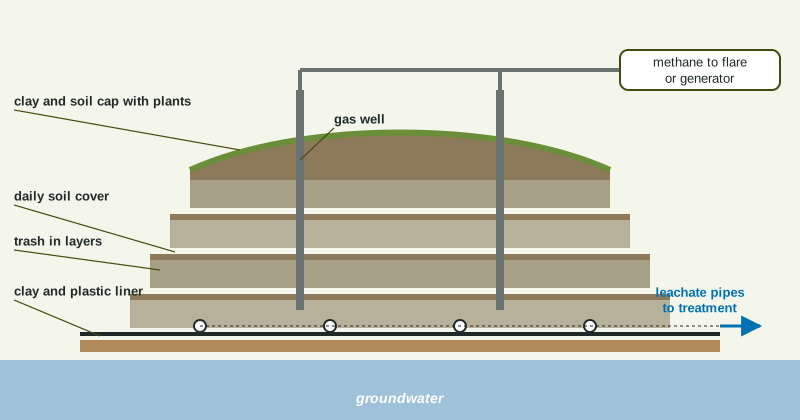
- Bacteria break down food, yard waste and paper with no oxygenmethane and CO2 form; gas wells collect the methane to burn or use for power
- Tightly packed, dry trash gets little oxygen and waterit decomposes very slowly, so landfills fill up and must be managed for decades
Part 5 · Key ideas
Key ideas
- Municipal solid waste is everyday trash from homes and businesses. In 2018 (EPA) about 50% was landfilled, 32% recycled or composted, and 12% burned for energy.
- A sanitary landfill has a clay and plastic liner, leachate collection pipes, daily soil cover, gas wells and a final cap. Leachate is liquid that seeps through trash and picks up pollutants.
- Buried organic waste decomposes slowly without oxygen and makes methane. Incineration cuts volume about 90% and can make power, but releases air pollutants and toxic ash.
- E-waste holds lead, mercury and cadmium and needs special handling. Ocean dumping of trash is banned in the United States.
Part 6 · Misconception
A common mistake
The wrong idea: Trash in a landfill rots away within a few years.
What actually happens: A landfill is packed tight and kept dry, so little oxygen and water reach the trash. Decomposition is very slow, and some newspapers and food stay recognizable for decades.
Part 7 · Check yourself
Check yourself
Exam-style questions. Anything you miss goes into your review queue.
1. Which feature of a sanitary landfill keeps leachate out of groundwater?
- A daily cover of soil over the trash
- A liner with collection pipes
- Gas wells that collect methane
- A fence around the whole site
Show the answer
A sanitary landfill sits on a clay and plastic liner, with pipes that collect leachate for treatment.
- A daily cover of soil over the trash: Daily soil cover controls pests and odors; the liner protects groundwater.
- Correct: A liner with collection pipes: Right: the liner blocks it and the pipes collect it.
- Gas wells that collect methane: Gas wells handle methane, not leachate.
- A fence around the whole site: A fence keeps people and animals out.
Data
What happened to United States municipal solid waste in 2018
| Management | Millions of tons |
|---|---|
| Landfilled | 146.1 |
| Recycled | 69.1 |
| Combusted with energy recovery | 34.6 |
| Composted | 24.9 |
| Other food management | 17.7 |
| Total generated | 292.4 |
2. What percent of the municipal solid waste generated in 2018 was landfilled?
Type a number, then its unit (%). Scale words (2.5 million) and powers of ten (2.5 × 10^6) are read.
Show the answer
- Answer: 50.0 %
3. What percent of the 2018 waste was recycled or composted together?
Type a number, then its unit (%). Scale words (2.5 million) and powers of ten (2.5 × 10^6) are read.
Show the answer
Recycled plus composted: million tons. Share: . The EPA reports 32.1%.
- Answer: 32.1 %
4. Which statement best describes how the United States managed its municipal solid waste in 2018?
- Most of it was recycled
- About half of it was landfilled
- Most of it was burned for energy
- More was made into compost than was landfilled
Show the answer
Half (146.1 of 292.4 million tons) went to landfills, more than recycling (69.1), combustion (34.6) and compost (24.9) put together.
- Most of it was recycled: Recycling took 69.1 million tons, under a quarter.
- Correct: About half of it was landfilled: Right: 146.1 of 292.4 million tons.
- Most of it was burned for energy: Combustion took 34.6 million tons, about 12%.
- More was made into compost than was landfilled: Only 24.9 million tons was composted, far less than was landfilled.
5. The United States had about 327 million people in 2018. About how many pounds of municipal solid waste did each person generate per day? (1 short ton = 2,000 lb.) Round to one decimal place.
Type a number, then its unit (lb/person/day). Scale words (2.5 million) and powers of ten (2.5 × 10^6) are read.
Show the answer
- Answer: 4.9 lb/person/day
6. Why do newspapers and food buried in a landfill decades ago often look almost unchanged when dug up?
- Little oxygen or water reaches them
- Landfills are too cold for any bacteria to live
- Newspapers and food are unable to decompose
- Methane preserves everything in the landfill
Show the answer
Landfills are packed tight and kept dry, with little oxygen or water, so decomposition is very slow.
- Correct: Little oxygen or water reaches them: Right: tight, dry conditions slow decay.
- Landfills are too cold for any bacteria to live: Landfills are often warm inside; the limit is oxygen and water.
- Newspapers and food are unable to decompose: They decompose readily where oxygen and moisture are present.
- Methane preserves everything in the landfill: Methane is a product of decay, not a preservative.
7. A town of 40,000 people generates 2.2 kg of municipal solid waste per person per day. Write the setup, with units, for the metric tons it generates in a year (1 metric ton = 1,000 kg), then the answer.
Type the setup as on the exam, with brackets and units, then the answer.
Show the answer
- Setup: ; answer 32,120 metric tons
Part 8 · Summary
Summary
Part 9 · Up next
What comes next
Part 10 · Connections