Environmental science is full of numbers that are too big or too small to write comfortably: the mass of carbon dioxide in the air, the water a country uses, a trace of a chemical in a glass of water. Scientific notation and metric prefixes are two ways to write those numbers compactly. On the exam you have only a scientific calculator and no formula sheet, so you need to move between the forms quickly and without losing a zero.
Scientific notation
A number in scientific notation has two parts: a front number from 1 up to (but not including) 10, and a power of ten.
To write a number this way, move the decimal point until exactly one nonzero digit is to its left, then count how many places you moved it. Moving it left gives a positive exponent (a big number); moving it right gives a negative exponent (a small number): .
Scale words are the same powers of ten in words. Write each number all three ways at least once until it feels automatic:
| Scale word | Power of ten | Written out |
|---|---|---|
| thousand | 1,000 | |
| million | 1,000,000 | |
| billion | 1,000,000,000 | |
| trillion | 1,000,000,000,000 |
So 2.5 million = = 2,500,000, and 40 billion = = 40,000,000,000.
Multiplying and dividing
Powers of ten follow two rules you can check with zeros.
- Multiply: multiply the front numbers and add the exponents. (10,000 × 1,000 has 4 + 3 = 7 zeros).
- Divide: divide the front numbers and subtract the exponents. .
If the front number ends up outside 1 to 10, fix it at the end: , and . Moving the point one place left adds 1 to the exponent; one place right subtracts 1.
Worked example: per person. A country of people throws away kg of trash in a year. How much is that per person?
Setup:
Fronts: . Exponents: . So , which is kg per person = 500 kg per person.
On a calculator, type the powers with brackets or the EE key: (1.2 × 10^11) / (2.4 × 10^8). Without the brackets the calculator divides by 2.4 and then multiplies by , which is a very different number.
Metric prefixes
A metric prefix in front of a unit is a power of ten in disguise. A kilogram is grams; a megaliter is liters; a milligram is grams.
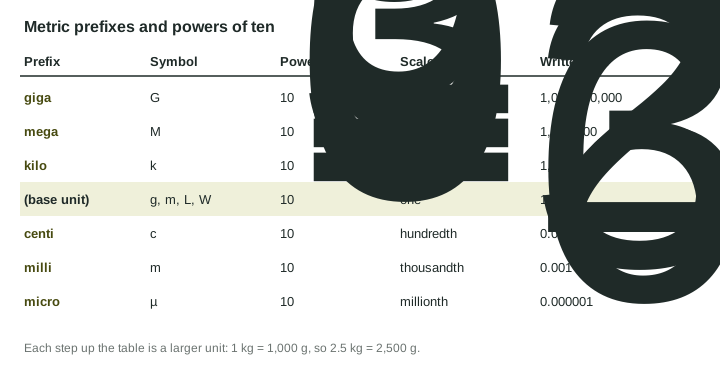
To change a prefix, replace it with its power of ten. 750 ML = L = L. Going to a smaller unit makes the number bigger (2.5 g = 2,500 mg); going to a bigger unit makes it smaller (2,500 g = 2.5 kg).
Worked example: a daily total. A landfill takes in kg of trash a day. How much in 30 days?
Setup: . The days cancel, leaving kg.
, so kg kg = 12 million kg.
Comparing numbers
Before comparing, put every number in the same form and the same unit. L looks larger than L because 5 is bigger than 3, but the power of ten matters far more: is six times larger. And 2 GL (gigaliters) is L, so compare it only after you rewrite it in liters.
Exam habits
- Write the setup with units, then the answer with its unit and its scale: " kg", not "6.0".
- If a question says "in millions", give the number of millions with the word: "12 million kg".
- Check the size: a city's water use in liters will be billions, not thousands.