Rates and Per-Capita Values
A rate divides one quantity by another: liters per day, people per km², kilograms per person.
Part 1 · Hook
Why this matters
Part 2 · Prerequisite check
Quick check before you start
1. What is ?
Show the answer
Divide the fronts (3.0) and subtract the exponents (7 - 3 = 4).
- Correct: :
- :
- :
- :
2. Which reservoir holds most of Earth’s freshwater that is not ice?
- Groundwater
- Rivers
- Clouds
- Lakes
Show the answer
Groundwater holds far more than lakes, rivers and the air.
- Correct: Groundwater:
- Rivers:
- Clouds:
- Lakes:
Part 3 · See it
See it first
Part 4 · Step by step
How it works, step by step
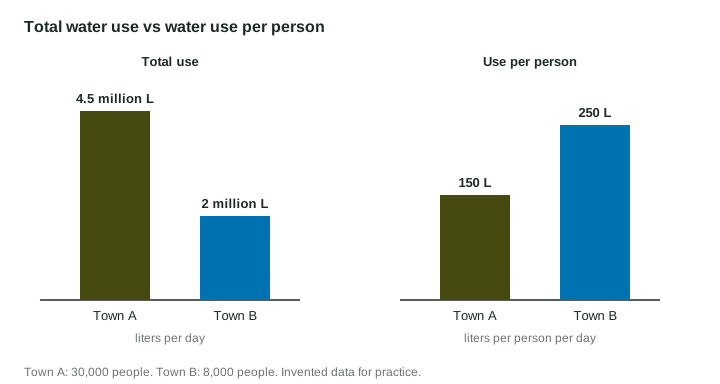
- Divide a total by the number of peopleyou get a per-capita value
- Divide by an area or a time insteadyou get a density or a rate per unit of time
- Keep the units in the setupthe answer’s unit tells you what you found: L per person, people per km²
Part 5 · Key ideas
Key ideas
- A rate compares two quantities with different units: liters per day, people per km², kg per person.
- A unit rate is a rate for one unit of the second quantity: 150 L per 1 person.
- Per capita means per person: the total ÷ the population.
- The word after "per" goes on the bottom: liters per km = L ÷ km.
Part 6 · Misconception
A common mistake
The wrong idea: The place with the biggest total uses resources the most heavily.
What actually happens: Big totals often just mean more people. Divide by the population (per capita) before you decide who uses more.
Part 7 · Check yourself
Check yourself
Exam-style questions. Anything you miss goes into your review queue.
1. A town of 30,000 people uses 4,500,000 liters of water a day. How many liters is that per person per day?
Type a number, then its unit (L/person/day). Scale words (2.5 million) and powers of ten (2.5 × 10^6) are read.
Show the answer
- Answer: 150 L/person/day
2. A family’s car used 1,200 liters of gasoline in 15,000 km of driving. Write the setup for the fuel used per km, with units, then give the answer.
Type the setup as on the exam, with brackets and units, then the answer.
Show the answer
- Setup: ; answer 0.08 L/km
3. A county of 2,500 square kilometers has 400,000 people. How many people live there per square kilometer?
Type a number, then its unit (people/km^2). Scale words (2.5 million) and powers of ten (2.5 × 10^6) are read.
Show the answer
- Answer: 160 people/km^2
Data
Household trash in three towns
| Town | Population | Trash collected per year (metric tons) |
|---|---|---|
| Alder | 12,000 | 6,000 |
| Birch | 50,000 | 20,000 |
| Cedar | 4,000 | 2,600 |
4. How many metric tons of trash per person did Alder collect in the year?
Type a number, then its unit (metric tons/person). Scale words (2.5 million) and powers of ten (2.5 × 10^6) are read.
Show the answer
- Answer: 0.5 metric tons/person
5. Which town produced the most trash per person?
- Cedar
- Birch
- Alder
- Alder and Birch tied
Show the answer
Per person: Alder 0.5, Birch
- Correct: Cedar: Right: 0.65 metric tons per person.
- Birch: Birch has the largest total but 0.4 per person.
- Alder: Alder is 0.5 per person.
- Alder and Birch tied: Alder (0.5) and Birch (0.4) are not equal.
6. How many kilograms of trash per person did Birch collect? (1 metric ton = 1,000 kg.)
Type a number, then its unit (kg/person). Scale words (2.5 million) and powers of ten (2.5 × 10^6) are read.
Show the answer
- Answer: 400 kg/person
7. A newspaper headline says "Birch is the most wasteful town." What does the per-person data show?
- Birch has the largest total but the smallest per-person amount.
- Birch is the most wasteful by both measures.
- Birch has the most trash per person.
- The towns are too different in size to compare.
Show the answer
Birch’s total (20,000 t) is largest because it has the most people; per person (0.4 t) it is the least wasteful of the three.
- Correct: Birch has the largest total but the smallest per-person amount.: Right: totals reflect size; per person shows behavior.
- Birch is the most wasteful by both measures.: Per person, Birch is the lowest.
- Birch has the most trash per person.: Cedar has the most per person (0.65 t).
- The towns are too different in size to compare.: Per-person values make a fair comparison across sizes.
Part 8 · Summary
Summary
Part 9 · Up next
What comes next
Part 10 · Connections